
Pulp Fiction, 1917 · page 16 of 228
Adventure, February 1917 — page 16: what you’re looking at
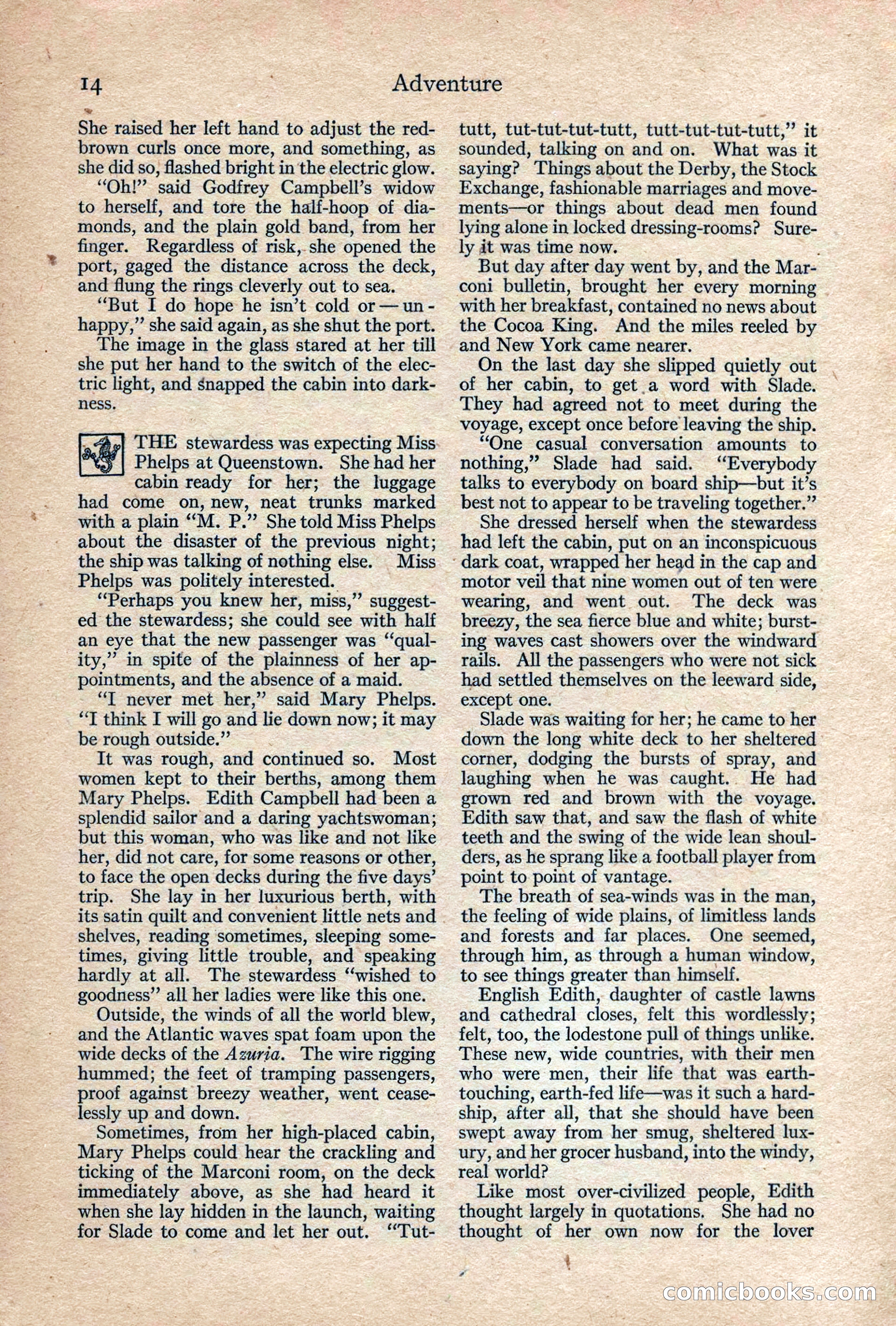
A restored page from Pulp Fiction, 1917. Page through the whole issue in the reader above.
📄 Transcribed text from this page (OCR, searchable)
Machine-transcribed from the original scan — historical spelling and the odd misread are preserved.
14 She raised her left hand to adjust the red- brown curls once more, and something, as she did so, flashed bright in the electric glow. “Oh!” said Godfrey Campbell’s widow to herself, and tore the half-hoop of dia- monds, and the plain gold band, from her finger. Regardless of risk, she opened the port, gaged the distance across the deck, and flung the rings cleverly out to sea. “But I do hope he isn’t cold or — un - happy,” she said again, as she shut the port. The image in the glass stared at her till she put her hand to the switch of the elec- tric light, and snapped the cabin into dark- ness. Phelps at Queenstown. She had her cabin ready for her; the luggage had come on, new, neat trunks marked with a plain ““M. P.”? She told Miss Phelps about the disaster of the previous night; the ship was talking of nothing else. Miss Phelps was politely interested. “Perhaps you knew her, miss,” suggest- ed the stewardess; she could see with half an eye that the new passenger was ‘‘qual- ity,” in spite of the plainness of her ap- pointments, and the absence of a maid. “T never met her,” said Mary Phelps. “T think I will go and lie down now; it may be rough outside.”’ It was rough, and continued so. Most women kept to their berths, among them Mary Phelps. Edith Campbell had been a splendid sailor and a daring yachtswoman; but this woman, who was like and not like her, did not care, for some reasons or other, to face the open decks during the five days’ trip. She lay in her luxurious berth, with its satin quilt and convenient little nets and shelves, reading sometimes, sleeping some- times, giving little trouble, and speaking hardly at all. The stewardess ‘‘wished to goodness” all her ladies were like this one. Outside, the winds of all the world blew, and the Atlantic waves spat foam upon the wide decks of the Azuria. The wire rigging hummed; the feet of tramping passengers, proof against breezy weather, went cease- lessly up and down. Sometimes, from her high-placed cabin, Mary Phelps could hear the crackling and ticking of the Marconi room, on the deck immediately above, as she had heard it when she lay hidden in the launch, waiting for Slade to come and let her out. ‘Tut- THE stewardess was expecting Miss: Adventure tutt, tut-tut-tut-tutt, tutt-tut-tut-tutt,” it sounded, talking on and on. What was it saying? Things about the Derby, the Stock Exchange, fashionable marriages and move- ments—or things about dead men found lying alone in locked dressing-rooms? Sure- ly it was time now. But day after day went by, and the Mar- coni bulletin, brought her every morning with her breakfast, contained no news about the Cocoa King. And the miles reeled by and New York came nearer. On the last day she slipped quietly out | of her cabin, to get a word with Slade. They had agreed not to meet during the voyage, except once before leaving the ship. “One casual conversation amounts to nothing,” Slade had said. “Everybody talks to everybody on board ship—but it’s best not to appear to be traveling together.” She dressed herself when the stewardess had left the cabin, put on an inconspicuous ‘dark coat, wrapped her head in the cap and motor veil that nine women out of ten were wearing, and went out. The deck was breezy, the sea fierce blue and white; burst- ing waves cast showers over the windward rails. All the passengers who were not sick had settled themselves on the leeward side, except one. | Slade was waiting for her; he came to her down the long white deck to her sheltered corner, dodging the bursts of spray, and laughing when he was caught. He had grown red and brown with the voyage. Edith saw that, and saw the flash of white teeth and the swing of the wide lean shoul- ders, as he sprang like a football player from point to point of vantage. The breath of sea-winds was in the man, the feeling of wide plains, of limitless lands and forests and far places. One seemed, through him, as through a human window, to see things greater than himself. English Edith, daughter of castle lawns and cathedral closes, felt this wordlessly; felt, too, the lodestone pull of things unlike. These new, wide countries, with their men who were men, their life that was earth- touching, earth-fed life—was it such a hard- ship, after all, that she should have been swept away from her smug, sheltered lux- ury, and her grocer husband, into the windy, real world? Like most over-civilized people, Edith thought largely in quotations. She had no thought of her own now for the lover ‘ P COLPMICOOOKS (CO)