
Pulp Fiction, 1917 · page 28 of 228
Adventure, February 1917 — page 28: what you’re looking at
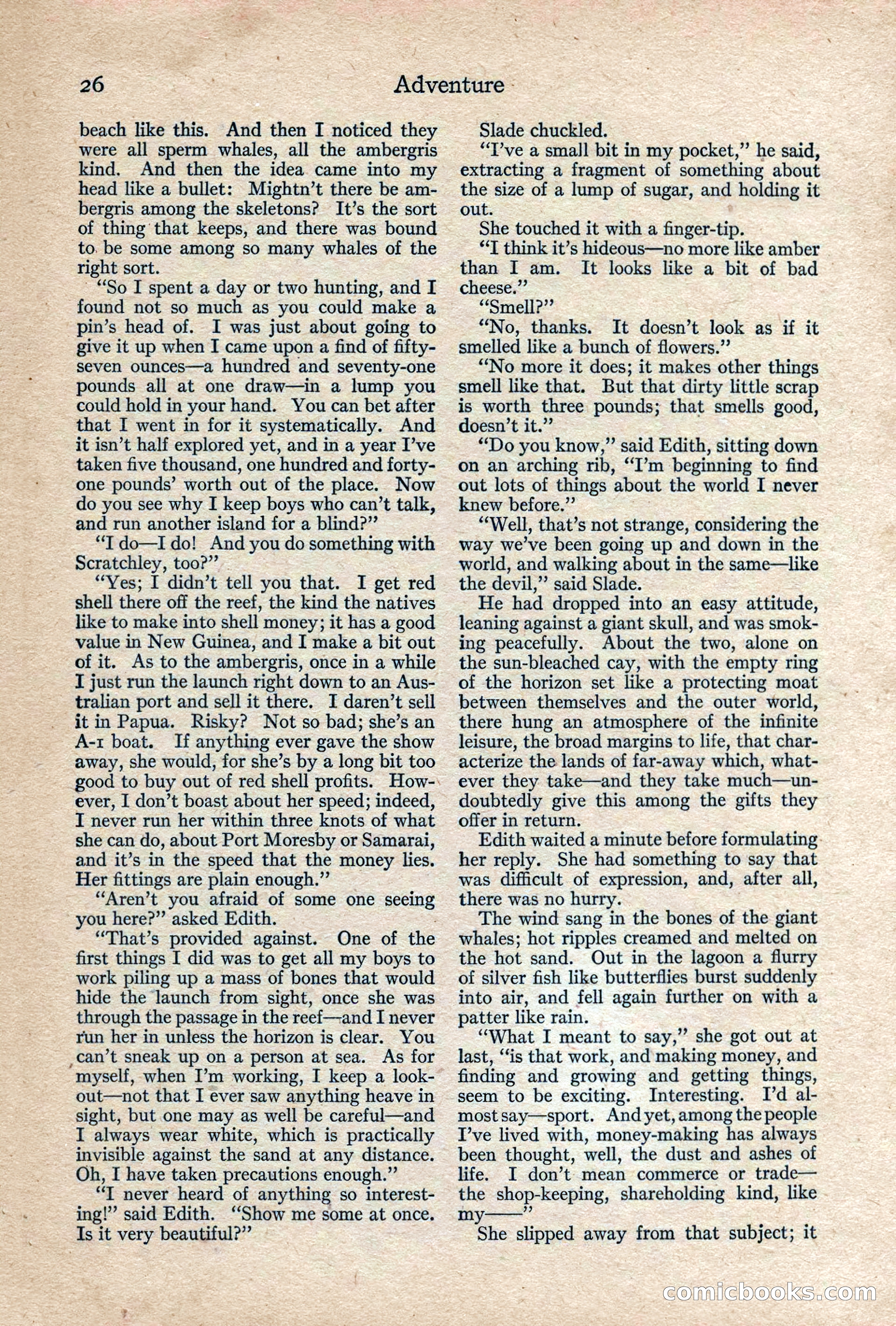
A restored page from Pulp Fiction, 1917. Page through the whole issue in the reader above.
📄 Transcribed text from this page (OCR, searchable)
Machine-transcribed from the original scan — historical spelling and the odd misread are preserved.
26 beach like this. And then I noticed they were all sperm whales, all the ambergris kind. And then the idea came into my head like a bullet: Mightn’t there be am- bergris among the skeletons? It’s the sort of thing that keeps, and there was bound to. be some among so many whales of the right sort. ~ “So I spent a day or two hunting, and I found not so much as you could make a pin’s head of. I was just about going to give it up when I came upon a find of fifty- seven ounces—a hundred and seventy-one pounds all at one draw—in a lump you could hold in your hand. You can bet after that I went in for it systematically. And it isn’t half explored yet, and in a year I’ve taken five thousand, one hundred and forty- one pounds’ worth out of the place. Now do you see why I keep boys who can’t talk, and run another island for a blind?” “T do—I do! And you do something with Scratchley, too?” - “Ves; I didn’t tell you that. I get red shell there off the reef, the kind the natives like to make into shell money; it has a good value in New Guinea, and I make a bit out of it. As to the ambergris, once in a while I just run the launch right down to an Aus- tralian port and sell it there. I daren’t sell it in Papua. Risky? Not so bad; she’s an A-1 boat. If anything ever gave the show away, she would, for she’s by a long bit too good to buy out ‘of red shell profits. ever, I don’t boast about her speed; indeed, I never run her within three knots of what she can do, about Port Moresby or Samarai, and it’s in the speed that the money lies. Her fittings are plain enough.” “‘Aren’t you afraid of some one seeing you here?” asked Edith. “That’s provided against. One of the first things I did was to get all my boys to work piling up a mass of bones that would hide the launch from sight, once she was through the passage in the reef—and I never run her in unless the horizon is clear. You can’t sneak up on a person at sea. As for “myself, when I’m working, I keep a look- out—not that I ever saw anything heave in sight, but one may as well be careful—and I always wear white, which is practically invisible against the sand at any distance. Oh, I have taken precautions enough.” “T never heard of anything so interest- ing!’ said Edith. “Show me some at once. Is it very beautiful?” How-: Adventure - Slade chuckled. “T’ve a small bit in my pocket,” he said, extracting a fragment of something about the size of a lump of sugar, and holding it out. She touched it with a finger-tip. **T think it’s hideous—no more like amber than I am. cheese.” “Smell?” “No, thanks. It doesn’t look as if it smelled like a bunch of flowers.” “No more it does; it makes other things smell like that. But that dirty little scrap is worth three pounds; that smells good, doesn’t it.” “Do you know,” said Edith, sitting down on an arching rib, “I’m beginning to find out lots of things about the world I never knew before.” “Well, that’s not strange, considering the way we've been going up and down in the world, and walking about in the same—like the devil,” said Slade. He had dropped into an easy attitude, leaning against a giant skull, and was smok- ing peacefully. About the two, alone on the sun-bleached cay, with the empty ring of the horizon set like a protecting moat between themselves and the outer world, there hung an atmosphere of the infinite leisure, the broad margins to life, that char- acterize the lands of far-away which, what- ever they take—and they take much—un- doubtedly give this among the gifts they offer in return. Edith waited a minute before formulating. her reply. She had something to say that was difficult of expression, and, after all, there was no hurry. The wind sang in the bones of the giant whales; hot ripples creamed and melted on the hot sand. Out in the lagoon a flurry It looks like a bit of bad © of silver fish like butterflies burst suddenly — into air, and fell again further on with a patter like rain. “What I meant to say,” she got out at last, “is that work, and making money, and finding and growing and getting things, seem to be exciting. Interesting. Id al- most say—sport. And yet, among the people I’ve lived with, money-making has always been thought, well, the dust and ashes of life. I don’t mean commerce or trade— the shop-keeping, shareholding kind, like ) my——”’ She slipped away from that subject; it EOMICLOOOKS (C (C@