
Pulp Fiction, 1917 · page 29 of 228
Adventure, February 1917 — page 29: what you’re looking at
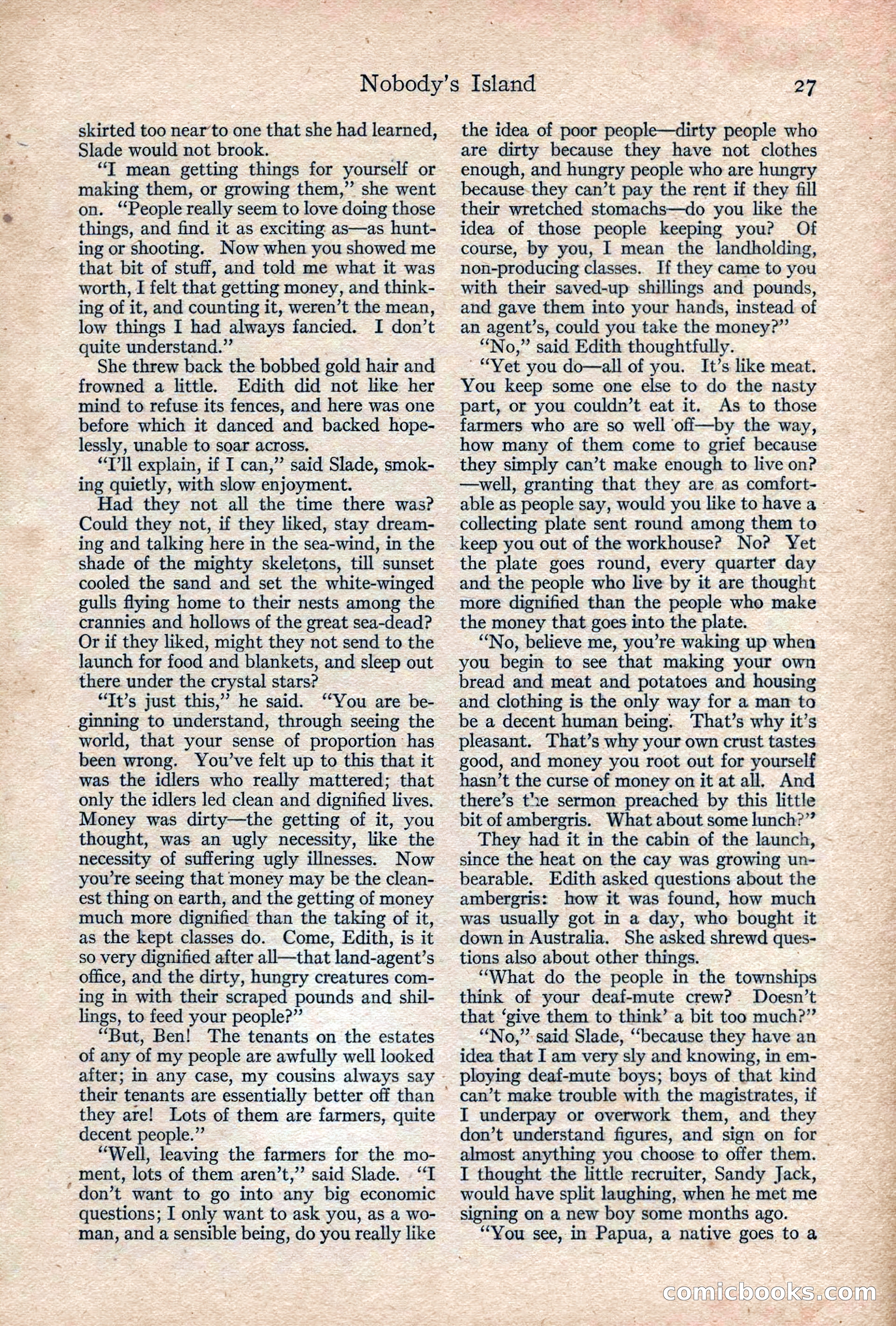
A restored page from Pulp Fiction, 1917. Page through the whole issue in the reader above.
📄 Transcribed text from this page (OCR, searchable)
Machine-transcribed from the original scan — historical spelling and the odd misread are preserved.
Nobody’s Island skirted too near’to one that she had learned, Slade would not brook. | “T mean getting things for yourself or making them, or growing them,” she went on. “People really seem to love doing those things, and find it as exciting as—as hunt- ing or shooting. Now when you showed me that bit of stuff, and told me what it was worth, I felt that getting money, and think- ing of it, and counting it, weren’t the mean, low things I had always fancied. I don’t quite understand.” _ She threw back the bobbed gold hair and frowned a little. Edith did not like her mind to refuse its fences, and here was one before which it danced and backed hope- lessly, unable to soar across, “T’ll explain, if I can,” said Slade, smok- ing quietly, with slow enjoyment. Had they not all the time there was? Could they not, if they liked, stay dream- ing and talking here in the sea-wind, in the shade of the mighty skeletons, till sunset cooled the sand and set the white-winged gulls flying home to their nests among the crannies and hollows of the great sea-dead? Or if they liked, might they not send to the launch for food and blankets, and sleep out there under the crystal stars? “Tt’s just this,” he said. ‘You are be- . ginning to understand, through seeing the world, that your sense of proportion has been wrong. You’ve felt up to this that it was the idlers who really mattered; that only the idlers led clean and dignified lives. Money was dirty—the getting of it, you thought, was an ugly necessity, like the necessity of suffering ugly illnesses. Now youre seeing that money may be the clean- est thing on earth, and the getting of money much more dignified than the taking of it, as the kept classes do. Come, Edith, is it so very dignified after all—that land-agent’s office, and the dirty, hungry creatures com- ing in with their scraped pounds and shil- lings, to feed your people?” “But, Ben! The tenants on the estates - of any of my people are awfully well looked after; In any case, my cousins always say - their tenants are essentially better off than they are! Lots of them are farmers, quite decent people.” “Well, leaving the farmers for the mo- ment, lots of them aren’t,”’ said Slade. . “I don’t want to go into any big economic questions; I only want to ask you, as a wo- man, and a sensible being, do you really like 27 the idea of poor people—dirty people who are dirty because they have not clothes enough, and hungry people who are hungry because-they can’t pay the rent if they fill their wretched stomachs—do you like the idea of those people keeping you? Of course, by you, I mean the landholding, non-producing classes. If they came to you with their saved-up shillings and pounds, and gave them into your hands, instead of an agent’s, could you take the money?” “No,” said Edith thoughtfully. “Vet you do—all of you. It’s like meat. You keep some one else to do the nasty part, or you couldn’t eat it. As to those farmers who are so well ‘offi—by the way, how many of them come to grief because they simply can’t make enough to live on? —well, granting that they are as comfort- able as people say, would you like to have a - collecting plate sent round among them to keep you out of the workhouse? No? Yet the plate goes round, every quarter day and the people who live by it are thought more dignified than the people who make the money that goes into the plate. “No, believe me, you’re waking up when you begin to see that making your own bread and meat and potatoes and housing and clothing is the only way for a man to be a decent human being. That’s why it’s pleasant. That’s why your own crust tastes good, and money you root out for yourself hasn’t the curse of money on it at all. And there’s t'ie sermon preached by this little bit of ambergris. What about some lunch?” They had it in the cabin of the launch, since the heat on the cay was growing un- bearable. Edith asked questions about the ambergris: how it was found, how much was usually got in a day, who bought it down in Australia. She asked shrewd ques- tions also about other things. “What do the people in the townships think of your deaf-mute crew? Doesn’t that ‘give them to think’ a bit too much?” “No,” said Slade, ‘‘because they have an idea that I am very sly and knowing, in em- ploying deaf-mute boys; boys of that kind can’t make trouble with the magistrates, if I underpay or overwork them, and they ~ don’t understand figures, and sign on for almost anything you choose to offer them. I thought the little recruiter, Sandy Jack, would have split laughing, when he met me signing on a new boy some months ago. “You see, in Papua, a native goes to a (E@) COPMIGE OOO KS ) TAS AD wel Oe te Ee PAD oa