
Pulp Fiction, 1917 · page 31 of 228
Adventure, February 1917 — page 31: what you’re looking at
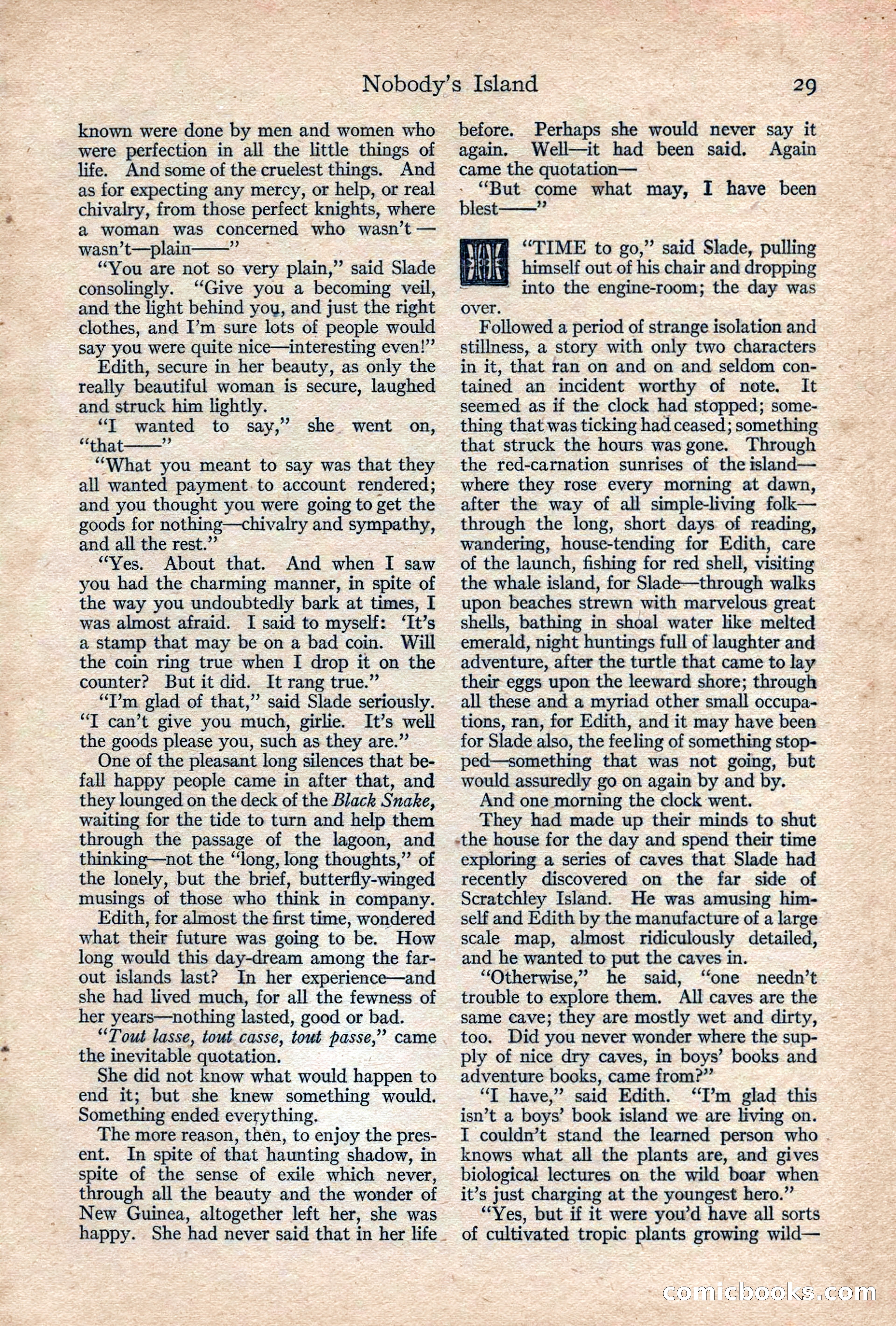
A restored page from Pulp Fiction, 1917. Page through the whole issue in the reader above.
📄 Transcribed text from this page (OCR, searchable)
Machine-transcribed from the original scan — historical spelling and the odd misread are preserved.
Nobody’s Island known were done by men and women who were perfection in all the little things of life. And some of the cruelest things. And as for expecting any mercy, or help, or real chivalry, from those perfect knights, where a woman was concerned who wasn’t — wasn’t—plain——”’ “You are not so very plain, ” said Slade consolingly. “Give you a becoming veil, and the light behind you, and just the right clothes, and I’m sure lots of people would say you were quite nice—interesting even!”’ Edith, secure in her beauty, as only the really beautiful woman is secure, laughed and struck him lightly. “T wanted to say,” “that——” : “What you meant to say was that they all wanted payment.to account rendered; and you thought you were going to get the goods for nothing—chivalry and sympathy, and all the rest.” | “Yes. About that. And when I saw you had the charming manner, in spite of the way you undoubtedly bark at times, I was almost afraid. I said to myself: ‘It’s a stamp that may be on a bad coin. Will the coin ring true when I drop it on the counter? But it did. It rang true.” “T’m glad of that,” said Slade seriously. “T can’t give you much, girlie. It’s well the goods please you, such as they are.” One of the pleasant long silences that be- fall happy people came in after that, and they lounged on the deck of the Black Snake, waiting for the tide to turn and help them through the passage of the lagoon, and thinking—not the “long, long thoughts,” of the lonely, but the brief, butterfly-winged musings of those who think in company. Edith, for almost the first time, wondered what their future was going to be. How long would this day-dream among the far- out islands last? In her experience—and she had lived much, for all the fewness of her years—nothing lasted, good or bad. “Tout lasse, tout casse, tout passe,” came the inevitable quotation. She did not know what would happen to end it; but she knew something would. ‘Something ended everything. The more reason, then, to enjoy the pres- ent. In spite of that haunting shadow, in spite of the sense of exile which never, through all the beauty and the wonder of New Guinea, altogether left her, she was she went on, happy. She had never said that in her life _ 29 before. Perhaps she would never say it again. Well—it had been said. Again came the quotation— - “But come what may, I have been blest——” “TIME to go,” said Slade, pulling himself out of his chair and dropping " into the engine-room; the day was over. Followed a period of strange isolation and stillness, a story with only two characters in it, that ran on and on and seldom con- tained an incident worthy of note. It seemed as if the clock had stopped; some- thing that was ticking had ceased; something that struck the hours was gone. Through the red-carnation sunrises of the island— where they rose every morning at dawn, after the way of all simple-living folk— through the long, short days of reading, wandering, house-tending for Edith, care of the launch, fishing for red shell, visiting the whale island, for Slade—through walks upon beaches strewn with marvelous great shells, bathing in shoal water like melted emerald, night huntings full of laughter and adventure, after the turtle that came to lay their eggs upon the leeward shore; through all these and a myriad other small occupa- tions, ran, for Edith, and it may have been for Slade also, the feeling of something stop- ped—something that was not going, but would assuredly go on again by and by. And one morning the clock went. They had made up their minds to shut -the house for the day and spend their time exploring a series of caves that Slade had recently discovered on the far side of Scratchley Island. He was amusing him- self and Edith by the manufacture of a large scale map, almost ridiculously detailed, and he wanted to put the caves in. “Otherwise,” he said, “one needn’t trouble to explore them. All caves are the same cave; they are mostly wet and dirty, too. Did you never wonder where the sup- ply of nice dry caves, in boys’ books and adventure books, came from?” “T have,” said Edith. “I’m glad this isn’t a boys’ book island we are living on. I couldn’t stand the learned person who . knows what all the plants are, and gives biological lectures on the wild boar when it’s just charging at the youngest hero.” “Yes, but if it were you'd have all sorts of cultivated tropic plants growing wild— COMME OO (c S (eC)