
Pulp Fiction, 1917 · page 32 of 228
Adventure, February 1917 — page 32: what you’re looking at
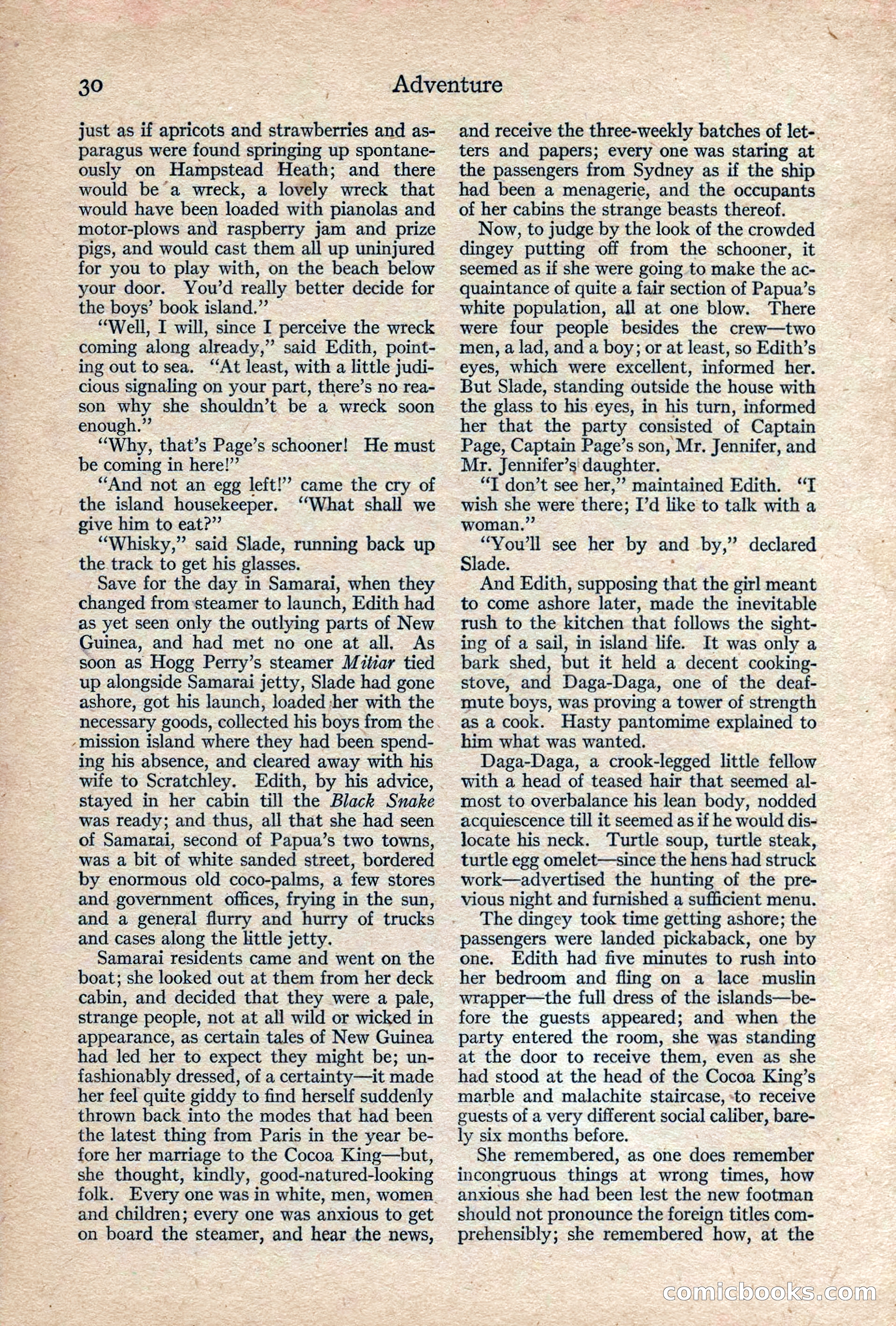
A restored page from Pulp Fiction, 1917. Page through the whole issue in the reader above.
📄 Transcribed text from this page (OCR, searchable)
Machine-transcribed from the original scan — historical spelling and the odd misread are preserved.
30 just as if apricots and strawberries and as- paragus were found springing up spontane- ously on Hampstead Heath; and there would be a wreck, a lovely wreck that would have been loaded with pianolas and motor-plows and raspberry jam and prize ' pigs, and would cast them all up uninjured for you to play with, on the beach below your door. You’d really better decide for the boys’ book island.” “Well, I will, since I perceive the wreck coming along already,” said Edith, point- _ ing out tosea. “At least, with a little judi- cious signaling on your part, there’s no rea- son why she shouldn’t be a wreck soon enough.” “Why, that’s Dace’ s schooner! He must be coming in here!”’ “And not an egg left!’ came the cry of the island housekeeper. ‘‘What shall we give him to eat?” “Whisky,” said Slade, running back up the track to get his glasses. Save for the day in Samarai, when they changed from steamer to launch, Edith had as yet seen only the outlying parts of New Guinea, and had met no one at all, As soon as Hogg Perry’s steamer Mitzar tied up alongside Samarai jetty, Slade had gone ashore, got his launch, loaded :her with the necessary goods, collected his boys from the. -mission island where they had been spend- ing his absence, and cleared away with his wife to Scratchley. Edith, by his advice, stayed in her cabin till the Black Snake was ready; and thus, all that she had seen of Samarai, second of Papua’s two towns, was a bit of white sanded street, bordered by enormous old coco-palms, a few stores and government offices, frying in the sun, and a general flurry and hurry of trucks and cases along the little jetty. Samarai residents came and went on the boat; she looked out at them from her deck cabin, and decided that they were a pale, strange people, not at all wild or wicked in appearance, as certain tales of New Guinea had led her to expect they might be; un- fashionably dressed, of a certainty—it made her feel quite giddy to find herself suddenly thrown back into the modes that had been the latest thing from Paris in the year be- fore her marriage to the Cocoa King—but, she thought, kindly, good-natured-looking folk. Every one was in white, men, women. and children; every one was anxious to get on board the steamer, and hear the news, Adventure and receive the three-weekly batches of let-. ters and papers; every one was staring at the passengers from Sydney as if the ship had been a menagerie, and the occupants of her cabins the strange beasts thereof. Now, to judge by the look of the crowded dingey putting off from the schooner, it seemed as if she were going to make the ac- quaintance of quite a fair section of Papua’s white population, all at one blow. There were four people besides the crew—two men, a lad, and a boy; or at least, so Edith’s eyes, which were excellent, informed her. But Slade, standing outside the house with the glass to his eyes, in his turn, informed her that the party consisted of Captain Page, Captain Page’s son, Mr. Jennifer, and Mr. Jennifer’s daughter. “T don’t see her,” maintained Edith. “T wish she were ‘there; I'd like to talk with a woman.’ oul see her by and by,” declared Slade. And Edith, supposing that the girl meant to come ashore later, made the inevitable rush to the kitchen that follows the sight- ing of a sail, in island life. It was only a bark shed, but it held a decent cooking- stove, and Daga-Daga, one of the deaf- mute boys, was proving a tower of strength as a cook. Hasty pantomime explained to him what was wanted. Daga-Daga, a crook-legged little fellow with a head of teased hair that seemed al- most to overbalance his lean body, nodded acquiescence till it seemed as if he would dis- locate his neck. Turtle soup, turtle steak, turtle egg omelet—since the hens had struck work—advertised the hunting of the pre- vious night and furnished a sufficient menu. The dingey took time getting ashore; the passengers were landed pickaback, one by one. Edith had five minutes to rush into her bedroom and fling on a lace muslin wrapper—the full dress of the islands—be- fore the guests appeared; and when the party entered the room, she was standing at the door to receive them, even as she had stood at the head of the Cocoa King’s marble and malachite staircase, to receive guests of a very different social caliber, bare- ly six months before. She remembered, as one does remember incongruous things at wrong times, how anxious she had been lest the new footman should not pronounce the foreign titles com- prehensibly; she remembered how, at the (G Com S (E@) 5} 0\(0)(6)