
Pulp Fiction, 1917 · page 39 of 228
Adventure, February 1917 — page 39: what you’re looking at
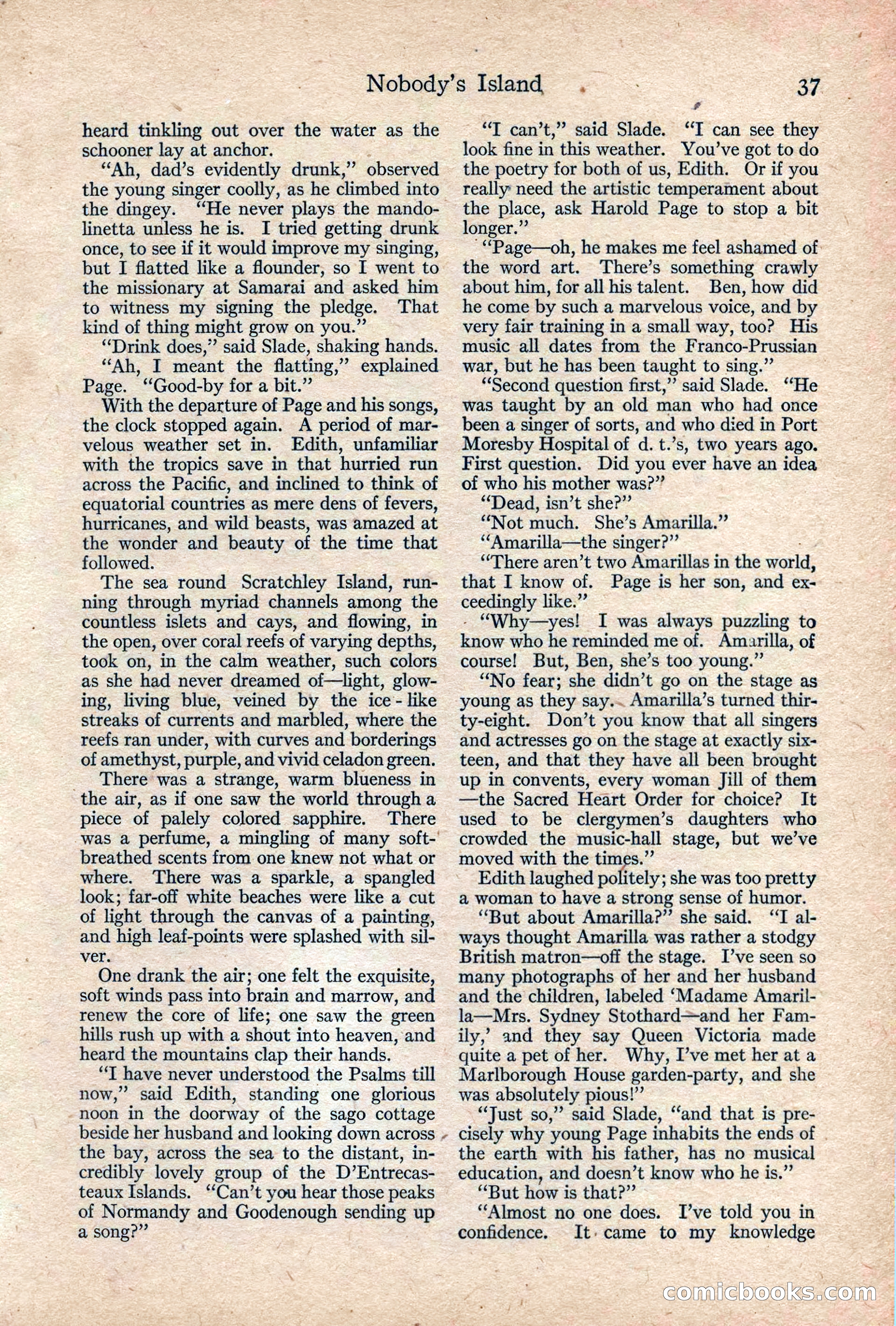
A restored page from Pulp Fiction, 1917. Page through the whole issue in the reader above.
📄 Transcribed text from this page (OCR, searchable)
Machine-transcribed from the original scan — historical spelling and the odd misread are preserved.
Nobody’s Island .— heard tinkling out over the water as the schooner lay at anchor. “Ah, dad’s evidently drunk,” observed the young singer coolly, as he climbed into the dingey. linetta unless he is. I tried getting drunk once, to see if it would improve my singing, but I flatted like a flounder, so I went to the missionary at Samarai and asked him to witness my signing the pledge. That kind of thing might grow on you.”’ “Drink does,” said Slade, shaking hands. “Ah, I meant the flatting,” explained Page. ‘“Good-by for a bit.” With the departure of Page and his songs, the clock stopped again. A period of mar- velous weather set in. Edith, unfamiliar with the tropics save in that hurried run across the Pacific, and inclined to think of equatorial countries as mere dens of fevers, hurricanes, and wild beasts, was amazed at the wonder and beauty of the time that followed. The sea round Scratchley Island, run- ning through myriad channels among the countless islets and cays, and flowing, in the open, over coral reefs of varying depths, took on, in the calm weather, such colors as she had never dreamed of—light, glow- ing, living blue, veined by the ice- like streaks of currents and marbled, where the reefs ran under, with curves and borderings of amethyst, purple, and vivid celadon green. _ There was a strange, warm blueness in the air, as if one saw the world through a piece of palely colored sapphire. There was a perfume, a mingling of many soft-' breathed scents from one knew not what or where. There was a sparkle, a spangled look; far-off white beaches were like a cut of light through the canvas of a painting, and high leat-points were splashed with sil- ver. One drank the air; one felt the exquisite, soft winds pass into brain and marrow, and renew the core of life; one saw the green hills rush up with a shout into heaven, and heard the mountains clap their hands. “I have never understood the Psalms till now,’ said Edith, standing one glorious -noon in the doorway of the sago cottage beside her husband and looking down across the bay, across the sea to the distant, in- credibly lovely group of the D’Entrecas- teaux Islands. ‘“Can’t you hear those peaks of Normandy and Goodenough sending up a song?” “He never plays the mando- A od “T can’t,” said Slade. “TI can see they look fine in this weather. You’ve got to do the poetry for both of us, Edith. Or if you really need the artistic temperament about the place, ask Harold Page to stop a bit longer.” -“Page—oh, he makes me feel ashamed of: the word art. There’s something crawly about him, for all his talent. Ben, how did he come by such a marvelous voice, and by very fair training in a small way, too? His music all dates from the Franco-Prussian war, but he has been taught to sing.” ‘Second question first,”’ said Slade. “He was taught by an old man who had once been a singer of sorts, and who died in Port Moresby Hospital of d. t.’s, two years ago. First question. Did you ever have an idea of who his mother was?” “Dead, isn’t she?” “Not much. She’s Amarilla.” ‘“‘Amarilla—the singer?” “‘There aren’t two Amarillas in the world: that I know of. Page is her son, and ex- ceedingly like.” - “Why—yes! I was always puzzling to know who he reminded me of. Amarilla, of course! But, Ben, she’s too young.”’ “No fear; she didn’t go on the stage as young as they say.~ Amarilla’s turned thir- ty-eight. Don’t you know that all singers and actresses go on the stage at exactly six- teen, and that they have all been brought up in convents, every woman Jill of them —the Sacred Heart Order for choice? It used to be clergymen’s daughters who crowded the music-hall stage, but we’ve moved with the times. Edith laughed politely; she was too pretty a woman to have a strong sense of humor. “But about Amarilla?” she said. “T al- ways thought Amarilla was rather a stodgy British matron—off the stage. I’ve seen so many photographs of her and her husband and the children, labeled ‘Madame Amaril- la—Mrs. Sydney Stothard—and her Fam- ily,’ and they say Queen Victoria made quite a pet of her. Why, I’ve met her at a Marlborough House garden-party, and she was absolutely pious!”’ “Just so,” said Slade, “and that is pre- 37 cisely why young Page inhabits the ends of . the earth with his father, has no musical education, and doesn’t know who he is.’ “But how is that?” “Almost no one does. I’ve told you in confidence. It. came to my knowledge (COMMU S (E@) JOO -~