
Pulp Fiction, 1917 · page 40 of 228
Adventure, February 1917 — page 40: what you’re looking at
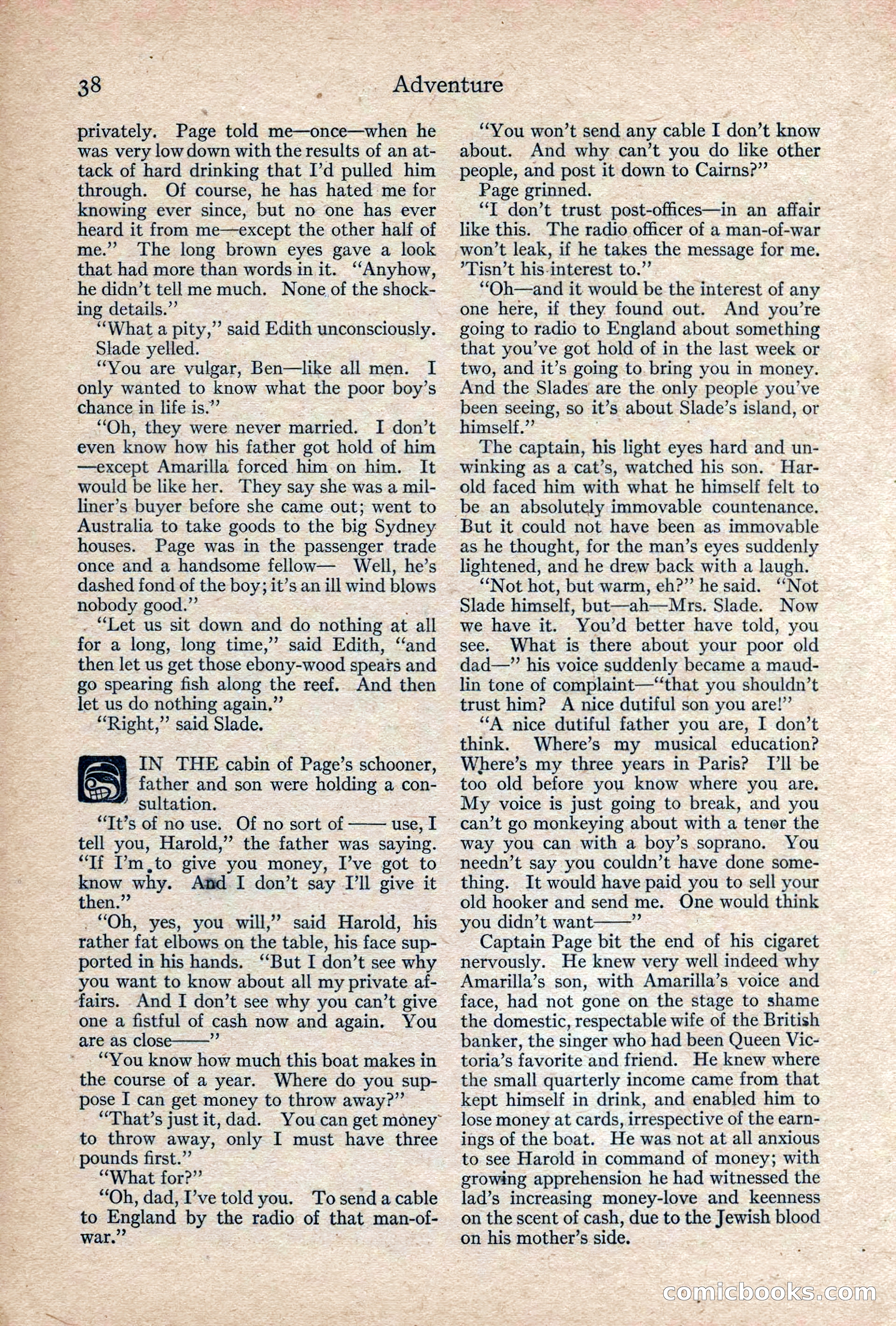
A restored page from Pulp Fiction, 1917. Page through the whole issue in the reader above.
📄 Transcribed text from this page (OCR, searchable)
Machine-transcribed from the original scan — historical spelling and the odd misread are preserved.
38 privately. Page told me—once—when he was very low down with the results of an at- tack of hard drinking that I’d pulled him through. Of course, he has hated me for knowing ever since, but no one has ever heard it from me—except the other half of me.” The long brown eyes gave a look that had more than words init. “Anyhow, he didn’t tell me much. None of the shock- ing details.”’ “What a pity,” said Edith unconsciously. _ Slade yelled. “Vou are vulgar, Ben—like all men. I only wanted to know what the poor boy’s chance in life is.” “Oh, they were never married. I don’t even know how his father got hold of him —except Amarilla forced him on him. It would be like her. They say she was a mil- liner’s buyer before she came out; went to Australia to take goods to the big Sydney houses. Page was in the passenger trade once and a handsome fellow— Well, he’s dashed fond of the boy; it’s an ill wind blows nobody good.” “Let us sit down and do nothing at all for a long, long time,” said Edith, ‘‘and then let us get those ebony-wood spears and go spearing fish along the reef. And then let us do nothing again.” “Right,” said Slade. = IN THE cabin of Page’s schooner, cS) father and son were holding 4 a con- “< sultation. “It’s of no use. Of no sort of —— use, I - tell you, Harold,” the father was saying. “Tf I’m,to give you money, I’ve got to know why. And I don’t say I’ll give it then.” - “Oh, yes, you will,” said Harold, his rather fat elbows on the table, his face sup- ported in his hands. ‘‘But I don’t see why you want to know about all my private af- fairs. And I don’t see why you can’t give one a fistful of cash now and again. You are as close——” “You know how much this boat makes i in the course of a year. Where do you sup- pose I can get money to throw away?” “That’s just it, dad. You can get money” to throw away, only I must have three ‘pounds first.” “What for?” “Oh, dad, I’ve told you. Tosendacable to England by the radio of that man-of- war.’ . _ Adventure “You won’t send any cable I don’t know about. And why can’t you do like other people, and post it down to Cairns?”’ Page grinned. “T don’t trust post-offices—in an affair like this. The radio officer of a man-of-war won’t leak, if he takes the message for me. *Tisn’t his-interest to.”’ ““Oh—and it would be the interest of any one here, if they found out. And you’re going to radio to England about something that you’ve got hold of in the last week or two, and it’s going to. bring you in money. And the Slades are the only people you’ve been seeing, so it’s about Slade’s island, or himself.” The captain, his light eyes hard and un- winking as a cat’s, watched his son. © Har- old faced him with what he himself felt to -be an absolutely immovable countenance. But it could not have been as immovable as he thought, for the man’s eyes suddenly lightened, and he drew back with a laugh. ‘“‘Not hot, but warm, eh?” he said. ‘‘Not Slade himself, but—ah—Mrs. Slade. Now we have it. You’d better have told, you see. What is there about your poor old dad—” his voice suddenly became a maud- lin tone of complaint—“that you shouldn’t trust him? A nice dutiful son you are!”’ ““A nice dutiful father you are, I don’t think. Where’s my musical education? Where’s my three years in Paris? Ill be too old before you know where you are. My voice is just going to break, and you can’t go monkeying about with a tenor the way you can with a boy’s soprano. You needn’t say you couldn’t have done some- thing. It would have paid you to sell your old hooker and send me. One would think you didn’t want Captain Page bit the end of his cigaret nervously. He knew very well indeed why Amarilla’s son, with Amarilla’s voice and face, had not gone on the stage to shame the domestic, respectable wife of the British banker, the singer who had been Queen Vic- toria’s favorite and friend. He knew where the small quarterly income came from that kept himself in drink, and enabled him to lose money at cards, irrespective of the earn- ings of the boat. He was not at all anxious to see Harold in command of money; with growing apprehension he had witnessed the lad’s increasing money-love and keenness on the scent of cash, due to the Jewish blood on his mother’s side. IOOK (E@)