
Pulp Fiction, 1917 · page 66 of 228
Adventure, February 1917 — page 66: what you’re looking at
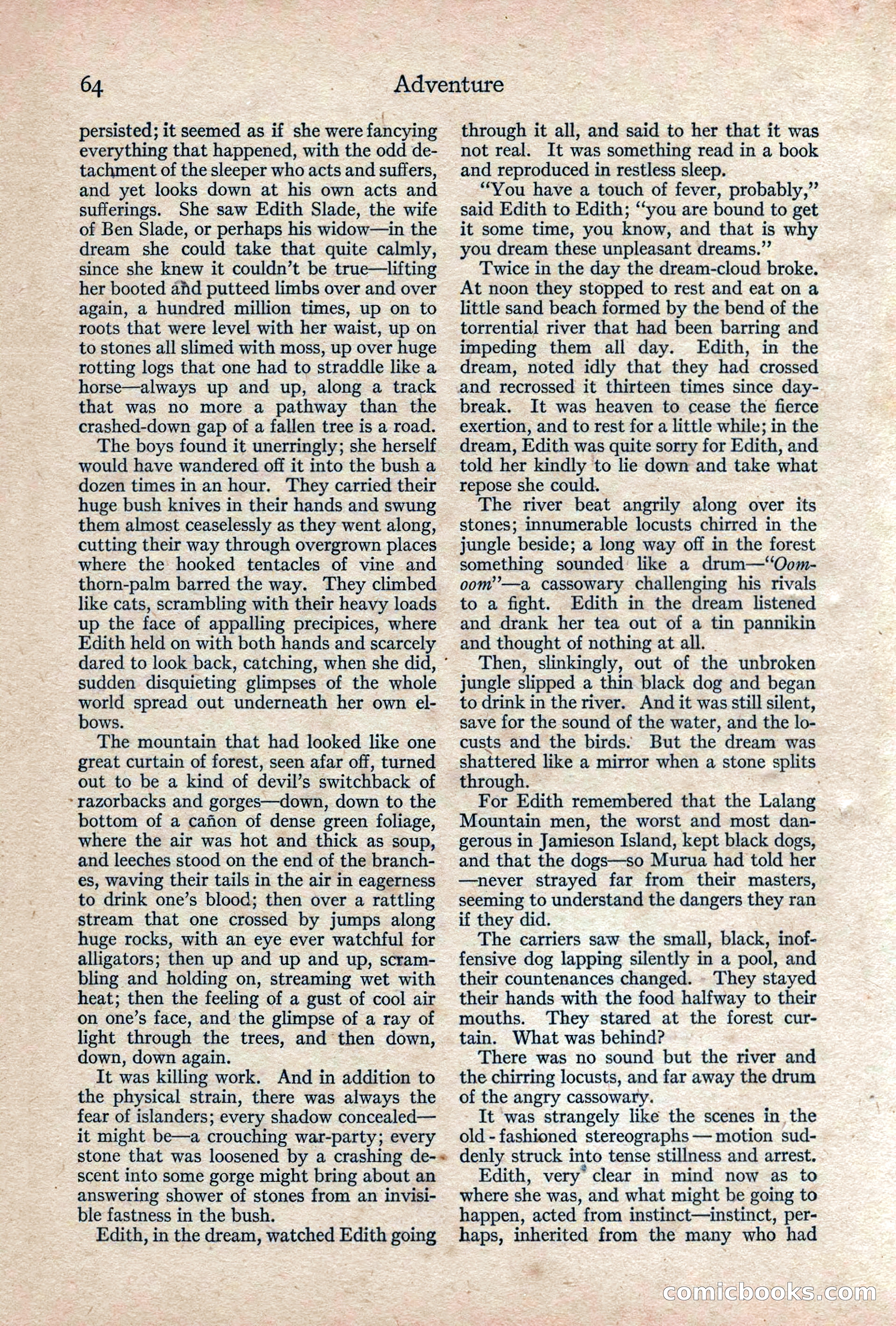
A restored page from Pulp Fiction, 1917. Page through the whole issue in the reader above.
📄 Transcribed text from this page (OCR, searchable)
Machine-transcribed from the original scan — historical spelling and the odd misread are preserved.
? 64 | persisted; it seemed as if she were fancying everything that happened, with the odd de- tachment of the sleeper who acts and suffers, and yet looks down at his own acts and sufferings. She saw Edith Slade, the wife of Ben Slade, or perhaps his widow—in the dream she could take that quite calmly, since she knew it couldn’t be true—lifting her booted and putteed limbs over and over again, a hundred million times, up on to roots that were level with her waist, up on to stones all slimed with moss, up over huge rotting logs that one had to straddle like a horse—always up and up, along a track that was no more a pathway than the crashed-down gap of a fallen tree is a road. The boys found it unerringly; she herself would have wandered off it into the bush a dozen times in an hour. They carried their huge bush knives in their hands and swung them almost ceaselessly as they went along, cutting their way through overgrown places where the hooked tentacles of vine and thorn-palm barred the way. They climbed like cats, scrambling with their heavy loads up the face of appalling precipices, where Edith held on with both hands and scarcely dared to look back, catching, when she did, ° sudden disquieting glimpses of the whole world spread out underneath her own el- bows. The mountain that had looked like one great curtain of forest, seen afar off, turned out to be a kind of devil’s switchback of razorbacks and gorges—down, down to the bottom of a cafion of dense green foliage, where the air was hot and thick as soup, and leeches stood on the end of the branch- es, waving their tails in the air in eagerness to drink one’s blood; then over a rattling stream that one crossed by jumps along huge rocks, with an eye ever watchful for alligators; then up and up and up, scram- bling and holding on, streaming wet with heat; then the feeling of a gust of cool air on one’s face, and the glimpse of a ray of light through the trees, and then down, down, down again. It was killing work. And in addition to the physical strain, there was always the fear of islanders; every shadow concealed— it might be—a crouching war-party; every _ stone that was loosened by a crashing de-« scent into some gorge might bring about an answering shower of stones from an invisi- ble fastness in the bush. Edith, in the dream, watched Edith going Adventure through it all, and said to her that it was not real. It was something read in a book and reproduced in restless sleep. “You have a touch of fever, probably,” said Edith to Edith; “‘you are bound to get it some time, you know, and that is why you dream these unpleasant dreams.”’ Twice in the day the dream-cloud broke. At noon they stopped to rest and eat on a little sand beach formed by the bend of the torrential river that had been barring and impeding them all day. Edith, in the dream, noted idly that they had crossed and recrossed it thirteen times since day- break. It was heaven to cease the fierce exertion, and to rest for a little while; in the dream, Edith was quite sorry for Edith, and told her kindly to lie down and take what repose she could. The river beat angrily along over its stones; innumerable locusts chirred in the jungle beside; a long way off in the forest something sounded like a drum—“Oom- oom’’—a cassowary challenging his rivals to a fight. Edith in the dream listened and drank her tea out of a tin pannikin and thought of nothing at all. Then, slinkingly, out of the unbroken jungle slipped a thin black dog and began to drink in the river. And it was still silent, save for the sound of the water, and the lo- custs and the birds. But the dream was shattered like a mirror when a stone splits through. For Edith remembered that the Lalang Mountain men, the worst and most dan- gerous in Jamieson Island, kept black dogs, and that the dogs—so Murua had told her —never strayed far from their masters, seeming to understand the dangers they ran if they did. The carriers saw the small, black, inof- fensive dog lapping silently in a pool, and their countenances changed. - They stayed their hands with the food halfway to their mouths. They stared at the forest cur- tain. What was behind? There was no sound but the river and the chirring locusts, and far away the drum of the angry cassowary. It was strangely like the scenes in the old-fashioned stereographs — motion sud- denly struck into tense stillness and arrest. Edith, very clear in mind now as to where she was, and what might be going to happen, acted from instinct—instinct, per- haps, inherited from the many who had GEomicbooks (CO)