
Pulp Fiction, 1917 · page 67 of 228
Adventure, February 1917 — page 67: what you’re looking at
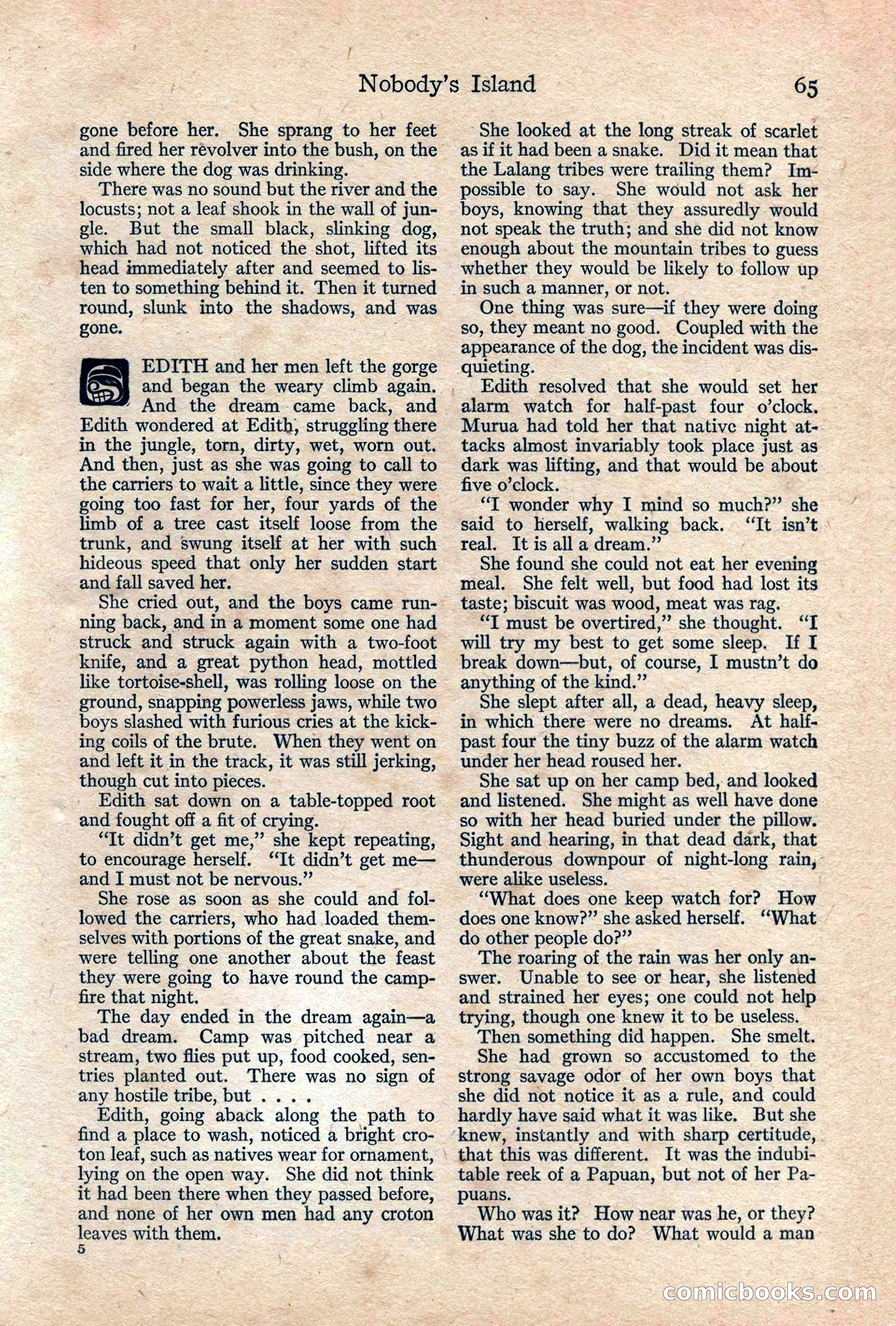
A restored page from Pulp Fiction, 1917. Page through the whole issue in the reader above.
📄 Transcribed text from this page (OCR, searchable)
Machine-transcribed from the original scan — historical spelling and the odd misread are preserved.
I Nobody’s Island gone before her. She sprang to her feet and fired her révolver into the bush, on the side where the dog was drinking. There was no sound but the river and the locusts; not a leaf shook in the wall of jun- gle. But the small black, slinking dog, which had not noticed the shot, lifted its head immediately after and seemed to lis- ten to something behind it. Then it turned round, slunk into the shadows, and was gone. EDITH and her men left the gorge cy and began the weary climb again. wa” And the dream came back, and Edith wondered at Edith, struggling there in the jungle, torn, dirty, wet, worn out. And then, just as she was going to call to the carriers to wait a little, since they were going too fast for her, four yards of the limb of a tree cast itself loose from the trunk, and swung itself at her with such hideous speed that only her sudden start and fall saved her. She cried out, and the boys came run- ning back, and in a moment some one had struck and struck again with a two-foot knife, and a great python head, mottled like tortoise-shell, was rolling loose on the ground, snapping powerless jaws, while two boys slashed with furious cries at the kick- ing coils of the brute. When they went on and left it in the track, it was still jerking, though cut into pieces. Edith sat down on a table-topped root and fought off a fit of crying. “Tt didn’t get me,” she kept repeating, to encourage herself. “It didn’t get me— and I must not be nervous.” : She rose as soon as she could and fol- lowed the carriers, who had loaded them- selves with portions of the great snake, and were telling one another about the feast they were going to have round the camp- fire that night. The day ended in the dream again—a bad dream. Camp was pitched near a stream, two flies put up, food cooked, sen- tries planted out. There was no sign of any hostile tribe, but . Edith, going aback along the path to find a place to wash, noticed a bright cro- ton leaf, such as natives wear for ornament, lying on the open way. She did not think it had been there when they passed before, and none of her own men had any croton leaves with them. 05 She looked at the long streak of scarlet as if it had been a snake. Did it mean that the Lalang tribes were trailing them? Im- possible to say. She would not ask her boys, knowing that they assuredly would not speak the truth; and she did not know enough about the mountain tribes to guess whether they would be likely to follow up in such a manner, or not. One thing was sure—if they were doing | so, they meant no good. Coupled with the appearance of the dog, the incident was dis- quieting. Edith resolved that she would set her alarm watch for half-past four o’clock. Murua had told her that native night at- tacks almost invariably took place just as dark was lifting, and that would be about five o’clock. “I. wonder why I mind so much?” she said to herself, walking back. “It isn’t real. It is all a dream.” She found she could not eat her evening meal. She felt well, but food had lost its taste; biscuit was wood, meat was rag. “T must be overtired,” she thought. “TI will try my best to get some sleep. If I break down—but, of course, I mustn’t do | anything of the kind.” She slept after all, a dead, heavy sleep, in which there were no dreams. At half- past four the tiny buzz of the alarm watch under her head roused her. She sat up on her camp bed, and looked and listened. She might as well have done so with her head buried under the pillow. Sight and hearing, in that dead dark, that thunderous downpour of night-long rain, were alike useless. “‘What does one keep watch for? How does one know?”’ she asked herself. ‘‘What do other people do?” The roaring of the rain was her only an- swer. Unable to see or hear, she listened and strained her eyes; one could not help trying, though one knew it to be useless. Then something did happen. She smelt. She had grown so accustomed to the strong savage odor of her own boys that she did not notice it as a rule, and could hardly have said what it was like. But she ‘knew, instantly and with sharp certitude, . that this was different. It was the indubi- table reek of a Papuan, but not of her Pa- puans. Who was it? How near was he, or they? What was she to do? cComichooks What would a man (E@)