
Pulp Fiction, 1920 · page 204 of 208
Adventure Magazine Cover — page 204: what you’re looking at
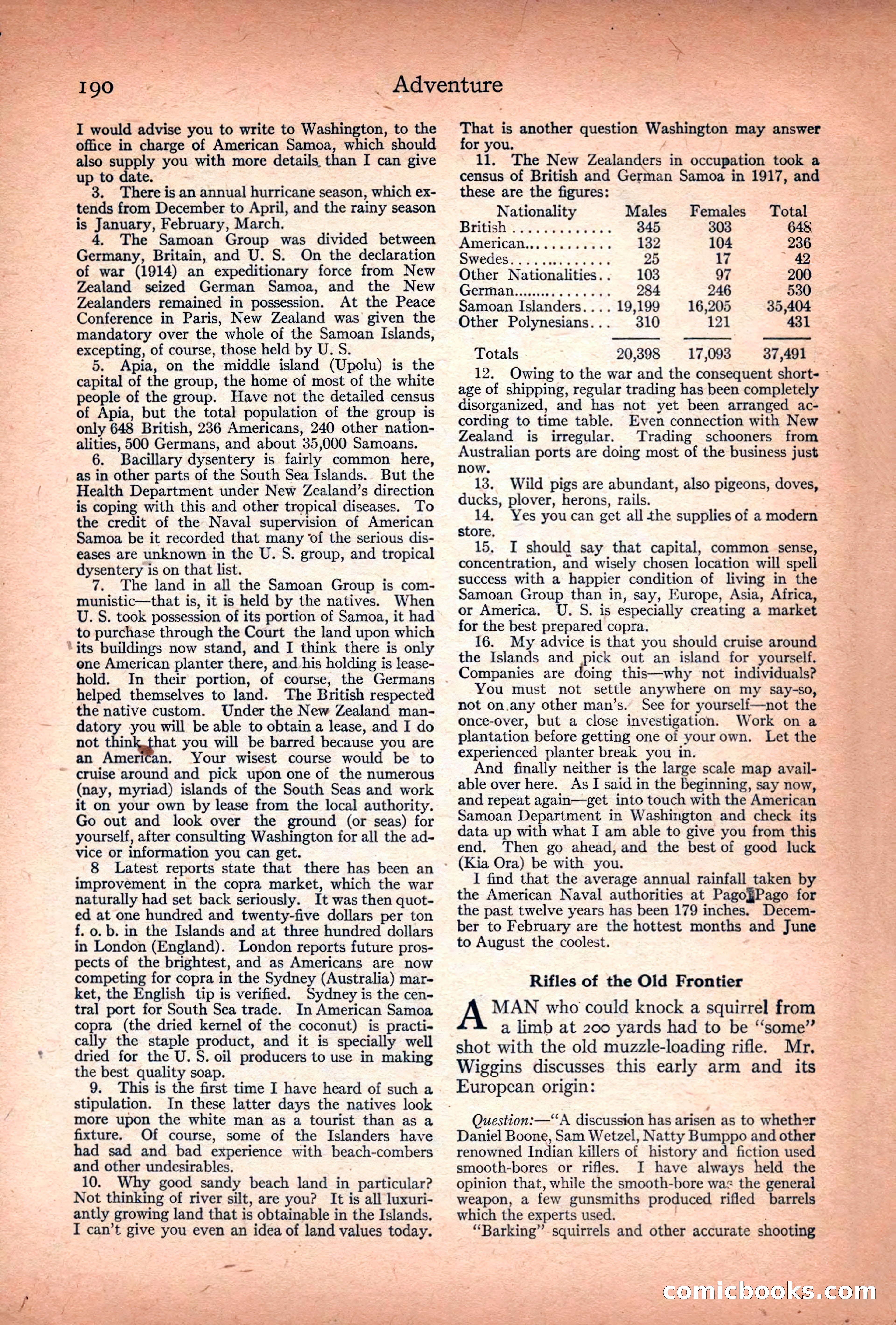
A restored page from Pulp Fiction, 1920. Page through the whole issue in the reader above.
📄 Transcribed text from this page (OCR, searchable)
Machine-transcribed from the original scan — historical spelling and the odd misread are preserved.
_ _ Adventure ~ I would advise you to write to Washington, to the Me office in charge of American Samoa, which should also supply you with more details. than I can give up to date. ' 3. There is an annual hurricane season, which ex- tends from December to April, and the rainy season is January, February, March. 4. The Samoan Group was divided between Germany, Britain, and U. S. On the declaration of war (1914) an expeditionary force from New Zealand seized German Samoa, and the New Zealanders remained in possession. At the Peace Conference in Paris, New Zealand was given the mandatory over the whole of the Samoan Islands, excepting, of course, those held by U. S. 5. Apia, on the middle island (Upolu) is the capital of the group, the home of most of the white people of the group. Have not the detailed census of Apia, but the total population of the group is only 648 British, 236 Americans, 240 other nation- alities, 500 Germans, and about 35,000 Samoans. 6. Bacillary dysentery is fairly common here, _ as in other parts of the South Sea Islands. But the Health Department under New Zealand’s direction is coping with this and other tropical diseases. To the credit of the Naval supervision of American Samoa be it recorded that many ‘of the serious dis- eases are unknown in the U. S. group, and tropical dysentery is on that list. 7. The land in all the Samoan Group is com- munistic—that is, it is held by the natives. When U. S. took possession of its portion of Samoa, it had to purchase through the Court the land upon which its buildings now stand, and I think there is only ees planter there, and his holding is lease- old. the native custom. Under the New Zealand man- datory -you will be able to obtain a lease, and I do not thi hat you will be barred because you are an Amerifan. Your wisest course would be to cruise around and pick upon one of the numerous (nay, myriad) islands of the South Seas and work it on your own by lease from the local authority. Go out and look over the ground (or seas) for yourself, after consulting Washington for all the ad- vice or information you can get. 8 Latest reports state that there has been an © improvement in the copra market, which the war naturally had set back seriously. It was then quot- ed at one hundred and twenty-five dollars per ton f. o. b. in the Islands and at three hundred dollars in London (England). London reports future pros- pects of the brightest, and as Americans are now competing for copra in the Sydney (Australia) mar- ket, the English tip is verified. Sydney is the cen- tral port for South Sea trade. In American Samoa copra (the dried kernel of the coconut) is practi- cally the staple product, and it is specially well dried for the U.S. oil producers to use in making the best quality soap. 9. This is the first time I have heard of such a stipulation. In these latter days the natives look more upon the white man as a tourist than as a fixture. Of course, some of the Islanders have had sad and bad experience with beach-combers and other undesirables. 10. Why good sandy beach land in particular? Not thinking of river silt, are you? It is all luxuri- antly growing land that is obtainable in the Islands. I can’t give you even an idea of land values today. In their portion, of course, the Germans . helped themselves to land. The British respected That is another question Washington may answer for you. / 3 3 11. The New Zealanders in occupation tooka census of British and German Samoa in 1917, and these are the figures: me aE Nationality Males Females Total Be aa, ial ae ee rae 345 303 648 aps PUTICTICOD «5. 6.< accce Sea's 132 104 236 - SPMOES oe. cise os oe Us 25 17 ~ 42 Other Nationalities.. 103 97 200 GEAR. irs occ va Oe 246 530 % é Samoan Islanders....19,199 16,205 35,404 = Other Polynesians... 310 121 431 Totals - 20,398 17,093 37,491 -ee 12. Owing to the war and the consequent short-" ee age of shipping, regular trading has been completely — disorganized, and has not yet been arranged ac- ~ cording to time table. Even connection with New Zealand is irregular. Trading schooners from — . Australian ports are doing most of the business just = now. 13. Wild pigs are abundant, also pigeons, doves, = ducks, plover, herons, rails. _ 2 eS 14, Yes youcan get allthe suppliesofa modern store, e 15. I should say that capital, common sense, concentration, and wisely chosen location will spell success with a happier condition of living in the Samoan Group than in, say, Europe, Asia, Africa, or America. U. S. is especially creating a market for the best prepared copra. 16. My advice is that you should cruise around the Islands and pick out an island for yourself. Companies are doing this—why not individuals? You must not settle anywhere on my say-so, not on.any other man’s. See for yourself—not the once-over, but a close investigation. Work on a plantation before getting one of yourown. Letthe experienced planter break you in. , And finally neither is the large scale map avail-— able over here. As I said in the beginning, say now, and repeat again—get into touch with the American Samoan Department in Washington and check its © data up with what I am able to give you from this end. Then go ahead, and the best of good luck (Kia Ora) be with you. I find that the average annual rainfall taken by des the American Naval authorities at Pago§Pago for eee, the past twelve years has been 179 inches. Decem- age ber to February are the hottest months and June pees to August the coolest. ns ae HM 3) ‘ de tes te ding ee Nie i ; j Peli de aN e's iy ff q ase Lewy yA \ oa) fF ke “ele oY a) ee ae See Ve 2, Pe} aah y's ‘ i? is J ¢ Salers Ln i 3 4 wee eo Paty bb, alle J bie bake { re ge a ‘ APY RIE ty a 7 by Aen f : Hees ee lt ap? Et Fa by i A%, eye hy: yar i) t Rifles of the Old Frontier A MAN who could knock a squirrel from a limb at 200 yards had to be ‘‘some” shot with the old muzzle-loading rifle. Mr. Wiggins discusses this early arm and its European origin: Question: —“A discussion has arisen as to whether sf Daniel Boone, Sam Wetzel, Natty Bumppo and other Pan Te renowned Indian killers of history and fiction used = smooth-bores or rifles. I have always held the opinion that, while the smooth-bore was the general weapon, a few gunsmiths produced rifled barrels which the experts used. i is “Barking” squirrels and other accurate shooting = 8