
Pulp Fiction, 1920 · page 205 of 208
Adventure Magazine Cover — page 205: what you’re looking at
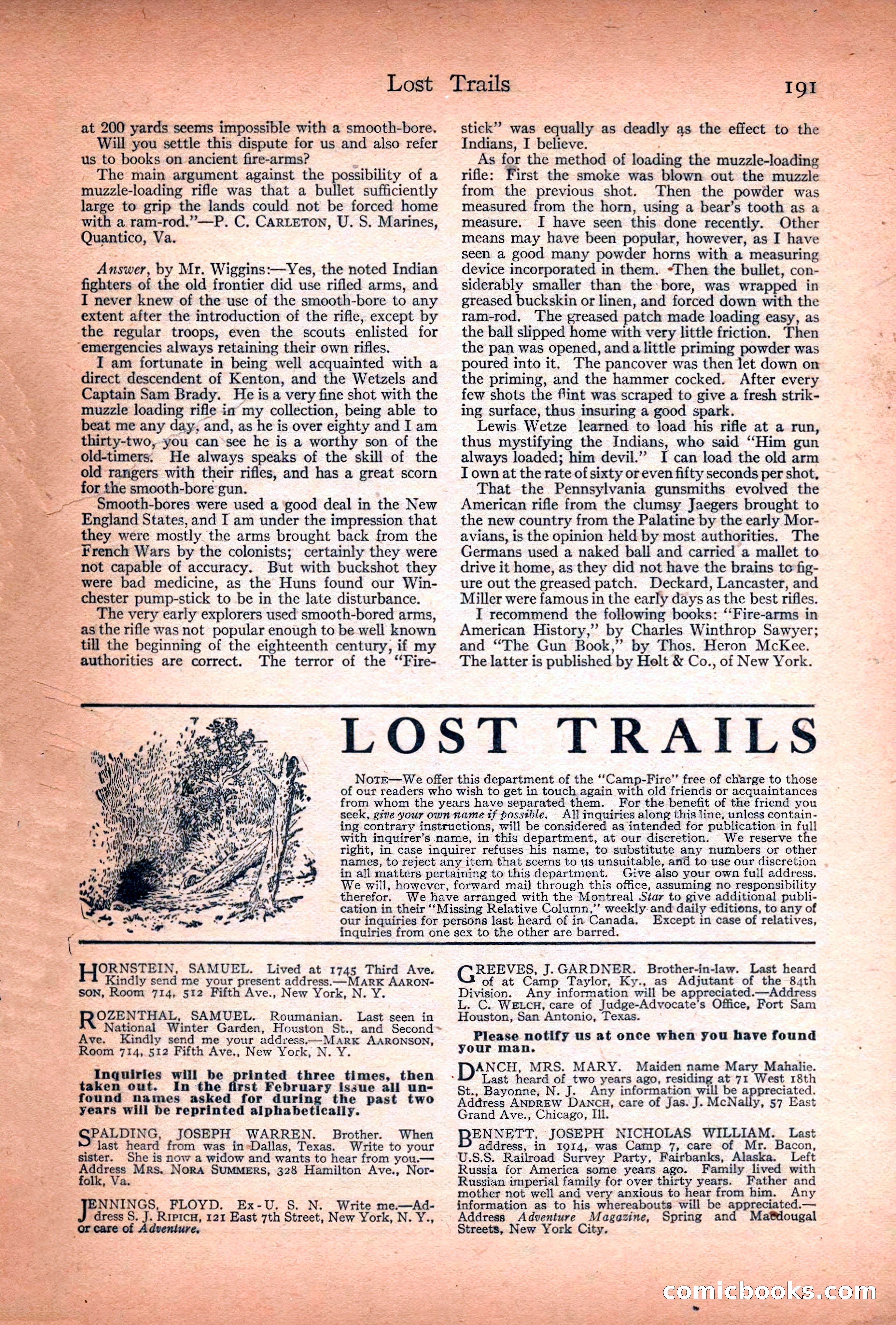
A restored page from Pulp Fiction, 1920. Page through the whole issue in the reader above.
📄 Transcribed text from this page (OCR, searchable)
Machine-transcribed from the original scan — historical spelling and the odd misread are preserved.
* ¢ “ef eS See aS ee ae ee _ old-timers. - authorities are correct. Lost Trails at 200 yards seems impossible with a smooth-bore. Will you settle this dispute for us and also refer us to books on ancient fire-arms? The main argument against the possibility of a muzzle-loading rifle was that a bullet sufficiently large to grip the lands could not be forced home with a ram-rod.”—P. C. CARLETON, U. S. Marines, Quantico, Va. Answer, by Mr. Wiggins:—Yes, the noted Indian fighters of the old frontier did use rifled arms, and I never knew of the use of the smooth-bore to any extent after the introduction of the rifle, except by the regular troops, even the scouts enlisted for ‘emergencies always retaining their own rifles. I am fortunate in being well acquainted with a - direct descendent of Kenton, and the Wetzels and Captain Sam Brady. He isa very fine shot with the muzzle loading rifle in my collection, being able to beat me any day, and, as he is over eighty and I am thirty-two, you can*see he is a worthy son of the He always speaks of the skill of the old rangers with their rifles, and has a great scorn for the smooth-bore gun. ~ §$mooth-bores were used a ‘good deal in the New England States, and I am under the impression that ey were mostly the arms brought back from the French Wars by the colonists; certainly they were not capable of accuracy. But with buckshot they were bad medicine, as the Huns found our Win- chester pump-stick to be in the late disturbance. The very early explorers used smooth-bored arms, as the rifle was not popular enough to be well known till the beginning of the eighteenth century, if my The terror of the ‘‘Fire- er mers ie wa \ Ahi ) manip! ute \ % / yf ats WN Me ee ‘ We will therefor. HORNSTEIN, SAMUEL. Lived at 1745 Third Ave. Kindly send me your present address.—MARK AARON- SON, Room 714, 512 Fifth Ave., New York, N. Y. ROZENTHAL, SAMUEL. Roumanian. Last seen in National Winter Garden, Houston St., and Second Ave. Kindly send me your address.—MarK AARONSON, Room 714, 512 Fifth Ave., New York, N. Y. Inquiries will be printed three times, then taken out. In the first February Issue all un- found names asked for during the past two years will be reprinted alphabetically. SPALDING, JOSEPH WARREN. Brother. When ~ last heard from was in-Dallas, Texas. Write to your sister. She is now a widow and wants to hear from you.u— ee Mrs. Nora SuMMERS, 328 Hamilton Ave., Nor- olk, Va. NNINGS, FLOYD. Ex-U. S. N. Write me—Ad- dress S. J. Rrpicu, 121 East 7th Street, New York, N. Y., or care of Adveniure, eS hey em Re ae os eS Se ~ _<_ = te eer <a Se — a, = stick” was equally as deadly as the effect to the Indians, I believe. As for the method of loading the muzzle-loading rifle: First the smoke was blown out the muzzle from the previous shot. Then the powder was measured from the horn, using a bear’s tooth as a measure. I have seen this done recently. Other means may have been popular, however, as I have seen a good many powder horns with a measuring device incorporated in them. «Then the bullet, con- siderably smaller than the bore, was wrapped in greased buckskin or linen, and forced down with the ram-rod. The greased patch made loading easy, as the ball slipped home with very little friction. Then the pan was opened, and alittle priming powder was poured into it. The pancover was then let down on the priming, and the hammer cocked. After every few shots the flint was scraped to give a fresh strik- ing surface, thus insuring a good spark. Lewis Wetze learned to load his rifle at a run, thus mystifying the Indians, who said “Him gun always loaded; him devil.” I can load the old arm I own at the rate of sixty or even fifty seconds per shot, That the Pennsylvania gunsmiths evolved the American rifle from the clumsy Jaegers brought to the new country from the Palatine by the early Mor- avians, is the opinion held by most authorities. The Germans used a naked ball and carried a mallet to drive it home, as they did not have the brains to fig- ure out the greased patch. Deckard, Lancaster, and Miller were famous in the early days as the best rifles. I recommend the following books: “‘Fire-arms in American History,” by Charles Winthrop Sawyer; and “The Gun Book,” by Thos. Heron McKee. The latter is published by Helt & Co., of New York. LOST TRAILS NotE—We offer this department of the ‘‘'Camp-Fire”’ free of charge to those of our readers who wish to get in touch again with old friends or acquaintances from whom the years have separated them. For the benefit of the friend you seek, give your own name tf possible. ing contrary instructions, will be considered as intended for publication in full with inquirer’s name, in this department, at our discretion. right, in case inquirer refuses his name, to substitute any numbers or other names, to reject any item that seems to us unsuitable, arid to use our discretion in all matters pertaining to this department. All inquiries along this line, unless contain- We reserve the Give also your own full address. ll, however, forward mail through this office, assuming no responsibility We have arranged with the Montreal Star to give additional publi- cation in their ‘‘Missing Relative Column,”’ weekly and daily editions, to any of our inquiries for persons last heard of in Canada. inquiries from one sex to the other are barred. Except in case of relatives, REEVES, J. GARDNER. Brother-in-law. Last heard of at Camp Taylor, Ky., as Adjutant of the 84th Division. Any information will be appreciated.—Address L. C. WELCH, care of Judge-Advocate’s Office, Fort Sam Houston, San Antonio, Texas. Please notify us at once when you have found your man. DANCE, MRS. MARY. Maiden name Mary Mahalie. Last heard of two years ago, residing at 71 West 18th St., Bayonne, N. J. Any information will be appreciated. Address ANDREW Dancn, care of Jas. J. McNally, 57 East Grand Ave., Chicago, Ill. ENNETT, JOSEPH NICHOLAS WILLIAM. Last address, in 1914, was Camp 7, care of Mr. Bacon, U.S.S. Railroad Survey Party, Fairbanks, Alaska. Left Russia for America some years ago. Family lived with Russian imperial family for over thirty years. Father and mother not well and very anxious to hear from him. Any information as to his whereabouts will be appreciated.— Address Adventure Magazine, Spring and Ma®dougal Streets, New York City. Eomicboo IQT (Ee)