
Pulp Fiction, 1920 · page 119 of 172
Adventure Magazine Cover — page 119: what you’re looking at
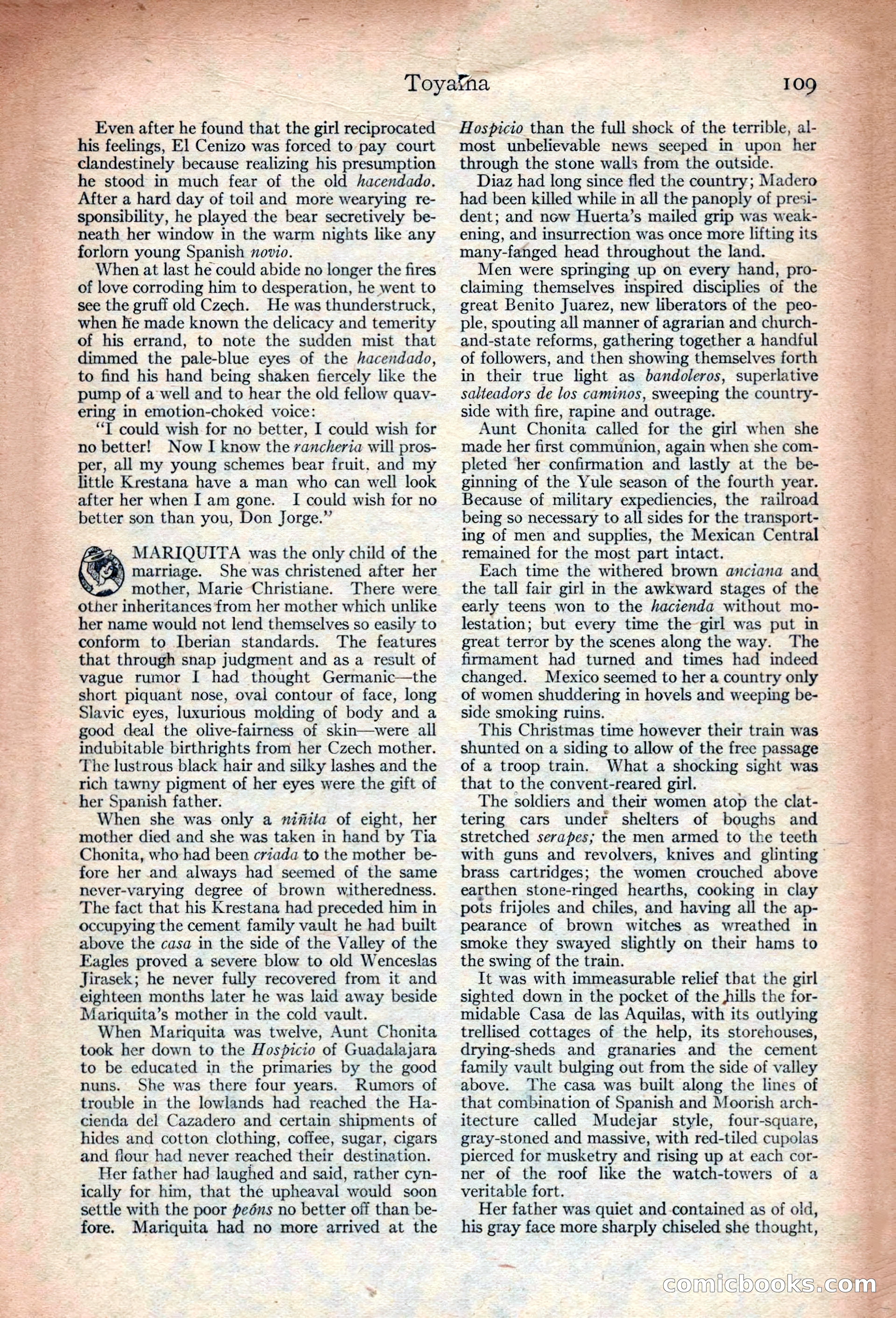
A restored page from Pulp Fiction, 1920. Page through the whole issue in the reader above.
📄 Transcribed text from this page (OCR, searchable)
Machine-transcribed from the original scan — historical spelling and the odd misread are preserved.
after her when I am gone. Even after he found that the girl reciprocated his feelings, El] Cenizo was forced to pay court - clandestinely because realizing his presumption he stood in much fear of the old hAacendado, After a hard day of toil and more wearying re- sponsibility, he played the bear secretively be- neath her window in the warm nights like any forlorn young Spanish novio. ‘When at last he could abide no longer the fires of love corroding him to desperation, he went to see the gruff old Czech. He was thunderstruck, when he made known the delicacy and temerity of his errand, to note the sudden mist that dimmed the pale-blue eyes of the hacendado, _ to find his hand being shaken fiercely like the pump of a well and to hear the old fellow quav- ering in emotion-choked voice: “T could wish for no better, I could wish for no better! Now I know the rancheria will pros- per, all my young schemes bear fruit, and my little Krestana have a man who can well look I could wish for no better son than you, Don Jorge.” Oe marriage. She was christened after her ~ mother, Marie Christiane. other inheritances from her mother which unlike her name would not lend themselves so easily to conform to Iberian standards. The features that through snap judgment and as a result of vague rumor I had thought Germanic—the short piquant nose, oval contour of face, long Slavic eyes, luxurious molding of body and a good deal the olive-fairness of skin—were all indubitable birthrights from her Czech mother. The lustrous black hair and silky lashes and the rich tawny pigment of her eyes were the gift of her Spanish father. When she was only a wifita of eight, her mother died and she was taken in hand by Tia Chonita, who had been criada to the mother be- fore her and always had seemed of the same never-varying degree of brown witheredness. The fact that his Krestana had preceded him in occupying the cement family vault he had built above the casa in the side of the Valley of the Eagles proved a severe blow to old Wenceslas Jirasek; he never fully recovered from it and eighteen months later he was laid away beside Mariquita’s mother in the cold vault. When Mariquita was twelve, Aunt Chonita took her down to the Hospicio of Guadalajara to be educated in the primaries by the good nuns. She was there four years. Rumors of trouble in the lowlands had reached the Ha- cienda del Cazadero and certain shipments of hides and cotton clothing, coffee, sugar, cigars and flour had never reached their destination. Her father had laughed and said, rather cyn- ically for him, that the upheaval would soon settle with the poor pedns no better off than be- fore. Mariquita had no more arrived at the Toyamna LP MARIQUITA was the only child of the _ There were Hospicio than the full shock of the terrible, al- — : : ise ed most unbelievable news seeped in upon her through the stone walls from the outside. Diaz had long since fled the country; Madero had been killed while in all the panoply of presi- dent; and now Huerta’s mailed grip was weak- — : ening, and insurrection was once more lifting its many-fanged head throughout the land. Men were springing up on every hand, pro- claiming themselves inspired disciplies of the great Benito Juarez, new liberators of the peo- ple, spouting all manner of agrarian and church- and-state reforms, gathering together a handful — | of followers, and then showing themselves forth in their true light as bandoleros, superlative salteadors de los caminos, sweeping the country- side with fire, rapine and outrage. Aunt Chonita called for the girl when she made her first communion, again when she com- pleted ‘her confirmation and lastly at the be- ginning of the Yule season of the fourth year. Because of military expediencies, the railroad being so necessary to all sides for the transport- ing of men and supplies, the Mexican Central > remained for the most part intact. Each time the withered brown anciana and the tall fair girl in the awkward stages of the early teens won to the hacienda without mo- lestation; but every time the girl was put in great terror by the scenes along the way. The firmament had turned and times had indeed changed. Mexico seemed to her a country only of women shuddering in hovels and weeping be- side smoking ruins. This Christmas time however their train was shunted on a siding to allow of the free passage of a troop train. What a shocking sight was that to the convent-reared girl. The soldiers and their women atop the clat- tering cars under shelters of boughs and stretched serapes; the men armed to the teeth with guns and revolvers, knives and glinting brass cartridges; the women crouched above earthen stone-ringed hearths, cooking in clay pots frijoles and chiles, and having all the ap- pearance of brown witches as wreathed in smoke they swayed slightly on their hams to the swing of the train. It was with immeasurable relief that the girl sighted down in the pocket of the Jills the for- midable Casa de las Aquilas, with its outlying trellised cottages of the help, its storehouses, drying-sheds and granaries and the cement family vault bulging out from the side of valley above. The casa was built along the lines of that combination of Spanish and Moorish arch- itecture called Mudejar style, four-square, gray-stoned and massive, with red-tiled cupolas pierced for musketry and rising up at each cor- ner of the roof like the watch-towers of a veritable fort. Her father was quiet and contained as of old, his gray face more sharply chiseled she thought, ~~ COMICOOOkKS