
Pulp Fiction, 1920 · page 120 of 172
Adventure Magazine Cover — page 120: what you’re looking at
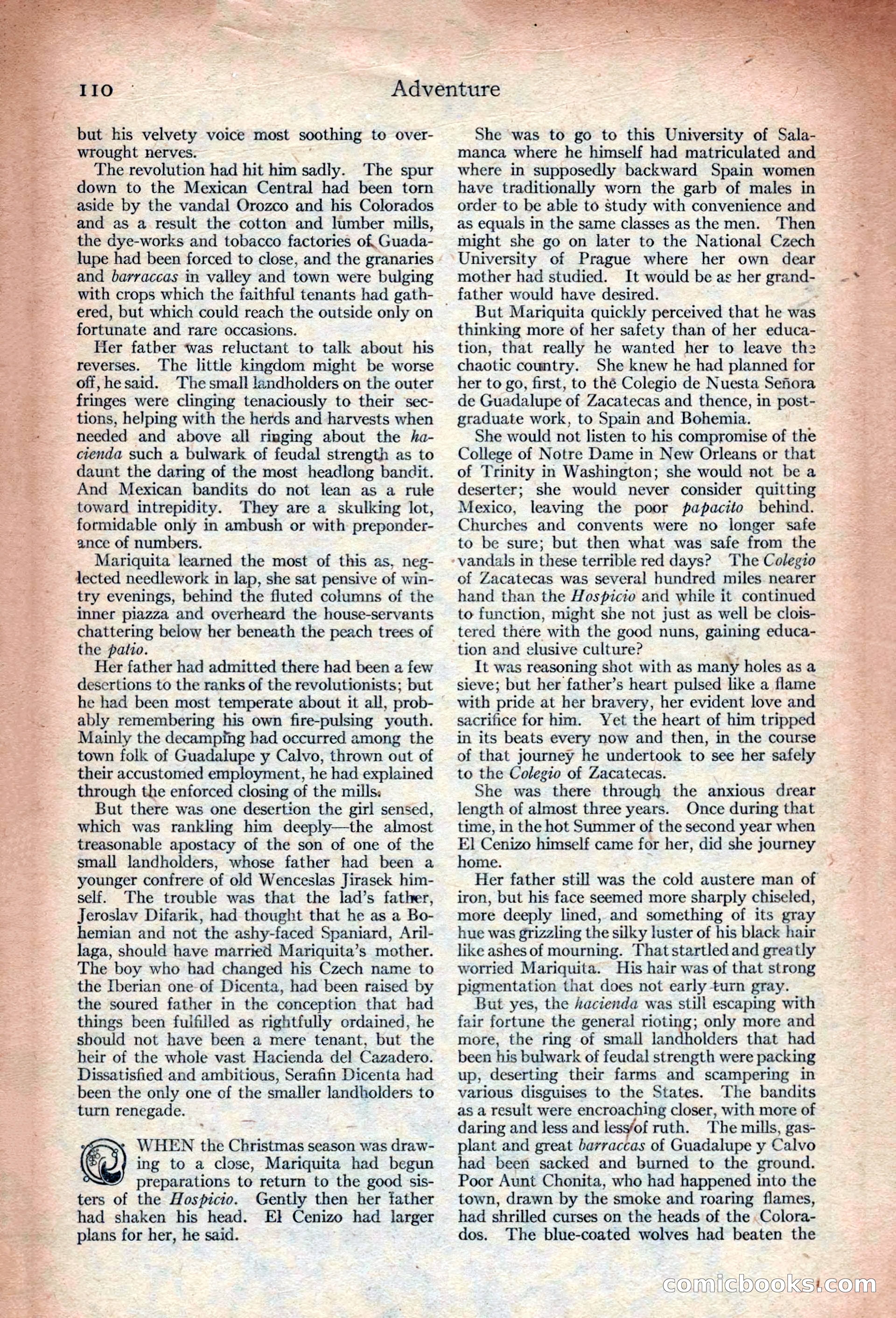
A restored page from Pulp Fiction, 1920. Page through the whole issue in the reader above.
📄 Transcribed text from this page (OCR, searchable)
Machine-transcribed from the original scan — historical spelling and the odd misread are preserved.
ny ee Be but his velvety voice most soothing to over- - wrought nerves. The revolution had hit him sadly. The spur down to the Mexican Central had been torn 2 ~ aside by the vandal Orozco and his Colorados _ and as a result the cotton and lumber mills, the dye-works and tobacco factories of, Guada- lupe had been forced to close, and the granaries » and barraccas in valley and town were bulging with crops which the faithful tenants had gath- ered, but which could reach the outside only on fortunate and rare occasions. Her father was reluctant to talk about his reverses. The little kingdom might be worse off, he said. The small landholders on the outer fringes were clinging tenaciously to their ‘sec- tions, helping with the herds and harvests when needed and above all ringing about the ka- cienda such a bulwark of feudal strength as to daunt the daring of the most headlong bandit. And Mexican bandits do not lean as a rule toward intrepidity. They are a skulking lot, formidable only in ambush or with preponder- ance of numbers. Mariquita learned the most of this as, neg- dected needlework in lap, she sat pensive of win- try evenings, behind the fluted columns of the inner piazza and overheard the house-servants chattering below her beneath the peach trees of the patio. Her father had admitted there had been a few desertions to the ranks of the revolutionists; but he had been most temperate about it all, prob- ably remembering his own fire-pulsing youth. Mainly the decamping bad occurred among the town folk of Guadalupe y Calvo, thrown out of their accustomed employment, he had explained through the enforced closing of the mills: But there was one desertion the girl sensed, which was rankling him deeply—the almost treasonable apostacy of the son of one of the small landholders, whose father had been a younger confrere of old Wenceslas Jirasek him- self. The trouble was that the lad’s father, Jeroslav Difarik, had thought that he as a Bo- hemian and not the ashy-faced Spaniard, Aril- laga, should have married Mariquita’s mother. The boy who had changed his Czech name to the Iberian one-of Dicenta, had been raised by the soured father in the conception that had things been fulfilled as rightfully ordained, he should not have been a mere tenant, but the heir of the whole vast Hacienda del Cazadero. Dissatisfied and ambitious, Serafin Dicenta had been the only one of the smaller landholders to turn renegade. WHEN the Christmas season was draw- ing to a close, Mariquita had begun preparations to return to the good sis- ters of the Hospicio. Gently then her father had shaken his head. El Cenizo had larger plans for her, he said. Adventure She ‘was to go to this University of Sala- cx manca where he himself had matriculated and where in supposedly backward Spain women have traditionally worn the garb of males in order to be able to study with convenience and as equals in the same classes as the men. Then might she go on later to the National Czech University of Prague where her own dear mother had studied. It would be ag her se . _ father would have desired. But Mariquita quickly perceived that he was thinking more of her safety than of her educa- tion, that really he wanted her to leave the chaotic country. She knew he had planned for her to go, first, to thé Colegio de Nuesta Sefiora - de Guadalupe of Zacatecas and thence, in post- graduate work, to Spain and Bohemia. She would not listen to his compromise of the College of Notre Dame in New Orleans or that of Trinity in Washington; she would not be a deserter; she would never consider quitting Mexico, leaving the poor papacito behind. Churches and convents were no longer safe to be sure; but then what was safe from the ‘vandals in these terrible red days? ‘The Colegio © of Zacatecas was several hundred miles nearer hand than the Hospicio and while it continued to function, might she not just as well be clois- tered there with the good nuns, gaining educa- tion and elusive culture? It was reasoning shot with as many holes as a sieve; but her father’s heart pulsed like a flame with pride at her bravery, her evident love and sacrifice for him. Yet the heart of him tripped in its beats every now and then, in the course of that journey he undertook to see her safely to the Colegio of Zacatecas. She was there through the anxious drear — Once during that length of almost three years. time, in the hot Summer of the second year when El Cenizo himself came for her, did she journey home. Her father still was ihe cold austere man of iron, but his face seemed more sharply chiseled, more deeply lined, and something of its gray hue was grizzling the silky luster of his black hair like ashes of mourning. That startled and greatly worried Mariquita. His hair was of that strong pigmentation that does not early turn gray. But yes, the hacienda was still escaping with fair fortune the general rioting; only more and more, the ring of small landholders that had been his bulwark of feudal strength were packing up, deserting their farms and scampering in various disguises to the States. The bandits as a result were encroaching closer, with more of daring and less and less/of ruth. The mills, gas- plant and great barraccas of Guadalupe y Calvo had been sacked and burned to the ground. Poor Aunt Chonita, who had happened into the town, drawn by the smoke and roaring flames, had shrilled curses on the heads of the Colora- dos. The blue-coated wolves had beaten the comiclbooksKeon ~ Coe es atte a - - es . ~— -%, — es od ae ¥ * > - ™ >a : Ve neha Se gia a » a: age 4 See ee ~ wm ake teh cw dla te Se ne; —< <a ie LAY a ay i sane ray