
Pulp Fiction, 1920 · page 146 of 172
Adventure Magazine Cover — page 146: what you’re looking at
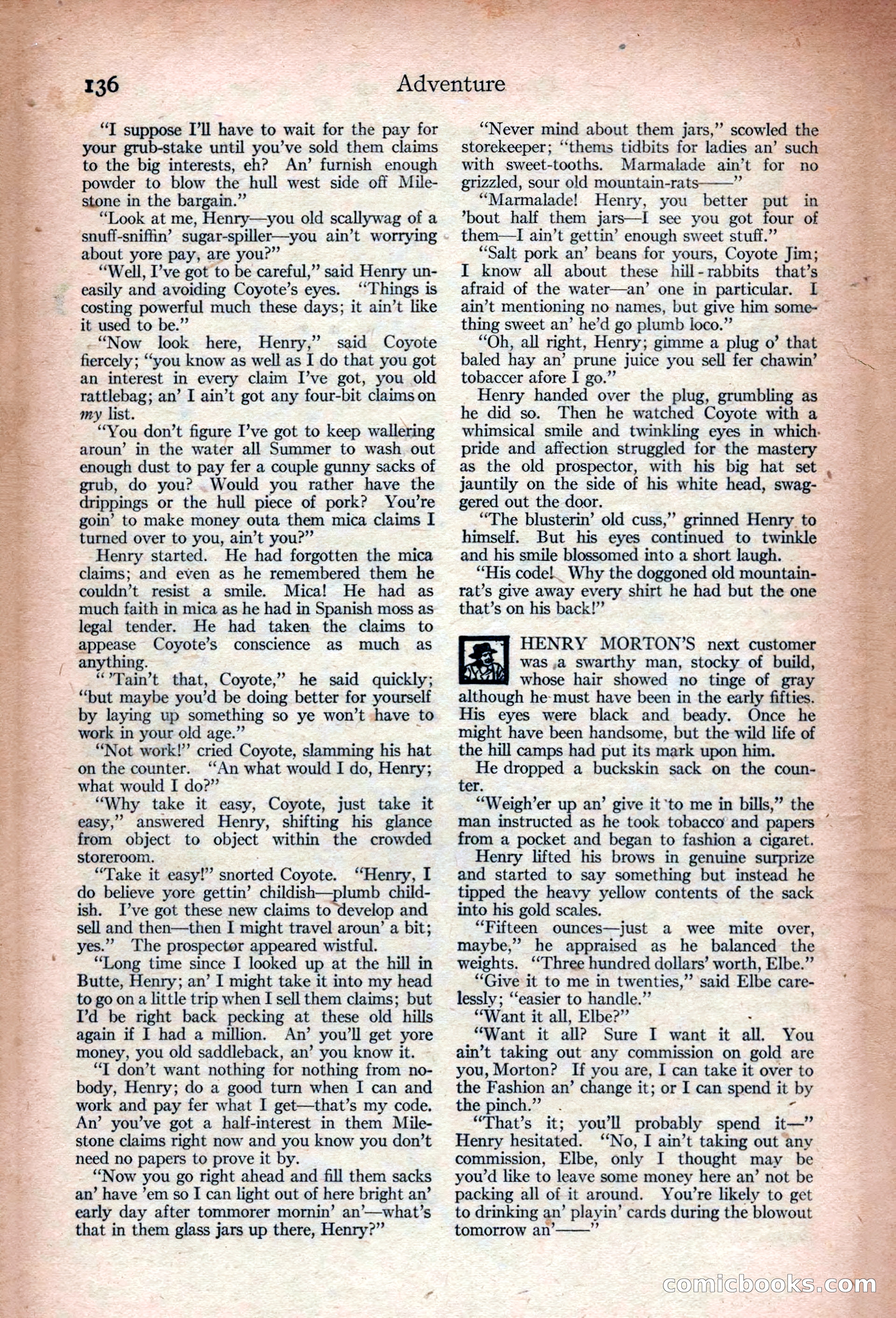
A restored page from Pulp Fiction, 1920. Page through the whole issue in the reader above.
📄 Transcribed text from this page (OCR, searchable)
Machine-transcribed from the original scan — historical spelling and the odd misread are preserved.
= =e as <d ” . = af. = ¢ act nal a "Lal qe ~ on the counter. A Ty tr wo; a Se ee eee S — ses = “SER Adventure “T suppose I’ll have to wait for the pay for your grub-stake until you’ve sold them claims to the big interests, eh? An’ furnish enough _ powder to blow the hull west side off Mile- stone in the bargain.” “Look at me, Henry—you old scallywag of a snuff-sniffin’ sugar-spiller—you ain’t worrying - about yore pay, are your” - “Well, I’ve got to be careful,” said Henry un- easily and avoiding Coyote’s eyes. ‘‘Things is costing powerful much these days; it ain’t like it used to be.” -“Now look here, Henry,” said Coyote fiercely; “you know as well as I do that you got an interest in every claim I’ve got, you old rattlebag; an’ I ain’t got any four-bit claims on my y list. “You don’t figure I’ve got to keep wallering aroun’ in the water all Summer to wash out enough dust to pay fer a couple gunny sacks of grub, do you? . Would you rather have the drippings or the hull piece of pork? You’re goin’ to make money outa them mica claims I turned over to you, ain’t you?” Henry started. He had forgotten the mica claims; and even as he remembered them he couldn’t resist a smile. Mica! He had as much faith in mica as he had in Spanish moss as legal tender. He had taken the claims to appease Coyote’s conscience as much as —— ) 8 9 - : . Tain’t that, Coyote,” he said quickly; “but maybe you’d be doing better for yourself by laying up something so ye won’t have to work in your old age.’ “Not work!” cried Coyote, slamming his hat ‘“‘An what would I do, Henry; what would I do?” “Why take it easy, Coyote, just take it easy,” answered Henry, shifting his glance from object to abject within the crowded storeroom. “Take it easy!” saaoetoil Coyote. “Henry, I do believe yore gettin’ childish—plumb child- ish. I’ve got these new claims to develop and sell and then—then I might travel aroun’ a bit; yes.” The prospector appeared wistful. “Long time since I looked up at the hill in Butte, Henry; an’ I might take it into my head to go on a little trip when I sell them claims; but I’d be right back pecking at these old hills again if I had a million. An’ you'll get yore money, you old saddleback, an’ you know it. “T don’t want nothing for nothing from no- body, Henry; do a good turn when I can and work and pay fer what I get—that’s my code. An’ you’ve got a half-interest in them Mile- stone claims right now and you know you don’t need no papers to prove it by. “Now you go right ahead and fill them sacks an’ have ’em so I can light out of here bright an’ early day after tommorer mornin’ an’—what’s _ that in them glass jars up there, Henry?” “Never mind about them jars,” scowled the se : storekeeper; “thems tidbits for ladies an’ such _ with sweet-tooths. izzled, sour old mountain-rats-———” “Marmalade! Henry, you better put in *bout half them jars—I see you got four of them—I ain’t gettin’ enough sweet stuff.” “Salt pork an’ beans for yours, Coyote ae : I know all about these hill-rabbits that’s Marmalade ain 't for 2a afraid of the water—an’ one in particular. I ~ ain’t mentioning no names, but give him some- thing sweet an’ he’d go plumb loco.” “Oh, all right, Henry; gimme a plug o’ that e baled hay an’ prune juice you sell fer chawin’ tobaccer afore I go.’ Henry handed over the plug, grumbling as he did so. Then he watched Coyote with a whimsical smile and twinkling eyes in which. pride and affection struggled for the mastery as the old prospector, with his big hat set . jauntily on the side of his white head, swag- ~ gered out the door. “The blusterin’ old cuss,”’ grinned Henry to himself. But his eyes continued to twinkle and his smile blossomed into a short laugh. - “His codel_ Why the doggoned old mountain- i rat’s give away every shirt he had but the one that’s on his back!” HENRY MORTON’S next customer was ,a swarthy man, stocky of build, ee he-must have been in the early fifties. His eyes were black and beady. Once he might have been handsome, but the wild life of the hill camps had put its mark upon him. He dropped a buckskin sack on the coun- ter. “Weigh’er up an’ give it ‘to me in bills,” the — man instructed as he took tobacco and papers ” from a pocket and began to fashion a cigaret. Henry lifted his brows in genuine surprize and started to say something but instead he tipped the heavy yellow contents of the sack into his gold scales. “Fifteen ounces—just a wee mite over, maybe,” he appraised as he balanced the weights. ‘“Three hundred dollars’ worth, Elbe.” “Give it to me in twenties,” said Elbe care- lessly; ‘‘easier to handle.” “Want it all, Elbe?” “Want it all? Sure I want it all You ain’t taking out any commission on gold are you, Morton? if you are, I can take it over to the Fashion an’ change it; or I can spend it by the pinch.” . “That’s it; you'll probably spend it—” Henry hesitated. “N 0, I ain’t taking out any commission, Elbe, only I thought may be- you'd like to leave some money here an’ not be packing all of it around. You’re likely to get to drinking an ’ playin’ cards during the blowout tomorrow an’——” CORICLOO whose hair showed no tinge of gray _ = €om ; 9 oH PON Hi Ae ae oo » if ie