
Pulp Fiction, 1920 · page 147 of 172
Adventure Magazine Cover — page 147: what you’re looking at
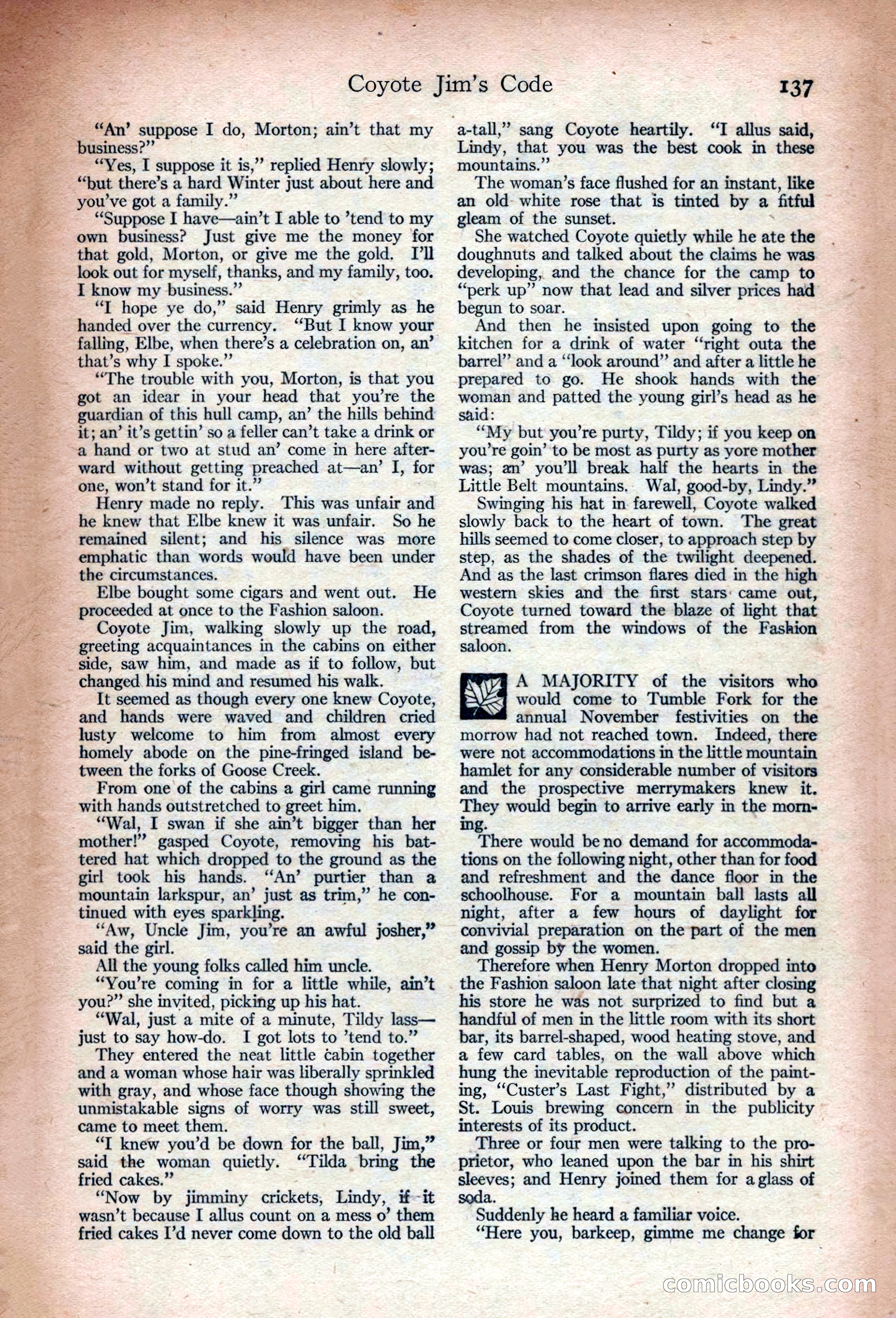
A restored page from Pulp Fiction, 1920. Page through the whole issue in the reader above.
📄 Transcribed text from this page (OCR, searchable)
Machine-transcribed from the original scan — historical spelling and the odd misread are preserved.
own business? Just give me the money for + ie wee 4 suppose it is,’ proceeded at once to the Fashion saloon. ’ replied Henry slowly; “but there’s a hard Winter just about here and B you’ve got a family.” “Suppose I have—ain’t I able to ’tend to my that gold, Morton, or give me the gold, Tl = look out for myself, thanks, and my family, too. I know my business.” “T hope ye do,” said Henry grimly as he handed over the currency. falling, Elbe, when there’ s a celebration on, an’ that’s why I spoke.” “The trouble with you, Morton, is that you got an idear in your head that you're the guardian of this hull camp, an’ the hills behind it; an’ it’s gettin’ soa feller can’t take a drink or i: hand or two at stud an’ come in here after- ward without getting preached at—an’ I, for one, won’t stand for it.’ Henry made no reply. This was unfair and he knew that Elbe knew it was unfair. So he remained silent; and his silence was more ee emphatic than words woufd have been under the circumstances. Elbe bought some cigars and went out. He Coyote Jim, walking slowly up the road, - greeting acquaintances in the cabins on either _ side, saw him, and made as if to follow, but changed. his mind and resumed his walk. It seemed as though every one knew Coyote, at ined: wine wawed” and: chiktten “cried lusty welcome to him from almost every homely abode on the pine-fringed island be- tween the forks of Goose Creek. From one of the cabins a girl came running with hands outstretched to greet him. “Wal, I swan if she ain’t bigger than her mother!” gasped Coyote, removing his bat- tered hat which dropped to the ground as the girl took his hands. ‘An’ purtier than a mountain larkspur, an’ just as trim,” he con- tinued with eyes Sparkling. “Aw, Uncle Jim, you’re an awful josher,” said the girl. All the young folks called him uncle. “You’re coming in for a little while, ain’t you?” she invited, picking up his hat. “Wal, just a mite of a minute, Tildy lass— just to say how-do. I got lots to ’tend to.” They entered the neat little cabin together and a woman whose hair was liberally sprinkled with gray, and whose face though showing the unmistakable signs of worry was still sweet, came to meet them. “T knew you’d be down for the ball, Jim,” said the woman quietly. “Tilda bring the fried cakes.” “Now by jimminy crickets, Lindy, if -it wasn’t because I allus count on a mess o’ them fried cakes I’d never come down to the old ball Coyote Jim’s Code ‘a-tall,” sang Coyote heartily. “But I know your “T allus said, Lindy, that you was the best cook in these mountains.” The woman’s face flushed for an instant, like an old- white rose that is tinted by a fitful gleam of the sunset. She watched Coyote quietly while he ate the doughnuts and talked about the claims he was developing, and the chance for the camp to “perk up” now that lead and silver prices had begun to soar. And then he imsisted upon going to the kitchen for a drink of water “right outa the barrel” and a “look around” and after a little he prepared to go. He shook hands with the — and patted the young girl’s head as he sald: ““My but you’re purty, Tildy; if you keep on you’re goin’ to be most as purty as yore mother was; an’ you'll break half the hearts in the Little Belt mountains. Wal, good-by, Lindy.” Swinging his hat in farewell, Coyote walked slowly back to the heart of town. The great hills seemed to come closer, to approach step by — step, as the shades of the twilight deepened. And as the last crimson flares died in the high western skies and the first stars: came out, Coyote turned toward the blaze of light that streamed from the windows of the Fashion saloon. Ww would come to Tumble Fork for the annual November festivities on the morrow had not reached town. Indeed, there were not accommodations in the little mountain hamlet for any considerable number of visitors and the prospective merrymakers knew it. They would begin to arrive early in the morn- in g. There would beno demand for accommoda- A MAJORITY of the visitors who tions on the following night, other than for food and refreshment and the dance floor in the schoolhouse. For a mountain ball lasts all night, after a few hours of daylight for convivial preparation on the part of the men and gossip by the women. Therefore when Henry Morton dropped into the Fashion saloon late that night after closing his store he was not surprized to find but a handful of men in the little room with its short bar, its barrel-shaped, wood heating stove, and a few card tables, on the wall above which hung the inevitable reproduction of the paint- ing, “Custer’s Last Fight,” distributed by a St. Louis brewing concern in the publicity interests of its product. Three or four men were talking to the pro- prietor, who leaned upon the bar in his shirt sleeves; and Henry joined them for aglass of soda. Suddenly he heard a familiar voice. “Here you, barkeep, gimme me change for S CORMIC OOO (C@ . hia gs, % F t fia ba Me Gal ii ay, rit ‘ Liat 7% POY ad, > Lae Te te Tre Tee <a : me Ae -* ~ ~. 4y an Xa uk es