
Pulp Fiction, 1920 · page 160 of 172
Adventure Magazine Cover — page 160: what you’re looking at
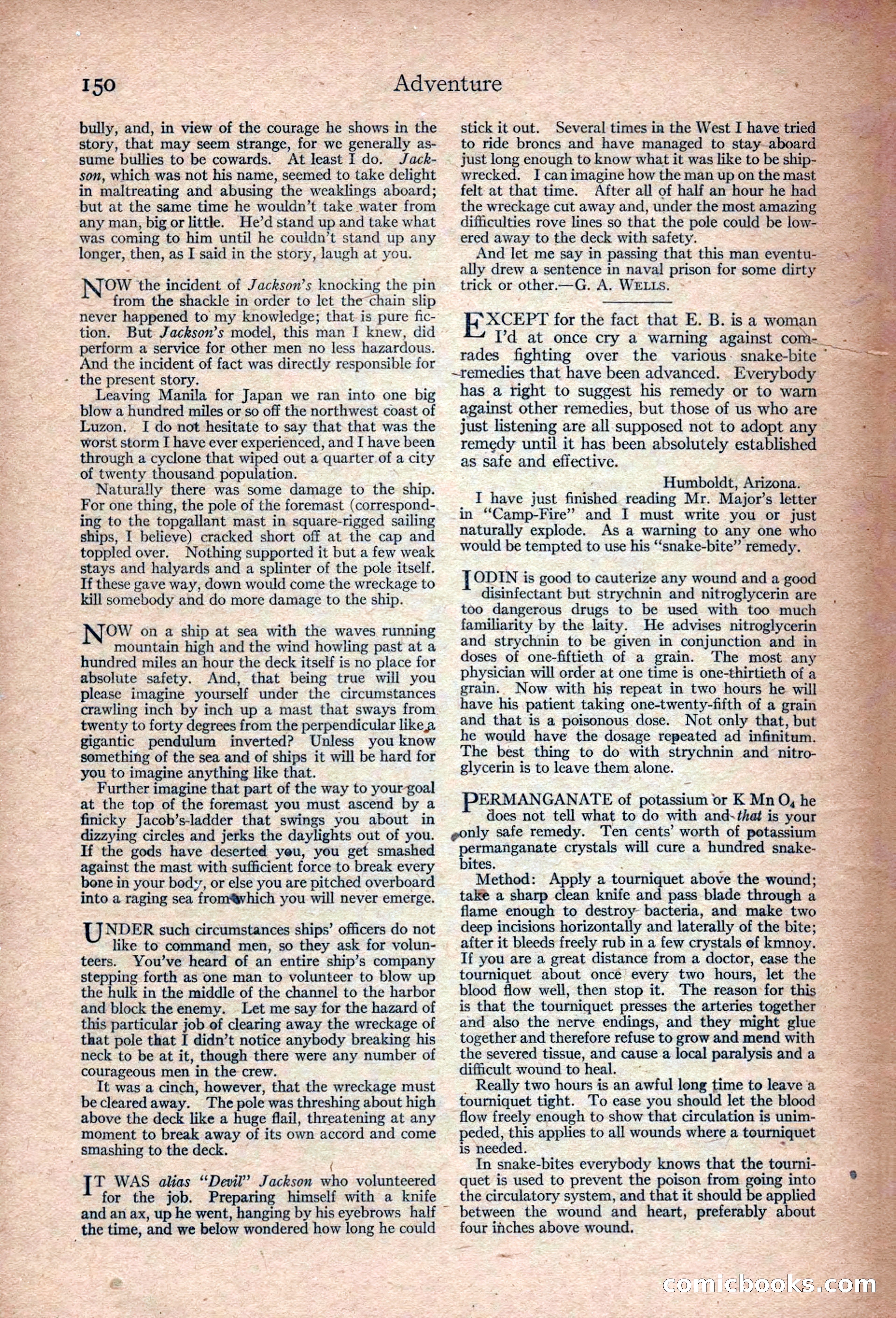
A restored page from Pulp Fiction, 1920. Page through the whole issue in the reader above.
📄 Transcribed text from this page (OCR, searchable)
Machine-transcribed from the original scan — historical spelling and the odd misread are preserved.
150 St bully, and, in view of the courage he shows in the story, that may seem strange, for we generally as- sume bullies to be cowards. Atleast I do. Jack- son, which was not his name, seemed to take delight in maltreating and abusing the weaklings aboard; -but at the same time he wouldn’t take water from — any man, big or little. He’d stand up and take what was coming to him until he couldn’t stand up any longer, then, as I said in the story, laugh at you. Now the incident of Jackson’s igckate the pin from the shackle in order to let the chain slip never happened to my knowledge; that-is pure fic- tion. But Jackson’s model, this man I knew, did perform a service for other men no less hazardous. And the incident of fact was directly responsible for the present story. Leaving Manila for Japan we ran into one big blow a hundred miles or so off the northwest coast of Luzon. I do not hesitate to say that that was the - worst storm I have ever experienced, and I have been through a cyclone that wiped out a quarter of a city _ of twenty thousand population. Naturally there was some damage to the ship. For one thing, the pole of the foremast (correspond-. ing to the topgallant mast in square-rigged sailing ships, I believe) cracked short off at the cap and toppled over. Nothing supported it but a few weak stays and halyards and a splinter of the pole itself. If these gave way, down would come the wreckage to kill somebody and do more damage to the ship. - Now on a ship at sea with the waves running mountain high and the wind howling past at a hundred miles an hour the deck itself is no place for absolute safety. And, that being true will you please imagine yourself under the circumstances crawling inch by inch up a mast that sways from. twenty to forty degrees from the perpendicular like a gigantic pendulum inverted? Unless you know something of the sea and of ships it will be hard for you to imagine anything like that. Further imagine that part of the way to your goal at the top of the foremast you must ascend by a finicky Jacob’s-ladder that swings you about in dizzying circles and jerks the daylights out of you. If the gods have deserted yeu, you get smashed against the mast with sufficient force to break every bone in your body, or else you are pitched overboard into a raging sea from®vhich you will never emerge. UNDER such circumstances ships’ officers do not like to command men, so they ask for volun- teers. You’ve heard of an entire ship’s company ee ing forth as one man to volunteer to blow up ig eae in the middle of the channel to the harbor Ao block the enemy. Let me say for the hazard of this particular job of clearing away the wreckage of that pole that I didn’t notice anybody breaking his neck to be at it, though there were any number of courageous men in the crew. It was a cinch, however, that the wreckage must be cleared away. The pole was threshing about high above the deck like a huge flail, threatening at any moment to break away of its own accord and come : smashing to the deck. : ( ie WAS alias ‘Devil’? Jackson who volunteered for the job. Preparing himself with a knife and an ax, up he went, hanging by his eyebrows half — 5 the time, and we below wondered how long he could Adventure | ~remedies that have been advanced. Everybody gonly safe remedy. ‘together and therefore refuse to grow and mend with stick it out. " Several-times in the West I face tried to ride broncs and have managed to stay-a just long enough to know what it was like to be ship- wrecked. I canimagine how the man uponthemast — felt at that time. After all of half an hour he had ~ the wreckage cut away and, under the most amazing — difficulties rove lines so that the pole could be low- ered away to the deck with safety. And let me say in passing that this man eventu-— ally drew a sentence in naval prison for some dint = trick or other.—G. A. WELLS. = XCEPT for the fact that E. B. is a woman I’d_ at once cry a warning against cor rades fighting over the various- snake-bite © has a right to suggest his remedy or to warn against other remedies, but those of us who are just listening are all. supposed not to adopt any — remedy until it has been absolutely established as safe and effective. Humboldt, Astvonaes Seg I have just fstidied reading Mr. Major’ s letter = in “Camp-Fire”’ and I must write you or just — naturally explode. As a warning to any one who — would be tempted to use his “‘snake-bite” remedy. — TODIN i is good to cauterize any wound and a pode disinfectant but strychnin and nitroglycerin are too dangerous drugs to be used with too much. familiarity by the laity. He advises nitroglycerin — and strychnin to be given in conjunction and in doses of one-fiftieth of a grain. The most any physician will order at one time is one-thirtieth ofa grain. Now with his repeat in two hours he will have his patient taking one-twenty-fifth of a grain and that is a poisonous dose. Not only that, but he would have the dosage repeated ad infinitum. The best thing to do with strychnin and nitro-— glycerin is to leave them alone. PERMAN GANATE of potassium’ or K Mn O, he does not tell what to do with and-that is your Ten cents’ worth of potassium permanganate crystals will cure a hundred snake- bites. . Method: Apply a tourniquet above the wound; take a sharp clean knife and pass blade through a flame enough to destroy bacteria, and make two ~ deep incisions horizontally and laterally of the bite; after it bleeds freely rub in a few crystals of kmnoy. If you are a great distance from a doctor, ease the tourniquet about once every two hours, let the blood flow well, then stop it. The reason for this is that the tourniquet presses the arteries together . and also the nerve endings, and they might glue the severed tissue, and cause a local paralysis anda — difficult wound to heal. ~~ Really two hours is an awful long time to leave a tourniquet tight. To ease you should let the blood flow freely enough to show that circulation is unim- peded, this applies to all wounds where a tourniquet is needed. tg In snake-bites everybody knows that the tourni-_ quet is used to prevent the poison from going into the circulatory system, and that it should e applied between the wound and heart, preferably abst’ four inches above siege ee CONNIE OOOL<