
Pulp Fiction, 1920 · page 161 of 172
Adventure Magazine Cover — page 161: what you’re looking at
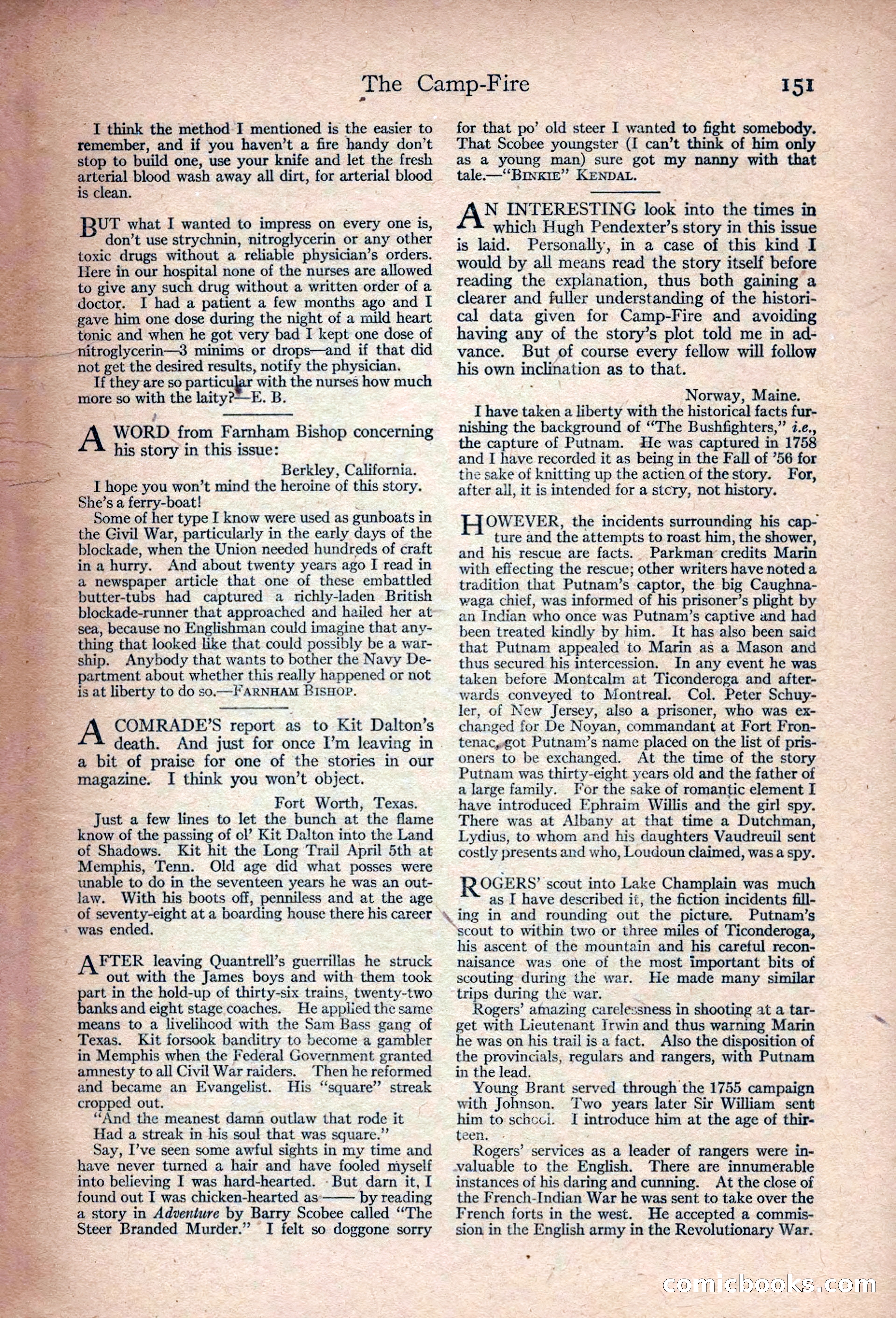
A restored page from Pulp Fiction, 1920. Page through the whole issue in the reader above.
📄 Transcribed text from this page (OCR, searchable)
Machine-transcribed from the original scan — historical spelling and the odd misread are preserved.
Se I think the method I mentioned is the easier to remember, and if you haven’t a fire handy don’t ______ stop to build one, use your knife and let the fresh erial blood wash away all dirt, for arterial blood ~~ don’t use strychnin, nitroglycerin or any other toxic drugs without a reliable physician’s orders. _ Here in our hospital none of the nurses are allowed to give any such drug without a written order of a doctor. I had a patient a few months ago and I gave him one dose during the night of a mild heart tonic and when he got very bad I kept one dose of nitroglycerin—3 minims or drops—and if that did - not get the desired results, notify the physician. If they are so parti with the nurses how much _ more so with the laity?-—FE. B. Pee Berkley, California. _ T hope you won’t mind the heroine of this story. _ She’s a ferry-boat! : Some of her type I know were used as gunboats in - the Givil War, particularly in the early days of the blockade, when the Union needed hundreds of craft _jinahurry. And about twenty years ago I read in a newspaper article that one of these embattled butter-tubs had captured a richly-laden British _ blockade-runner that approached and hailed her at sea, because no Englishman could imagine that any- thing that looked like that could possibly be a war- ship. Anybody that wants to bother the Navy De- _ partment about whether this really happened or not _ is at liberty to do so.—F ARNHAM BisHop. ‘ ; eee ee WORD from Farnham Bishop concerning his story in this issue: = COMRADE?’S report as to Kit Dalton’s a bit of praise for one of the stories in our _ magazine. I think you won’t object. | Fort Worth, Texas. Just a few lines to let the bunch at the flame _ know of the passing of ol’ Kit Dalton into the Land of Shadows. Kit hit the Long Trail April 5th at Memphis, Tenn. Old age did what posses were unable to do in the seventeen years he was an out- law. With his boots off, penniless and at the age of seventy-eight at a boarding house there his career +» was ended. i AFTER leaving Quantrell’s guerrillas he struck ~*~ out with the James boys and with them took art in the hold-up of thirty-six trains, twenty-two anks and eight stage coaches. He applied the same means to a livelihood with the Sam Bass gang of + Texas. Kit forsook banditry to become a gambler in Memphis when the Federal Government granted amnesty to all Civil War raiders. Then he reformed ; and became an Evangelist. His “‘square” streak cropped out. “And the meanest damn outlaw that rode it Had a streak in his soul that was square.” Say, I’ve seen some awful sights in my time and have never turned a hair and have fooled myself into believing I was hard-hearted. - But darn it, I found out I was chicken-hearted as——— by reading a story in Adventure by Barry Scobee called “The Steer Branded Murder.” © I felt so doggone sorry The -Camp-Fire _iBRur what I wanted to impress on every one is, death. And just for once I’m leaving in . for that po’ old steer I wanted to fight some % That Scobee youngster (I can’t think of him only as a young man) sure got my nanny with that tale—“Brvkie”’ KENDAL. N INTERESTING look into the times in which Hugh Pendexter’s story in this issue is laid. Personally, in a case of this kind I would by all means read the story itself before reading the explanation, thus both gaining a clearer and fuller understanding of the histori- cal data given for Camp-Fire and avoiding having any of the story’s plot told me in ad- vance. But of course every fellow will follow his own inclination as to that. | Norway, Maine. I have taken a liberty with the historical facts fur- nishing the background of ‘“The Bushfighters,” 7.e., the capture of Putnam. He was captured in 1758 and I have recorded it as being in the Fall of 756 for the sake of knitting up the action of the story. For, after all, it is intended for a stcry, not history. HOWEVER, the incidents surrounding his cap- ture and the attempts to roast him, the shower, and his rescue are facts. Parkman credits Marin with effecting the rescue; other writers have noted a tradition that Putnam’s captor, the big Caughna- waga chief, was informed of his prisoner’s plight by an Indian who once was Putnam’s captive and had been treated kindly by him. It has also been said that Putnam appealed to Marin as a Mason and thus secured his intercession. In any event he was taken before Montcalm at Ticonderoga and after- wards conveyed to Montreal. Col. Peter Schuy- ler, of New Jersey, also a prisoner, who was ex- changed for De Noyan, commandant at Fort Fron- tenac,ot Putnam’s name placed on the list of pris- oners to be exchanged. At the time of the story Putnam was thirty-eight years old and the father of a large family. For the sake of romantic element I have introduced Ephraim Willis and the girl spy. There was at Albany at that time a Dutchman, Lydius, to whom and his daughters Vaudreuil sent costly presents and who, Loudoun claimed, was a spy. ROGERS’ scout into Lake Champlain was much as I have described it, the fiction incidents fill- \.ing in and rounding out the picture. Putnam’s “scout to within two or three miles of Ticonderoga, his ascent of the mountain and his careful recon- naisance was one of the most important bits of scouting during the war. He made many similar trips during the war. | Rogers’ amazing carelessness in shooting at a tar- get with Lieutenant Irwin and thus warning Marin he was on his trail is a fact. Also the disposition of the provincials, regulars and rangers, with Putnam in the lead. Young Brant served through the 1755 campaign with Johnson. T'wo years later Sir William sent him to schcci. I introduce him at the age of thir- teen, Rogers’ services as a leader of rangers were in- valuable to the English. There are innumerable instances of his daring and cunning. At the close of the French-Indian War he was sent to take over the French forts in the west. He accepted a commis- sion in the English army in the Revolutionary War. CORICLOO© (C Sj 151 (E@