
Pulp Fiction, 1920 · page 13 of 172
Adventure, December 3, 1920 — page 13: what you’re looking at
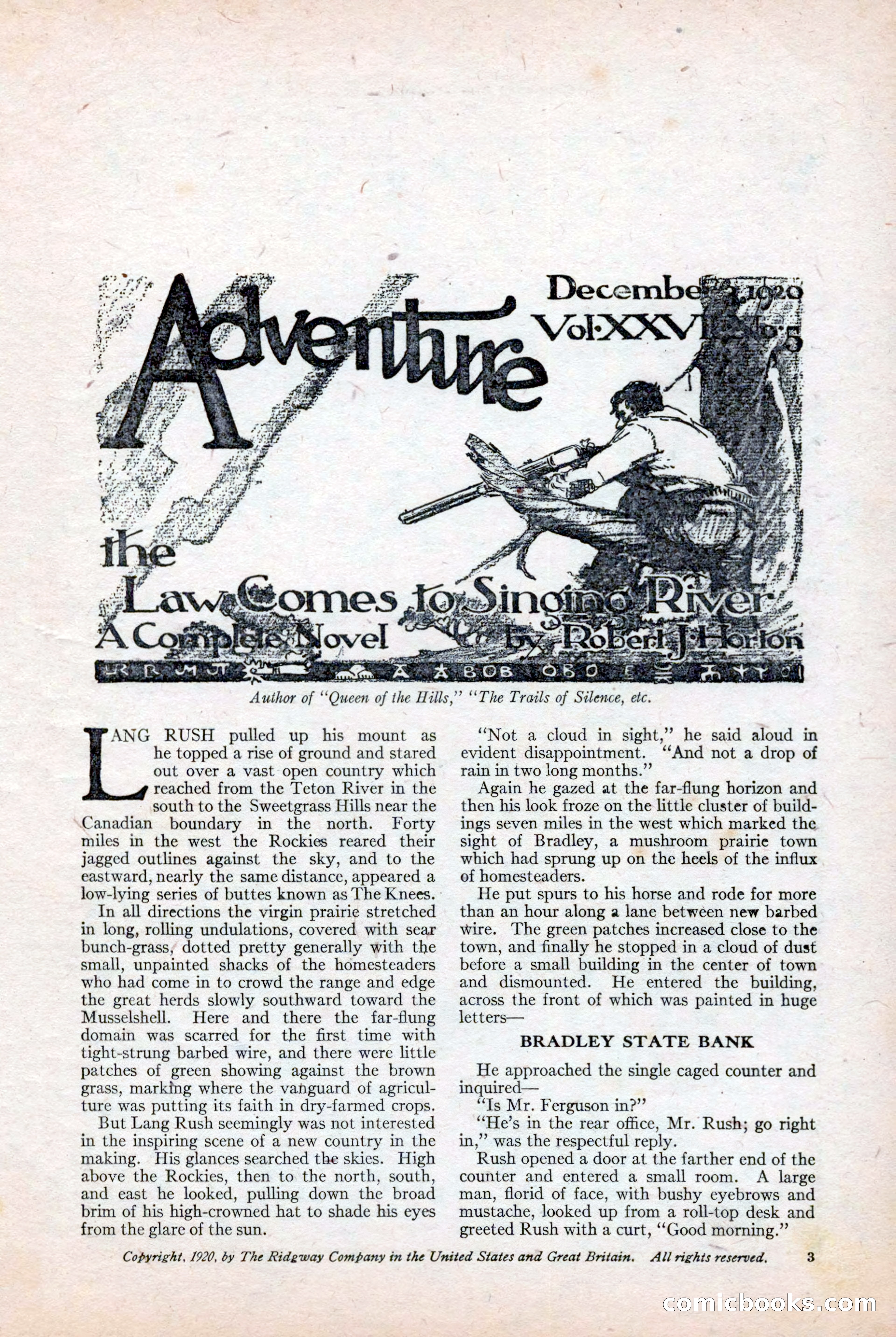
A restored page from Pulp Fiction, 1920. Page through the whole issue in the reader above.
📄 Transcribed text from this page (OCR, searchable)
Machine-transcribed from the original scan — historical spelling and the odd misread are preserved.
acs LIL WAR MIT {Pa let arple a Jovel “ “<a ~ SO ire "9 5 Pe eee) “ate or “nS 7 2% “SOB Author of Caaon of the Hills,” “‘The Trails of Silence, etc. ANG RUSH pulled up his mount as he topped a rise of ground and stared out over a vast open country which reached from the Teton River in the south to the Sweetgrass Hills near the Canadian boundary in the north. Forty miles in the west the Rockies reared their jagged outlines against the sky, and to the eastward, nearly the same distance, appeared a low-lying series of buttes known as The Knees. In all directions the virgin prairie stretched in long, rolling undulations, covered with sear bunch-grass, dotted pretty generally with the small, unpainted shacks of the homesteaders who had come in to crowd the range and edge the great herds slowly southward toward the Musselshell. Here and there the far-flung domain was scarred for the first time with tight-strung barbed wire, and there were little patches of green showing against the brown grass, marking where the vanguard of agricul- ture was putting its faith in dry-farmed crops. But Lang Rush seemingly was not interested in the inspiring scene of a new country in the making. His glances searched the skies. High above the Rockies, then to the north, south, and east he looked, pulling down the broad brim of his high-crowned hat to shade his eyes from the glare of the sun. Copyright, 1920, by The Ridgway Company in the United States and Great Britain. “Not a cloud in sight,” he said aloud in evident disappointment. “And not a drop of rain in two long months.” Again he gazed at the far-flung horizon and then his look froze on the little cluster of build- ings seven miles in the west which marked the sight of Bradley, a mushroom prairie town which had sprung up on the heels of the influx of homesteaders. He put spurs to his horse and rode for more than an hour along a lane between new barbed wire. The green patches increased close to the town, and finally he stopped in a cloud of dust before a small building in the center of town and dismounted. He entered the building, across the front of which was painted in huge letters— BRADLEY STATE BANK He approached the single caged counter and inquired— “Is Mr. Ferguson in?” nee s in the rear office, Mr. Rush; go right was the respectful reply. ” Rash opened a door at the farther end of the counter and entered a small room. A large man, florid of face, with bushy eyebrows and mustache, looked up from a roll-top desk and greeted Rush with a curt, ‘““Good morning.” All righis reserved, 3 (EO) 0)(0)(6) AMG (C@