
Pulp Fiction, 1920 · page 14 of 172
Adventure, December 3, 1920 — page 14: what you’re looking at
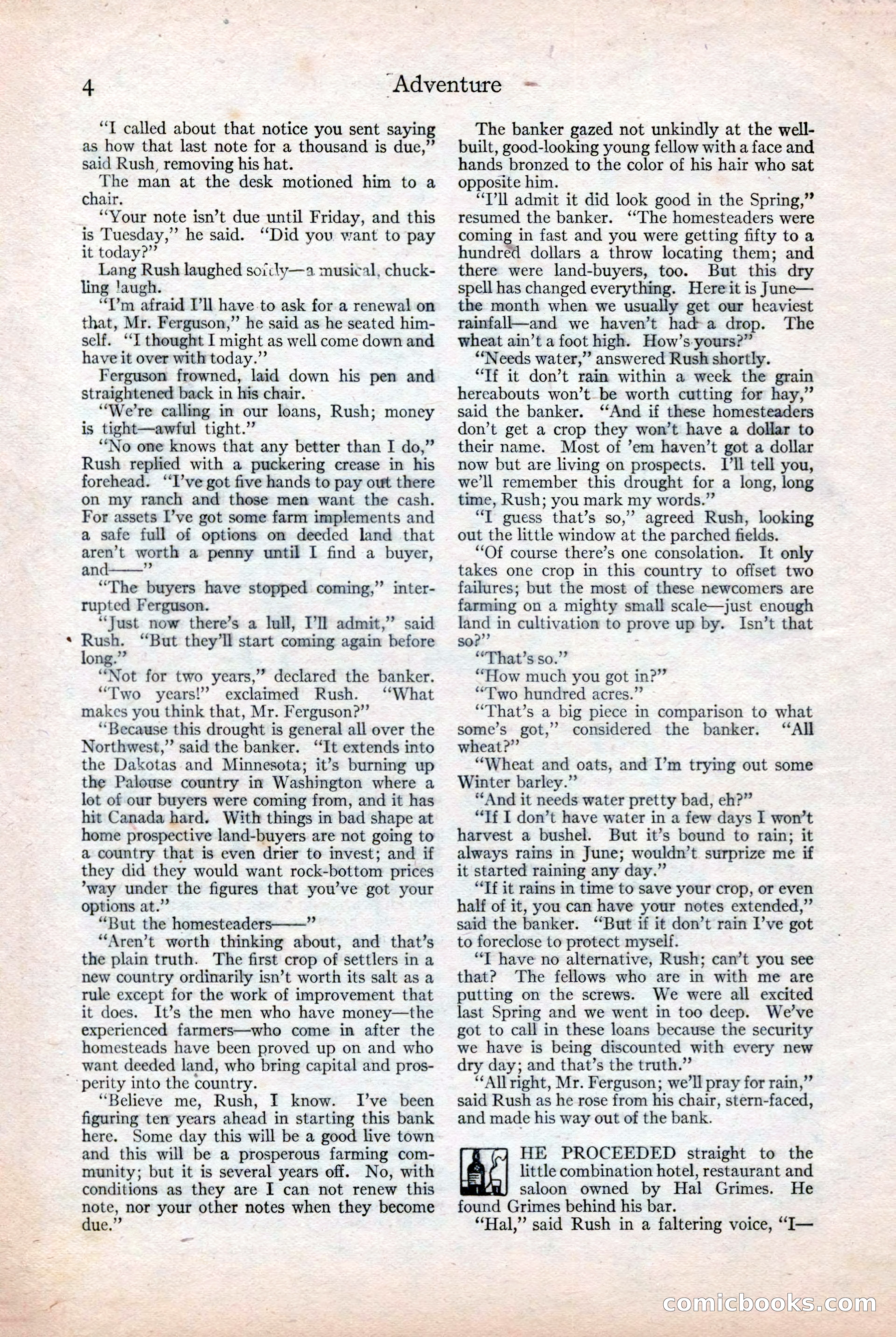
A restored page from Pulp Fiction, 1920. Page through the whole issue in the reader above.
📄 Transcribed text from this page (OCR, searchable)
Machine-transcribed from the original scan — historical spelling and the odd misread are preserved.
4. Adventure = “I called about that notice you sent saying as how that last note for a thousand is due,” said Rush, removing his hat. The man at the desk motioned him to a chair. “Your note isn’t due until Friday, and this is Tuesday,” he said. “Did you want to pay it today?” Lang Rush laughed soic:!y—a musical, chuck- ling 'augh. “T’m afraid V’ll have to ask for a renewal on that, Mr. Ferguson,” he said as he seated him- self. ‘I thought I might as well come down and have it over with today.” Ferguson frowned, laid down his pen and straightened back in his chair. “We're calling in our loans, Rush; money is tight—awful tight.” ‘“‘No one knows that any better than I do,” Rush replied with a puckering crease in his forehead. “I’ve got five hands to pay owt there on my ranch and those men want the cash. For assets I’ve got some farm implements and a safe full of options on deeded land that aren’t worth a penny until I find a buyer, and——” “The buyers have stopped coming,” inter- rupted Ferguson. “Just now there’s a lull, I'll admit,” said Rush. “But they'll start coming again before long.” “Not for two years,” declared the banker. “Two years!” exclaimed Rush. ‘What makes you think that, Mr. Ferguson?” ‘Because this drought is general all over the Northwest,” said the banker. “It extends into the Dakotas and Minnesota; it’s burning up the Palouse country in Washington where a lot of our buyers were coming from, and it has hit Canada hard. With things in bad shape at home prospective land-buyers are not going to a country that is even drier to invest; and if they did they would want rock-bottom prices ’way under the figures that you’ve got your options at.” “But the homesteaders——” ““Aren’t worth thinking about, and that’s the plain truth. The first crop of settlers in a new country ordinarily isn’t worth its salt as a rule except for the work of improvement that it does. It’s the men who have money—the experienced farmers—who come in after the homesteads have been proved up on and who _ want deeded land, who bring capital and pros- ‘perity into the country. “Believe me, Rush, I know. I’ve been figuring ten years ahead in starting this bank here. Some day this will be a good live town and this will be a prosperous farming com- munity; but it is several years off. No, with conditions as they are I can not renew this eg nor your other notes when they become ue.’ ~ The banker gazed not unkindly at the well- built, good-looking young fellow with a face and hands bronzed to the color of his hair who sat opposite him. “ll admit it did look good in the Spring,” resumed the banker. ‘The homesteaders were coming in fast and you were getting fifty to a hundred dollars a throw locating them; and there were land-buyers, too. But this dry spell has changed everything. Here it is June— the month when we usually get our heaviest rainfallt—and we haven’t hada drop. The wheat ain’t a foot high. How’s:yours?” “Needs water,” answered Rush shortly. “Tf it don’t rain within a week the grain hereabouts won’t be worth cutting for hay,’ said the banker. ‘‘And if these homesteaders don’t get a crop they won’t have a dollar to their name. Most of ’em haven’t got a dollar now but are living on prospects. I'll tell you, we'll remember this drought for a long, long time, Rush; you mark my words.” “T guess that’s so,’ agreed Rush, looking out the little window at the parched fields. “Of course there’s one consolation. It only takes one crop in this country to offset two failures; but the most of these newcomers are farming on a mighty small scale—just enough land in cultivation to prove up by. Isn’t that so?”’ 2 ““That’s so.” “How much you got in?” “Two hundred acres.” “That’s a big piece in comparison to what some’s got,” considered the banker. ‘All wheat?” “Wheat and oats, and I’m trying out some Winter barley.” “And it needs water pretty bad, eh?” “Tf I don’t have water in a few days I won't harvest a bushel. But it’s bound to rain; it always rains in June; wouldn’t surprize me if it started raining any day.” “Tf it rains in time to save your crop, or even half of it, you can have your notes extended,” said the banker. “But if it don’t rain I’ve got to foreclose to protect myself. “T have no alternative, Rush; can’t you see that? The fellows who are in with me are putting on the screws. We were all excited last Spring and we went in too deep. We’ve got to call in these loans because the security we have is being discounted with every new dry day; and that’s the truth.” “Allright, Mr. Ferguson; we'll pray for rain,” said Rush as he rose from his chair, stern-faced, and made his way out of the bank. f (J HE PROCEEDED straight to the Ay little combination hotel, restaurant and ar an found Grimes behind his bar. saloon owned by Hal Grimes. He “Hal,” said Rush in a faltering voice, “I— EORNICLOO© (C@)