
Pulp Fiction, 1920 · page 134 of 172
Adventure, December 3, 1920 — page 134: what you’re looking at
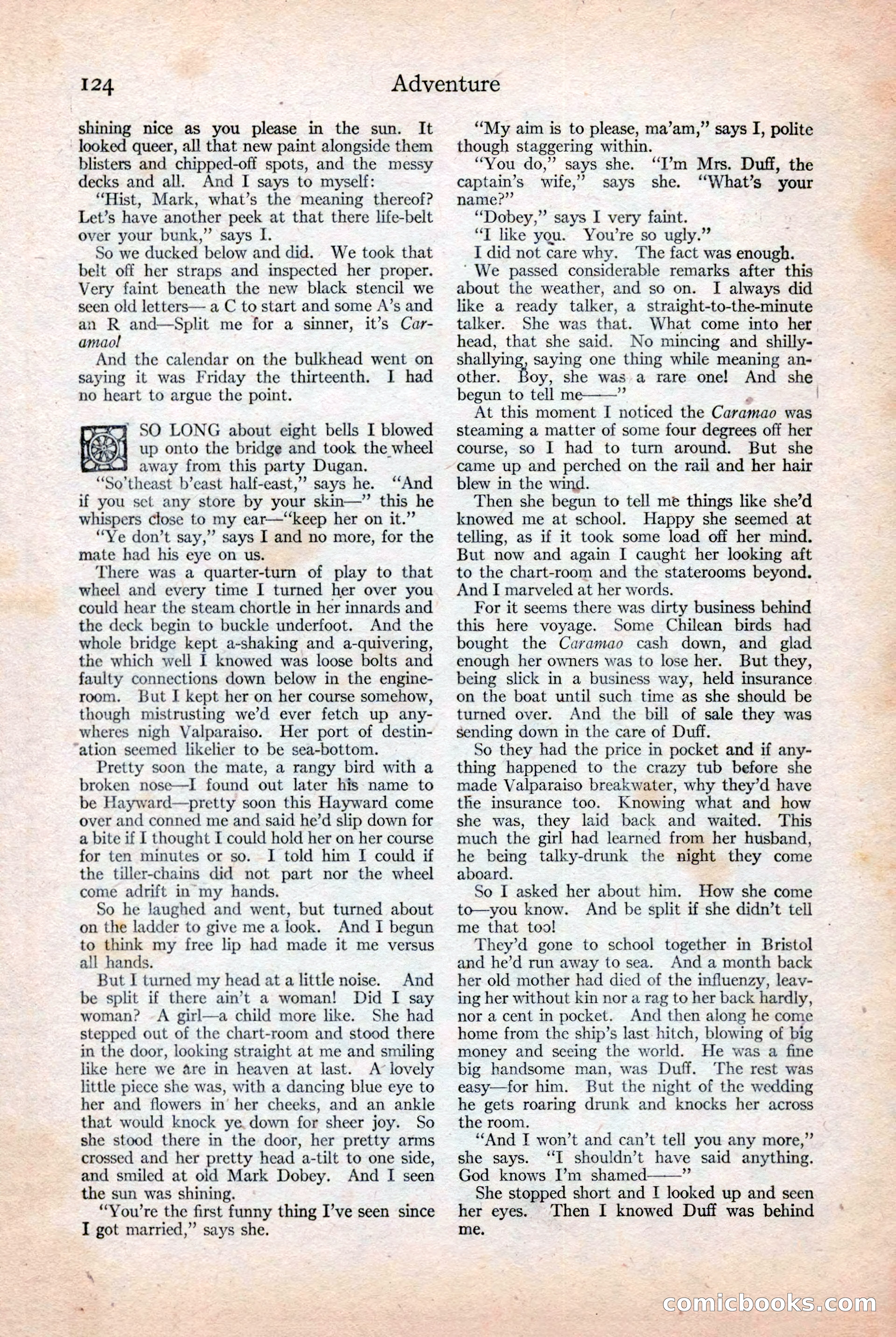
A restored page from Pulp Fiction, 1920. Page through the whole issue in the reader above.
📄 Transcribed text from this page (OCR, searchable)
Machine-transcribed from the original scan — historical spelling and the odd misread are preserved.
124 shining nice as you please in the sun. It looked queer, all that new paint alongside them blisters and chipped-off spots, and the messy decks and all. And I says to myself: “Hist, Mark, what’s the meaning thereof? Let’s have another peek at that there life-belt over your bunk,” says I. So we ducked below and did. We took that belt off her straps and inspected her proper. Very faint beneath the new black stencil we seen old letters— a C to start and some A’s and an R and—Split me for a sinner, it’s Car- amaol And the calendar on the bulkhead went on saying it was Friday the thirteenth. I had no heart to argue the point. eyaey_ SO LONG about eight bells I blowed iGee up onto the bridge and took the wheel Cr away from this party Dugan. “So’theast b’east half-east,” says he. “And if you set any store by your skin—” this he whispers close to my ear—‘‘keep her on it.” “Ye don’t say,” says I and no more, for the mate had his eye on us. There was a quarter-turn of play to that wheel and every time I turned her over you could hear the steam chortle in her innards and the deck begin to buckle underfoot. And the whole bridge kept a-shaking and a-quivering, the which well I knowed was loose bolts and faulty connections down below in the engine- room. But I kept her on her course somehow, though mistrusting we’d ever fetch up any- wheres nigh Valparaiso. Her port of destin- “ation seemed likelier to be sea-bottom. Pretty soon the mate, a rangy bird with a broken nose—I found out later his name to be Hayward—pretty soon this Hayward come over and conned me and said he’d slip down for a bite if I thought I could hold her on her course for ten minutes or so. I told him I could if the tiller-chains did not part nor the wheel come adrift in my hands. So he laughed and went, but turned about on the ladder to give me a look. And I begun to think my free lip had made it me versus all hands. But I turned my head at a little noise. And be split if there ain’t a woman! Did I say woman? -A girl—a child more like. She had stepped out of the chart-room and stood there in the door, looking straight at me and smiling like here we are in heaven at last. A’ lovely little piece she was, with a dancing blue eye to her and flowers in’ her cheeks, and an ankle that would knock ye. down for sheer joy. So she stood there in the door, her pretty arms crossed and her pretty head a-tilt to one side, and smiled at old Mark Dobey. And I seen the sun was shining. “You’re the first funny thing I’ve seen since I got married,” says she. Adventure “My aim is to please, ma’am,” says I, polite though staggering within. “You do,” says she. “I’m Mrs. Duff, the captain’s wife,” says she. “What’s your name?” “Dobey,” says I very faint. “I like you. You’re so ugly.” I did not care why. The fact was enough. ‘We passed considerable remarks after this about the weather, and so on. I always did like a ready talker, a straight-to-the-minute talker. She was that. What come into her head, that she said. No mincing and shilly- shallying, saying one thing while meaning an- other. Boy, she Was a rare one! And ane; begun to tell me——” At this moment I noticed the Caramao was steaming a matter of some four degrees off her course, so I had to turn around. But she came up and perched on the rail and her hair blew in the wind. Then she begun to tell me things like she’d knowed me at school. Happy she seemed at telling, as if it took some load off her mind. But now and again I caught her looking aft to the chart-room and the staterooms beyond. And I marveled at her words. For it seems there was dirty business behind this here voyage. Some Chilean birds had bought the Caramao cash down, and glad enough her owners was to lose her. But they, being slick in a business way, held insurance on the boat until such time as she should be turned over. And the bill of sale they was sending down in the care of Duff. So they had the price in pocket and if any- thing happened to the crazy tub before she made Valparaiso breakwater, why they’d have the insurance too. Knowing what and how she was, they laid back and waited. This much the girl had learned from her husband, he being talky-drunk the night they come aboard. So I asked her about him. How she come to—you know. And be split if she didn’t tell me that too! They’d gone to school together in Bristol and he’d run away to sea. And a month back her old mother had died of the influenzy, leav- ing her without kin nor a rag to her back hardly, nor a cent in pocket. And then along he come home from the ship’s last hitch, blowing of big money and seeing the world. He was a fine big handsome man, was Duff. The rest was easy—for him. But the night of the wedding he gets roaring drunk and knocks her across the room. ‘‘And I won’t and can’t tell you any more,” she says. ‘I shouldn’t have said anything. God knows I’m shamed a She stopped short and I looked up and seen her eyes. Then I knowed Duff was behind me. COMIC OOLKS 5 (E@)