
Pulp Fiction, 1920 · page 135 of 172
Adventure, December 3, 1920 — page 135: what you’re looking at
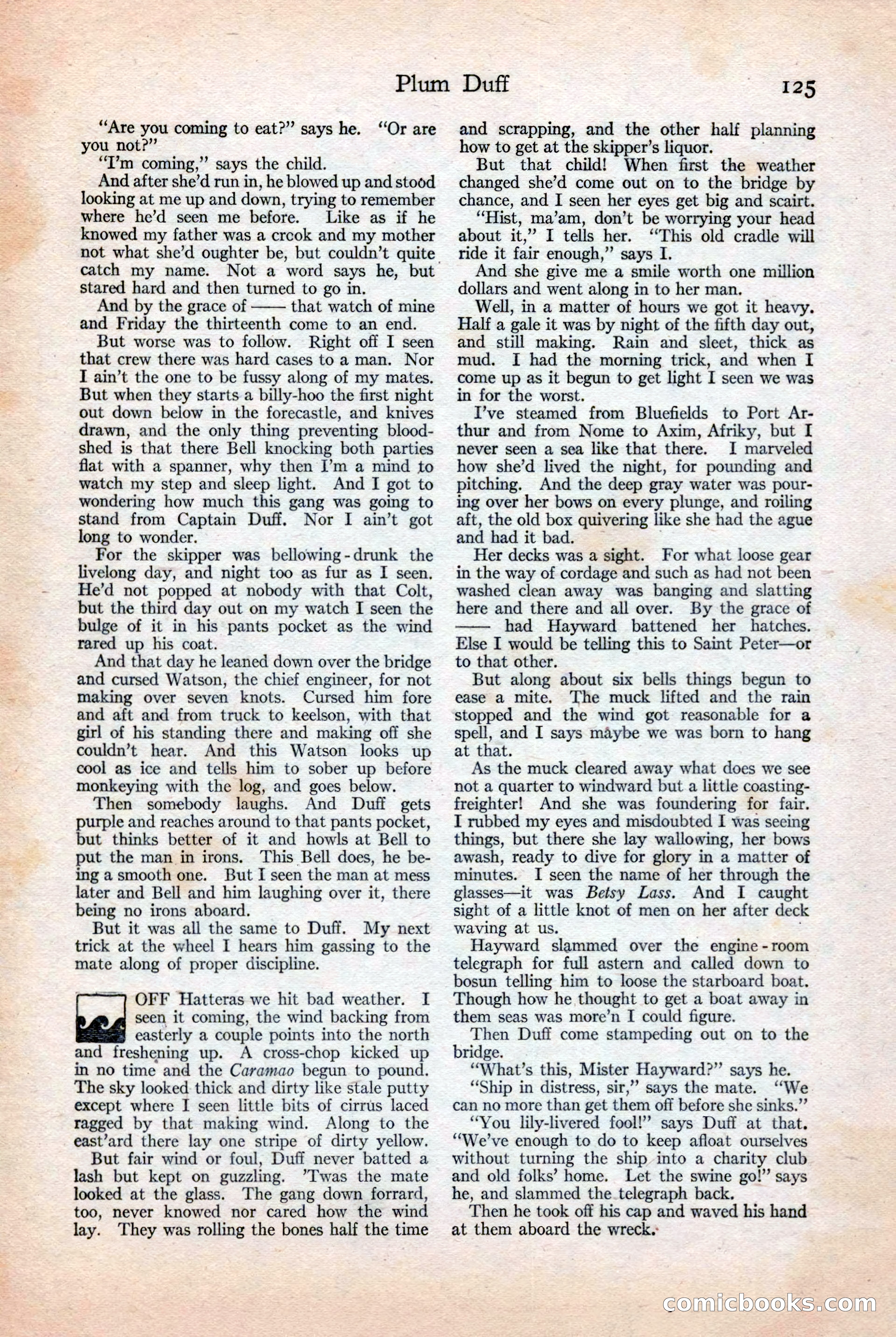
A restored page from Pulp Fiction, 1920. Page through the whole issue in the reader above.
📄 Transcribed text from this page (OCR, searchable)
Machine-transcribed from the original scan — historical spelling and the odd misread are preserved.
A . SS) : ' Plum Duff “Are you coming to eat?” says he. “Or are you not?” “T’m coming,” says the child. And after she’d run in, he blowed up and stood looking at me up and down, trying to remember where he’d seen me before. Like as if he knowed my father was a crcok and my mother not what she’d oughter be, but couldn’t quite catch my name. stared hard and then turned to go in. And by the grace of —— that watch of mine and Friday the thirteenth come to an end. But worse was to follow. Right off I seen that crew there was hard cases to a man. Nor I ain’t the one to be fussy along of my mates. But when they starts a billy-hoo the first night out down below in the forecastle, and knives drawn, and the only thing preventing blood- shed is that there Bell knocking both parties flat with a spanner, why then I’m a mind to watch my step and sleep light. And I got to wondering how much this gang was going to stand from Captain Duff. Nor I ain’t got long to wonder. For the skipper was bellowing-drunk the livelong day, and night too as fur as I seen. He’d not popped at nobody with that Colt, but the third day out on my watch I seen the bulge of it in his pants pocket as the wind rared up his coat. And that day he leaned down over the bridge and cursed Watson, the chief engineer, for not making over seven knots. Cursed him fore and aft and from truck to keelson, with that girl of his standing there and making off she couldn’t hear. And this Watson looks up cool as ice and tells him to sober up before monkeying with the log, and goes below. Then somebody laughs. And Duff gets purple and reaches around to that pants pocket, but thinks better of it and howls at Bell to put the man in irons. This Bell does, he be- ing a smooth one. But I seen the man at mess later and Bell and him laughing over it, there being no irons aboard. But it was all the same to Duff. My next trick at the wheel I hears him gassing to the mate along of proper discipline. OFF Hatteras we hit bad weather. I seen it coming, the wind backing from § easterly a couple points into the north and freshening up. A cross-chop kicked up in no time and the Caramao begun to pound. The sky looked thick and dirty like stale putty except where I seen little bits of cirrus laced ragged by that making wind. Along to the east’ard there lay one stripe of dirty yellow. But fair wind or foul, Duff never batted a lash but kept on guzzling. “T'was the mate looked at the glass. The gang down forrard, too, never knowed nor cared how the wind lay. They was rolling the bones half the time Not a word says he, but 125 and scrapping, and the other half planning how to get at the skipper’s liquor. But that child! When first the weather changed she’d come out on to the bridge by chance, and I seen her eyes get big and scairt. “Hist, ma’am, don’t be worrying your head about it,” I tells her. “This old cradle will ride it fair enough,” says I, And she give me a smile worth one million dollars and went along in to her man. Well, in a matter of hours we got it heavy. Half a gale it was by night of the fifth day out, and still making. Rain and sleet, thick as mud. I had the morning trick, and when I come up as it begun to get light I seen we was in for the worst. I’ve steamed from Bluefields to Port Ar- thur and from Nome to Axim, Afriky, but I never seen a sea like that there. I marveled how she’d lived the night, for pounding and pitching. And the deep gray water was pour- ing over her bows on every plunge, and roiling aft, the old box quivering like she had the ague and had it bad. Her decks was a sight. For what loose gear in the way of cordage and such as had not been washed clean away was banging and slatting here and there and all over. By the grace of ad Hayward battened her hatches. Else I would be telling this to Saint Peter—or to that other. But along about six bells things begun to ease a mite. The muck lifted and the rain stopped and the wind got reasonable for a spell, and I says maybe we was born to hang at that. As the muck cleared away what does we see not a quarter to windward but a little coasting- freighter! And she was foundering for fair. I rubbed my eyes and misdoubted I was seeing things, but there she lay wallowing, her bows awash, ready to dive for glory in a matter of minutes. I seen the name of her through the glasses—it was Betsy Lass. And I caught sight of a little knot of men on her after deck waving at us. Hayward slammed over the engine - room telegraph for full astern and called down to bosun telling him to loose the starboard boat. Though how he thought to get a boat away in them seas was more’n I could figure. Then Duff come stampeding out on to the bridge. “What’s this, Mister Hayward?” says he. “Ship in distress, sir,” says the mate. “We can no more than get them off before she sinks.”’ “You lily-livered fool!” says Duff at that. “We've enough to do to keep afloat ourselves without turning the ship into a charity club and old folks’ home. Let the swine go!” says he, and slammed the.telegraph back. Then he took off his cap and waved his hand at them aboard the wreck. GOmicbdooks (EO)