
Pulp Fiction, 1920 · page 68 of 172
Adventure, December 3, 1920 — page 68: what you’re looking at
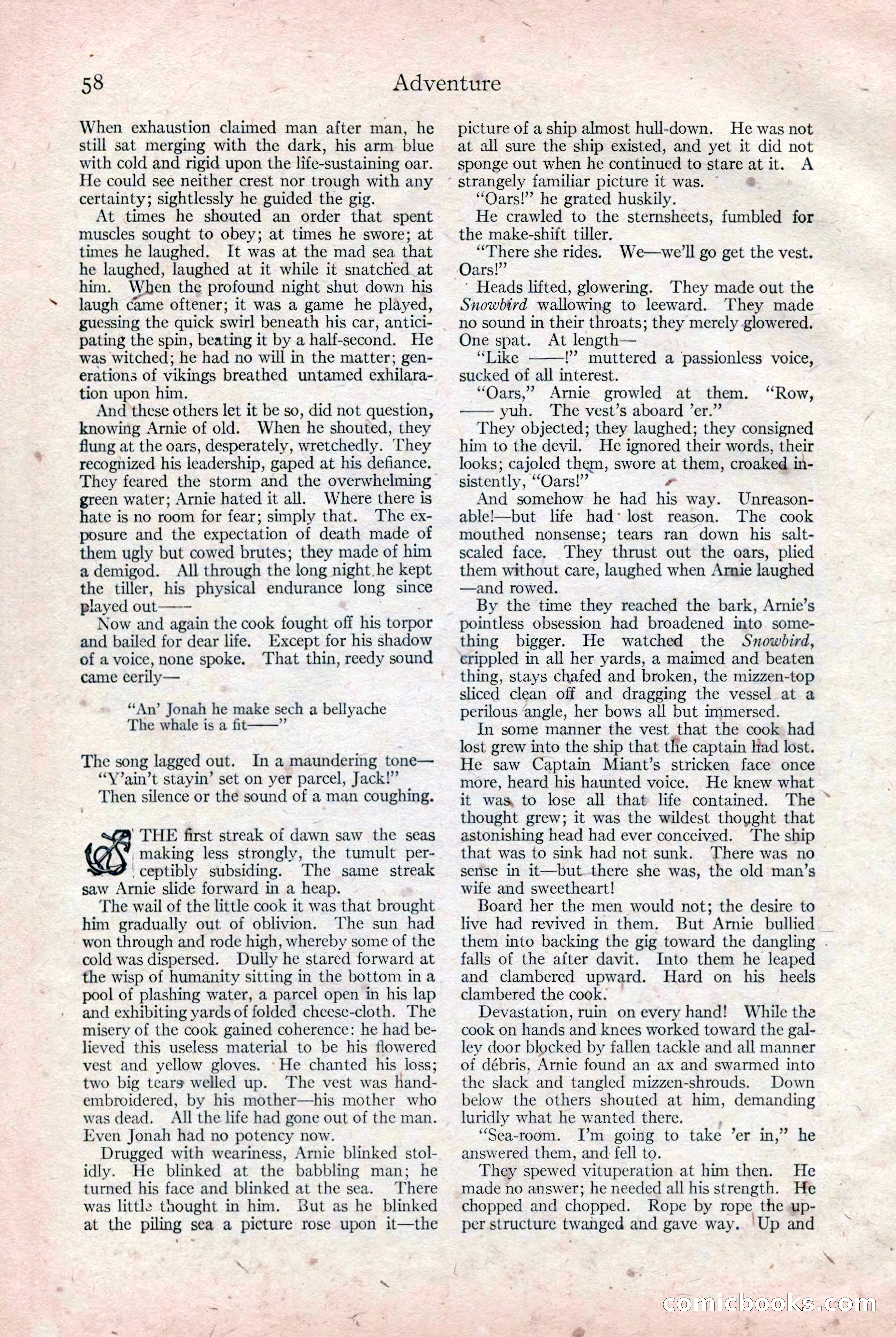
A restored page from Pulp Fiction, 1920. Page through the whole issue in the reader above.
📄 Transcribed text from this page (OCR, searchable)
Machine-transcribed from the original scan — historical spelling and the odd misread are preserved.
58 When. exhaustion claimed man after man, he still sat merging with the dark, his arm blue with cold and rigid upon the life-sustaining oar. He could see neither crest nor trough with any certainty; sightlessly he guided the gig. At times he shouted an order that spent muscles sought to obey; at times he swore; at times he laughed. It was at the mad sea that he laughed, laughed at it while it snatched at him. When the profound night shut down his laugh came oftener; it was a game he played, guessing the quick swirl beneath his car, antici- pating the spin, beating it by a half-second. He was witched; he had no will in the matter; gen- erations of vikings breathed untamed exhilara- tion upon him. And these others let it be so, did not question, knowing Arnie of old. When he shouted, they flung at the oars, desperately, wretchedly. They recognized his leadership, gaped at his defiance. They feared the storm and the overwhelming green water; Arnie hated it all. Where there is hate is no room for fear; simply that. The ex- posure and the expectation of death made of them ugly but cowed brutes; they made of him a demigod. All through the long night. he kept the tiller, his physical endurance long since played out——- Now and again the cook fought off his torpor and bailed for dear life. Except for his shadow of a voice, none spoke. That thin, reedy sound came eerily— “An’ Jonah he make sech a bellyache The whale is a fit——” The song lagged out. In a maundering tone— “V’ain’t stayin’ set on yer parcel, Jack!” Then silence or the sound of a man coughing. ' THE first streak of dawn saw the seas (a making less strongly, the tumult per- 'ceptibly subsiding. ‘The same streak saw Arnie slide forward in a heap. The wail of the little cook it was that brought him gradually out of oblivion. The sun had won through and rode high, whereby some of the cold was dispersed. Dully he stared forward at the wisp of humanity sitting in the bottom ina pool of plashing water, a parcel open in his lap and exhibiting yards of folded cheese-cloth. The misery of the cook gained coherence: he had be- lieved this useless material to be his flowered vest and yellow gloves. -He chanted his loss; two big tears welled up. The vest was hand- embroidered, by his mother—his mother who was dead. All the life had gone out of the man. Even Jonah had no potency now. Drugged with weariness, Arnie blinked stol- idly. He blinked at the babbling man; he turned his face and blinked at the sea. There was little thought in him. But as he blinked at the piling sea a picture rose upon it—the Adventure picture of a ship almost hull-down. He was not at all sure the ship existed, and yet it did not sponge out when he continued to stare at it. A strangely familiar picture it was. s_ @ “Oars!” he grated huskily. He crawled to the sternsheets, fumbled for the make-shift tiller. ‘““There she rides. Oars!” ‘ Heads lifted, glowering. They made out the Snowbird wallowing to leeward. They made no sound in their throats; they merely glowered. One spat. At length— “Like !? muttered a passionless voice, sucked of all interest. “Oars,” Arnie growled at them. — The vest’s aboard ’er.” They objected; they laughed; they consigned him to the devil. He ignored their words, their looks; cajoled them, swore at them, croaked in- sistently, Oars!” va And somehow he had his way. Unreason- able!—but life had~ lost reason. The cook mouthed nonsense; tears ran down his salt- scaled face. They thrust out the oars, plied them without care, laughed when Arnie laughed —and rowed. By the time they reached the bark, Arnie’s pointless obsession had broadened into some- thing bigger. He watched the Snowbird, crippled in all her yards, a maimed and beaten thing, stays chafed and broken, the mizzen-top sliced clean off and dragging the vessel at a perilous angle, her bows all but immersed. In some manner the vest that the cook had lost grew into the ship that the captain Had lost. He saw Captain Miant’s stricken face once more, heard his haunted voice. He knew what it was, to lose all that life contained. The thought grew; it was the wildest thought that astonishing head had ever conceived. The ship that was to sink had not sunk. There was no sense in it—but there she was, the old man’s wife and sweetheart! Board her the men would not; the desire to live had revived in them. But Arnie bullied We—we'll go get the vest. “Row, them into backing the gig toward the dangling . falls of the after davit. Into them he leaped and clambered upward. Hard on his heels clambered the cook. Devastation, ruin on every hand! While the cook on hands and knees worked toward the gal- ley door blocked by fallen tackle and all manner of débris, Arnie found an ax and swarmed into the slack and tangled mizzen-shrouds. Down below the others shouted at him, demanding luridly what he wanted there. “Sea-room. I’m going to take ’er in,” he answered them, and fell to. They spewed vituperation at him then. He made no answer; he needed all his strength. He chopped and chopped. Rope by rope the up- per structure twanged and gave way. ‘Up and (©) = a 0)(0)(6) (E@)