
Pulp Fiction, 1920 · page 69 of 172
Adventure, December 3, 1920 — page 69: what you’re looking at
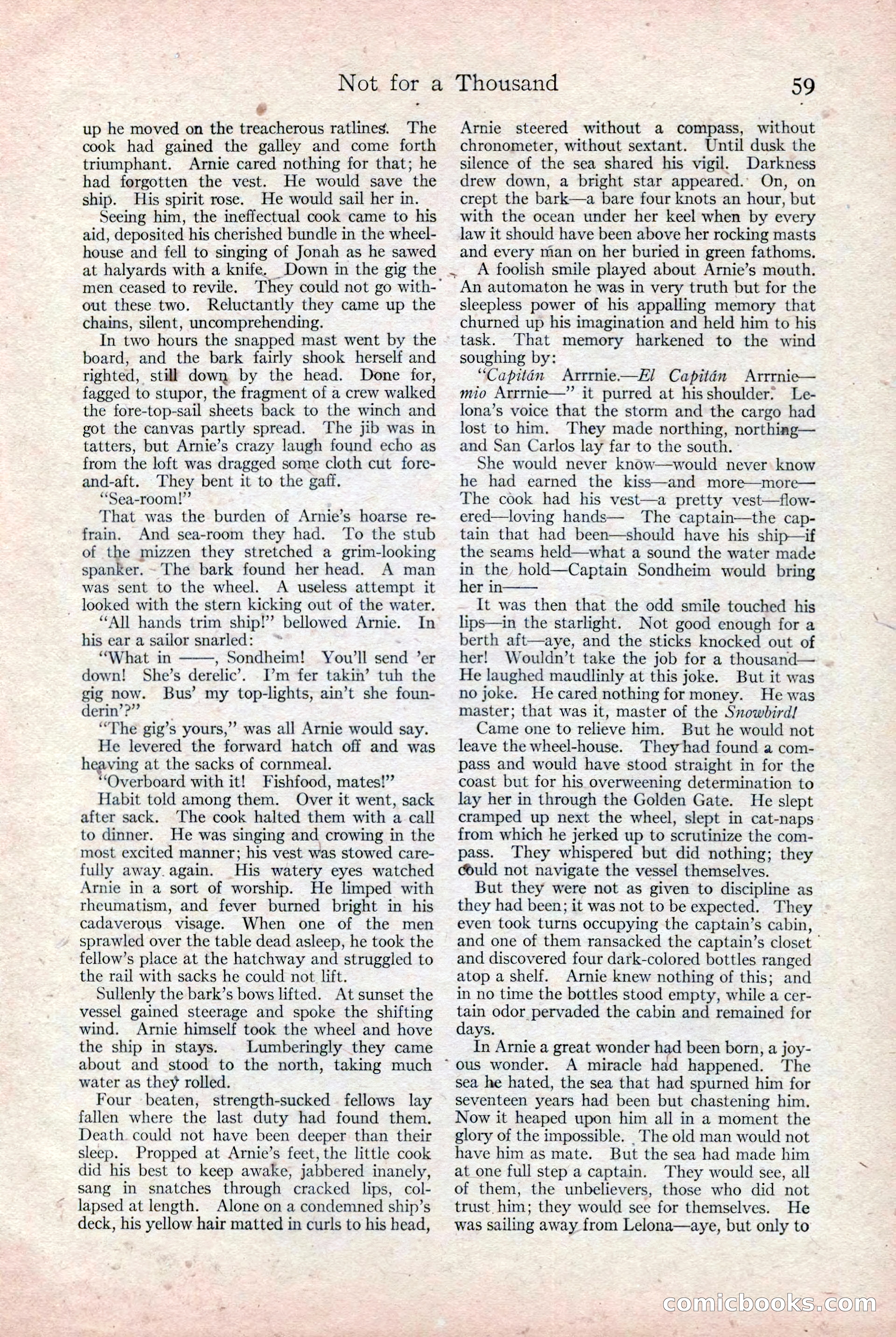
A restored page from Pulp Fiction, 1920. Page through the whole issue in the reader above.
📄 Transcribed text from this page (OCR, searchable)
Machine-transcribed from the original scan — historical spelling and the odd misread are preserved.
Not for a Thousand * up he moved on the treacherous ratlines. The cook had gained the galley and come forth triumphant. Arnie cared nothing for that; he had forgotten the vest. He would save the ship. His spirit rose. He would sail her in. Seeing him, the ineffectual cook came to his aid, deposited his cherished bundle in the wheel- house and fell to singing of Jonah as he sawed at halyards with a knife. Down in the gig the men ceased to revile. out these two. Reluctantly they came up the chains, silent, uncomprehending. In two hours the snapped mast went by the board, and the bark fairly shook herself and righted, stil down by the head. Done for, fagged to stupor, the fragment of a crew walked the fore-top-sail sheets back to the winch and got the canvas partly spread. ‘The jib was in tatters, but Arnie’s crazy laugh found echo as from the loft was dragged some cloth cut fore- and-aft. They bent it to the gaff. ““Sea-room!”’ That was the burden of Arnie’s hoarse re- frain. And sea-room they had. To the stub of the mizzen they stretched a grim-looking spanker. - The bark found her head. A man was sent to the wheel. A useless attempt it _ looked with the stern kicking out of the water. ‘All hands trim ship!’ bellowed Arnie. In his ear a sailor snarled: ~*~ “What in , sondheim! You'll send ’er down! She’s derelic’. I’m fer takin’ tuh the gig now. Bus’ my top-lights, ain’t she foun- deri’??? = “The gig’s yours,”’ was all Arnie would say. He levered the forward hatch off and was heaving at the sacks of cornmeal. “Overboard with it! Fishfood, mates!” Habit told among them. Over it went, sack after sack. The cook halted them with a call to dinner. He was singing and crowing in the most excited manner; his vest was stowed care- fully away. again. His watery eyes watched Arnie in a sort of worship. He limped with rheumatism, and fever burned bright in his cadaverous visage. When one of the men sprawled over the table dead asleep, he took the fellow’s place at the hatchway and struggled to the rail with sacks he could not lift. Sullenly the bark’s bows lifted. At sunset the vessel gained steerage and spoke the shifting wind. Arnie himself took the wheel and hove the ship in stays. | Lumberingly they came about and stood to the north, taking much water as they rolled. Four beaten, strength-sucked fellows lay fallen where the last duty had found them. Death. could not have been deeper than their sleep. Propped at Arnie’s feet, the little cook did his best to keep awake, jabbered inanely, sang in snatches through cracked lips, col- _ lapsed at length. Alone on a condemned ship’s deck, his yellow hair matted in curls to his head, They could not go with- 59 Arnie steered without a compass, without chronometer, without sextant. Until dusk the silence of the sea shared his vigil. Darkness drew down, a bright star appeared. On, on crept the bark—a bare four knots an hour, but with the ocean under her keel when by every law it should have been above her rocking masts and every man on her buried in green fathoms. A foolish smile played about Arnie’s mouth. An automaton he was in very truth but for the sleepless power of his appalling memory that churned up his imagination and held him to his task. That memory harkened to the wind soughing by: “Capitén Arrrnie—E/ Capitén Arrrnie— mio Arrrnie—”’ it purred at hisshoulder: Le- lona’s voice that the storm and the cargo had lost to him. They made northing, northiag— and San Carlos lay far to the south. She would never know—would never know he had earned the kiss—and more—more— The cook had his vest—a pretty vest—flow- ered—loving hands— The captain—the cap- tain that had been—should have his ship—if the seams held—what a sound the water made = the hold—Captain Sondheim would bring er It was then that the odd smile touched his lips—in the starlight. Not good enough for a berth aft—aye, and the sticks knocked out of her! Wouldn’t take the job for a thousand— He laughed maudlinly at this joke. But it was no joke. He cared nothing formoney. He was master; that was it, master of the Sxowbird/ Came one to relieve him. But he would not leave the wheel-house. They had found a com- pass and would have stood straight in for the coast but for his overweening determination to lay her in through the Golden Gate. He slept cramped up next the wheel, slept in cat-naps from which he jerked up to scrutinize the com- pass. They whispered but did nothing; they Could not navigate the vessel themselves. But they were not as given to discipline as they had been; it was not to be expected. They even took turns occupying the captain’s cabin, and one of them ransacked the captain’s closet ’ and discovered four dark-colored bottles ranged atop a shelf. Arnie knew nothing of this; and in no time the bottles stood empty, while a cer- tain odor pervaded the cabin and remained for days. In Arnie a great wonder had been born, a joy- “ous wonder. A miracle had happened. The sea he hated, the sea that had spurned him for seventeen years had been but chastening him. Now it heaped upon him all in a moment the glory of the impossible. The old man would not have him as mate. But the sea had made him at one full step a captain. They would see, all of them, the unbelievers, those who did not trust. him; they would see for themselves. He was sailing away from Lelona—aye, but only to EORNICLO© (E@)