
Pulp Fiction, 1920 · page 92 of 172
Adventure, December 3, 1920 — page 92: what you’re looking at
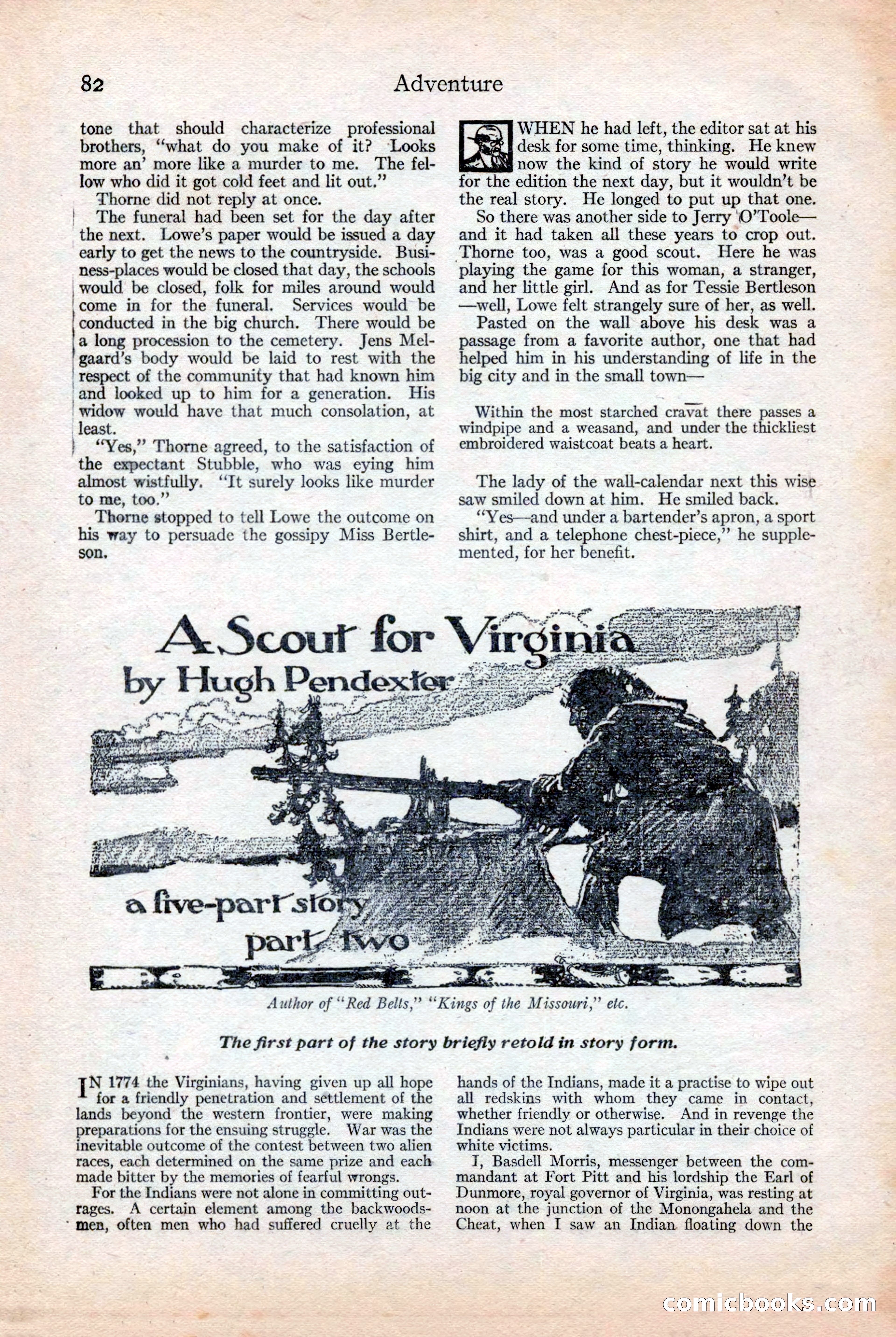
A restored page from Pulp Fiction, 1920. Page through the whole issue in the reader above.
📄 Transcribed text from this page (OCR, searchable)
Machine-transcribed from the original scan — historical spelling and the odd misread are preserved.
82 tone that should characterize professional brothers, “what do you make of it? ‘Looks more an’ more like a murder to me. The fel- low who did it got cold feet and lit out.” Thorne did not reply at once. ' The funeral had been set for the day after the next. Lowe’s paper would be issued a day early to get the news to the countryside. Busi- ness-places would be closed that day, the schools |would be closed, folk for miles around would come in for the funeral. Services would be conducted in the big church. There would be a long procession to the cemetery. Jens Mel- gaard’s body would be laid to rest with the respect of the community that had known him | and looked up to him for a generation. His beng would have that much consolation, at east. | “Yes,” Thorne agreed, to the satisfaction of the expectant Stubble, who was eying him almost wistfully. ‘It surely looks like murder to me, too,” Thorne stopped to tell Lowe the outcome on his way to persuade the gossipy Miss Bertle- son, Author of “Red Belts,” “Kings of the Missouri,’ Thorne too, was a good scout. Adventure WHEN he had left, the editor sat at his j desk for some time, thinking. He knew now the kind of story he would write ior oe edition the next day, but it wouldn’t be the real story. He longed to put up that one. So there was another side to Jerry ‘O’Toole— and it had taken all these years to crop out. Here he was playing the game for this woman, a stranger, and her little girl. And as for Tessie Bertleson —well, Lowe felt strangely sure of her, as well. Pasted on the wall above his desk was a passage from a favorite author, one that had helped him in his understanding of life in the big city and in the small town— Within the most starched cravat there passes a windpipe and a weasand, and under the thickliest embroidered waistcoat beats a heart. The lady of the wall-calendar next this wise saw smiled down at him. He smiled back. ““Yes—and under a bartender’s apron, a sport shirt, and a telephone chest-piece,” he supple- mented, for her benefit. yee) EP Ee ~Landelbrvst a ir % WF ” etc. The first part of the story briefly retold in story form. 1X 1774 the Virginians, having given up all hope for a friendly penetration and settlement of the lands beyond the western frontier, were making preparations for the ensuing struggle. War was the inevitable outcome of the contest between two alien races, each determined on the same prize and each made bitter by the memories of fearful wrongs. For the Indians were not alone in committing out- rages. A certain element among the backwoods- “men, often men who had suffered cruelly at the hands of the Indians, made it a practise to wipe out all redskins with whom they came in contact, whether friendly or otherwise. And in revenge the Indians were not always particular in their choice of white victims. J, Basdell Morris, messenger between the com- mandant at Fort Pitt and his lordship the Earl of Dunmore, royal governor of Virginia, was resting at noon at the junction of the Monongahela and the Cheat, when I saw an Indian floating down the COPMICLOOO (C@