
Pulp Fiction, 1920 · page 93 of 172
Adventure, December 3, 1920 — page 93: what you’re looking at
A restored page from Pulp Fiction, 1920. Page through the whole issue in the reader above.
📄 Transcribed text from this page (OCR, searchable)
Machine-transcribed from the original scan — historical spelling and the odd misread are preserved.
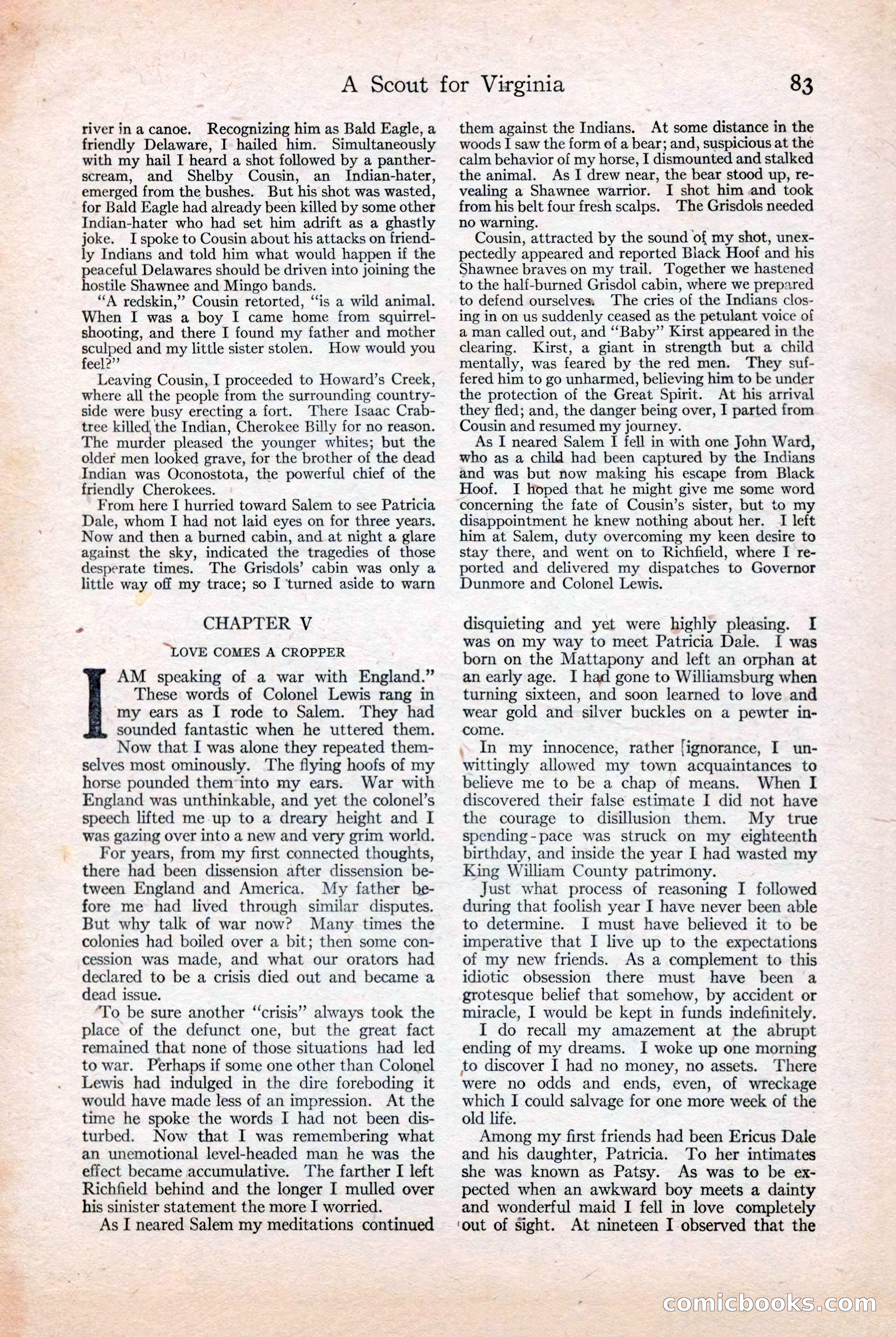
A Scout for Virginia river inacanoe. Recognizing him as Bald Eagle, a friendly Delaware, I hailed him. Simultaneously with my hail I heard a shot followed by a panther- scream, and Shelby Cousin, an _ Indian-hater, emerged from the bushes. But his shot was wasted, for Bald Eagle had already been killed by some other Indian-hater who had set him adrift as a ghastly joke. Ispoke to Cousin about his attacks on friend- ly Indians and told him what would happen if the peaceful Delawares should be driven into joining the hostile Shawnee and Mingo bands. ““A redskin,” Cousin retorted, “is a wild animal. When I was a boy I came home from squirrel- shooting, and there I found my father and mother aes and my little sister stolen. How would you eel?” Leaving Cousin, I proceeded to Howard’s Creek, where all the people from the surrounding country- side were busy erecting a fort. There Isaac Crab- tree killed, the Indian, Cherokee Billy for no reason. The murder pleased the younger whites; but the older men looked grave, for the brother of the dead Indian was Oconostota, the powerful chief of the friendly Cherokees. From here I hurried toward Salem to see Patricia Dale, whom I had not laid eyes on for three years. Now and then a burned cabin, and at night a glare against the sky, indicated the tragedies of those desperate times. The Grisdols’ cabin was only a little way off my trace; so I turned aside to warn * CHAPTER V “LOVE COMES A CROPPER AM speaking of a war with England.” These words of Colonel Lewis rang in my ears as I rode to Salem. They had sounded fantastic when he uttered them. Now that I was alone they repeated them- selves most ominously. The flying hoofs of my horse pounded them into my ears. War with England was unthinkable, and yet the colonel’s speech lifted me up to a dreary height and I was gazing over into a new and very grim world. For years, from my first connected thoughts, there had been dissension after dissension be- tween England and America. My father be- fore me had lived through similar disputes. But why talk of war now? Many times the colonies had boiled over a bit; then some con- cession was made, and what our orators had declared to be a crisis died out and became a dead issue. ‘To be sure another “crisis” always took the place of the defunct one, but the great fact remained that none of those situations had led to war. Perhaps if some one other than Colonel Lewis had indulged in the dire foreboding it would have made less of an impression. At the time he spoke the words I had not been dis- turbed. Now that I was remembering what an unemotional level-headed man he was the effect became accumulative. The farther I left Richfield behind and the longer I mulled over his sinister statement the more I worried. As I neared Salem my meditations continued 83 them against the Indians. At some distance in the woods I saw the form of a bear; and, suspicious at the calm behavior of my horse, I dismounted and stalked the animal. As I drew near, the bear stood up, re- vealing a Shawnee warrior. I shot him and took from his belt four fresh scalps. The Grisdols needed no warning. Cousin, attracted by the sound of my shot, unex- pectedly appeared and reported Black Hoof and his Shawnee braves on my trail. Together we hastened to the half-burned Grisdol cabin, where we prepared to defend ourselves: ‘The cries of the Indians clos- ing in on us suddenly ceased as the petulant voice of a man called out, and ‘‘Baby” Kirst appeared in the clearing. Kirst, a giant in strength but a child mentally, was feared by the red men. They suf- fered him to go unharmed, believing him to be under the protection of the Great Spirit. At his arrival they fled; and, the danger being over, I parted from Cousin and resumed my journey. As I neared Salem I fell in with one John Ward, who as a child had been captured by the Indians and was but now making his escape from Black Hoof. I Hoped that he might give me some word concerning the fate of Cousin’s sister, but to my disappointment he knew nothing about her. [I left him at Salem, duty overcoming my keen desire to stay there, and went on to Richfield, where I re- ported and delivered my dispatches to Governor Dunmore and Colonel Lewis. disquieting and yet were highly pleasing. I was on my way to meet Patricia Dale. I was born on the Mattapony and left an orphan at an early age. I had gone to Williamsburg when turning sixteen, and soon learned to love and wear gold and silver buckles on a pewter in- come. . In my imnocence, rather fignorance, I un- wittingly allowed my town acquaintances to believe me to be a chap of means. When I discovered their false estimate I did not have the courage to disillusion them. My true spending-pace was struck on my eighteenth birthday, and inside the year I had wasted my King Wiliam County patrimony. Just what process of reasoning I followed during that foolish year I have never been able to determine. I must have believed it to be imperative that I live up to the expectations of my new friends. As a complement to this idiotic obsession there must have been a grotesque belief that somehow, by accident or miracle, I would be kept in funds indefinitely. I do recall my amazement at the abrupt ending of my dreams. I woke up one morning to discover I had no money, no assets. There were no odds and ends, even, of wreckage which I could salvage for one more week of the old life. Among my first friends had been Ericus Dale and his daughter, Patricia. To her intimates she was known as Patsy. As was to be ex- pected when an awkward boy meets a dainty and wonderful maid I fell in love completely ‘out of sight. At nineteen I observed that the Gomichboo (C@)