
Pulp Fiction, 1921 · page 126 of 204
Adventure Magazine Cover — page 126: what you’re looking at
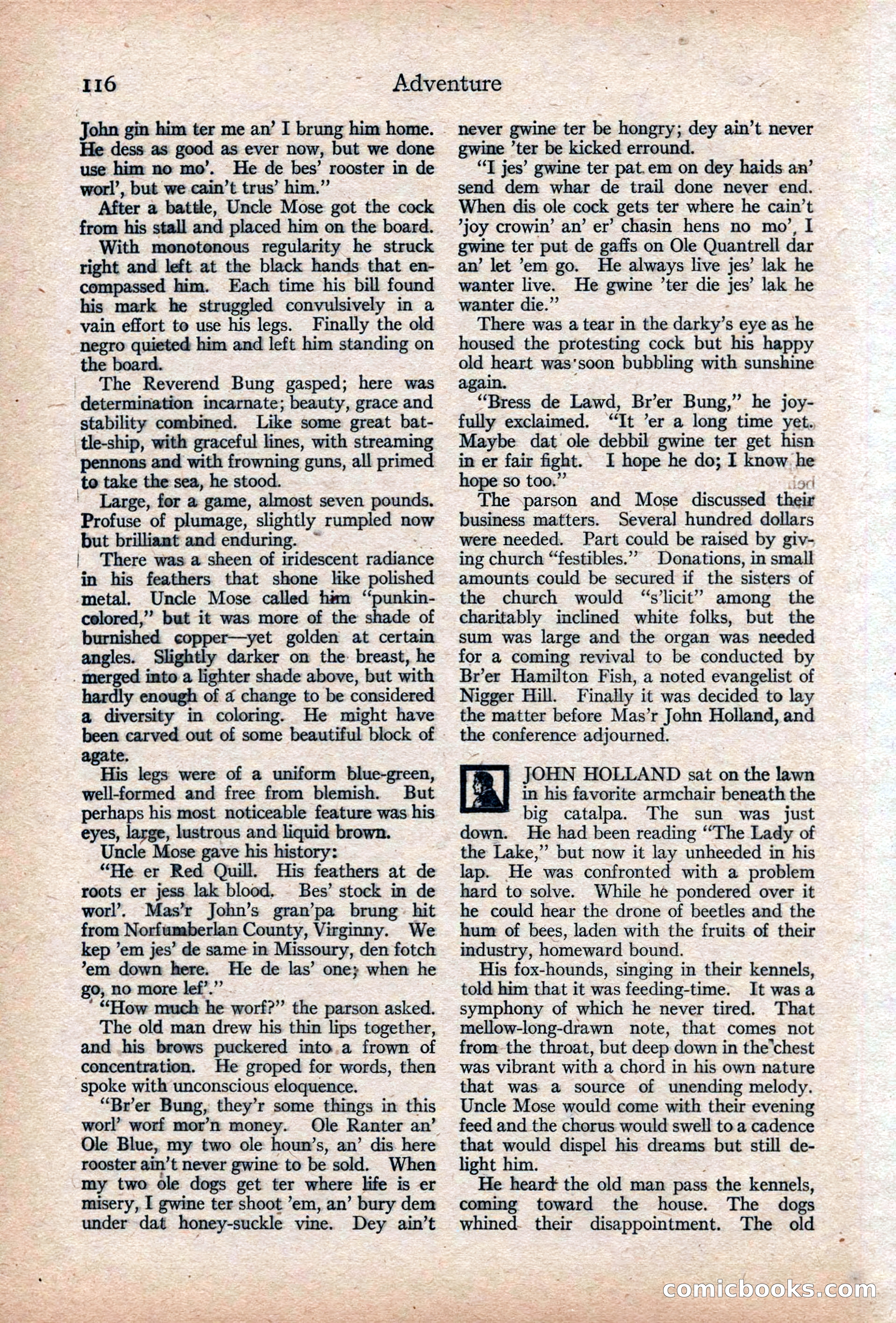
A restored page from Pulp Fiction, 1921. Page through the whole issue in the reader above.
📄 Transcribed text from this page (OCR, searchable)
Machine-transcribed from the original scan — historical spelling and the odd misread are preserved.
~~ ~— 116 ‘John gin him ter me an’ I brung him home. He dess as good as ever now, but we done use him no mo’. He de bes’ rooster in de worl’, but we cain’t trus’ him.” After a battle, Uncle Mose got the cock from his stall and placed him on the board. With monotonous regularity he struck right and left at the black hands that en- compassed him. Each time his bill found his mark he struggled convulsively in a _ vain effort to use his legs. Finally the old negro quieted him and left him standing on the board. The Reverend Bung gasped; here was determination incarnate; beauty, grace and stability combined. Like some great bat- tle-ship, with graceful lines, with streaming and with frowning guns, all primed to take the sea, he stood. Large, for a game, almost seven pounds. Profuse of plumage, slightly rumpled now but brilliant and enduring. There was a sheen of iridescent radiance in his feathers that shone like polished ‘metal. Uncle Mose called him “punkin- colored,” but it was more of the shade of burnished copper—yet golden at certain angles. Slightly darker on the: breast, he . merged into a lighter shade above, but with hardly enough of 4 change to be considered a diversity in coloring. He might have been carved out of some beautiful block of agate. His legs were of a uniform blue-green, well-formed and free from blemish. But perhaps his most noticeable feature was his eyes, large, lustrous and liquid brown. Uncle Mose gave his history: “He er Red Quill. His feathers at de roots er jess lak blood. — Bes’ stock in de worl’, Mas’r John’s gran’pa brung: hit from Norfumberlan County, Virginny. We kep ° em jes’ de same in Missoury, den fotch ’em down here. He de las’ one; when he go, no more lef’.”’ . “How much he worf?” the parson asked. The old man drew his thin lips together, and his brows puckered into.a frown of concentration. He groped for words, then spoke with unconscious eloquence. “Br’er Bung, they’r some things in this worl’ worf mor’n money. Ole Ranter an’ Ole Blue, my two ole houn’s, an’ dis. here rooster ain’t never gwine to be sold. When my two ole dogs get ter where life is er misery, I gwine ter shoot ’em, an’ bury dem under dat honey-suckle vine. Dey ain’t Adventure - never gwine ter be hongry; dey ain’t never gwine ’ter be kicked erround. “T jes’ gwine ter pat.em on dey haids an’ send dem whar de trail done never end. When dis ole cock gets ter where he cain t "joy crowin’ an’ er’ chasin hens no mo’, I gwine ter put de gaffs on Ole Quantrell dar an’ let ’°em go. He always live jes’ lak he wanter live. He gwine ’ter die Jes lak he wanter die.” There was a tear in the darky’s eye as he housed the protesting cock but his happy old heart was'soon bubbling with sunshine again. “Bress de Lawd, Br’er Bung,” he joy- fully exclaimed. Maybe dat ole debbil gwine ter get hisn in er fair fight. I hope he do; I know he hope so too.” The sparson and Mose discussed their business matters. Several hundred dollars were needed. Part could be raised by giv- ing church “festibles.”” Donations, in small amounts could be secured if the sisters of the church would “s’licit” among the charitably inclined white folks, but the sum was large and the organ was needed for a coming revival to be conducted by Br’er Hamilton Fish, a noted evangelist of Nigger Hill. Finally it was decided to lay the matter before Mas’r John Holland, and the conference adjourned. Ey in his favorite armchair beneath the big catalpa. The sun was just down. He had been reading “The Lady of the Lake,” but now it lay unheeded in his lap. He was confronted with a problem hard to solve. While he pondered over it he could hear the drone of beetles and the hum of bees, laden with the fruits of their industry, homeward bound. His fox-hounds, singing in their kennels, told him that it was feeding-time. It was a symphony of which he never tired. That mellow-long-drawn note, that comes not from the throat, but deep down in the’chest was vibrant with a chord in his own nature that was a source of unending melody. Uncle Mose would come with their evening feed and the chorus would swell to a cadence that would dispel his dreams but still de- light him. He heard the old man pass the kestels; coming toward the house. The dogs whined. their disappointment. The old JOHN HOLLAND sat on the lawn Comichboo cS “Tt ’er a long time yet., (avoy