
Pulp Fiction, 1921 · page 136 of 204
Adventure Magazine Cover — page 136: what you’re looking at
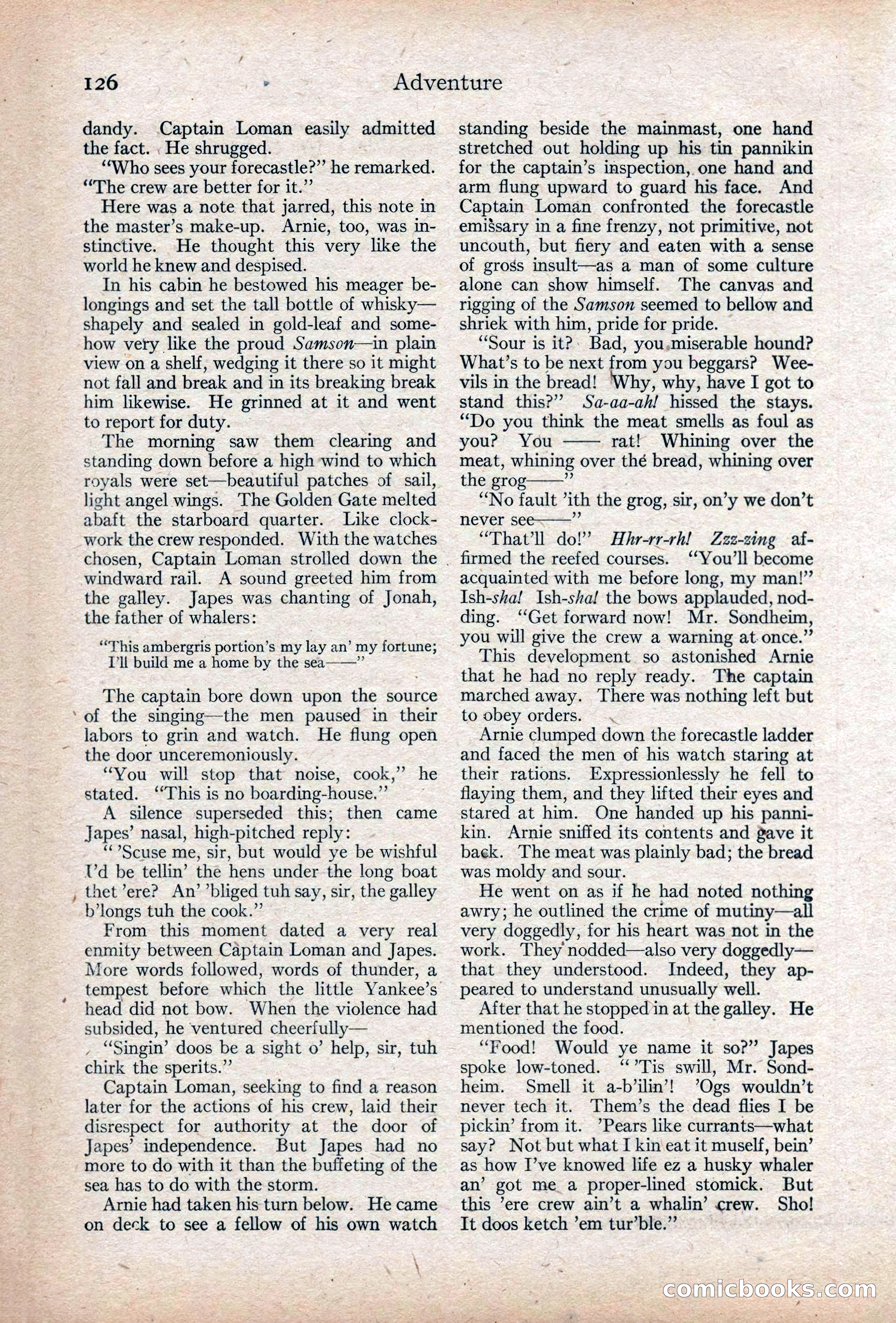
A restored page from Pulp Fiction, 1921. Page through the whole issue in the reader above.
📄 Transcribed text from this page (OCR, searchable)
Machine-transcribed from the original scan — historical spelling and the odd misread are preserved.
126 e dandy. Captain Loman easily admitted the fact. _He shrugged. “Who sees your forecastle?” he eniack ok “The crew are better for it.’ Here was a note that jarred, this note in the master’s make-up. Arnie, too, was in- stinctive. He thought this very like the world he knew and despised. In his cabin he bestowed his meager be- longings and set the tall bottle of whisky— shapely and sealed in gold-leaf and some- how very like the proud Samson—in plain view on a shelf, wedging it there so it might not fall and break and in its breaking break him likewise. He grinned at it and went to report for duty. The morning saw them clearing and standing down before a high wind to which royals were set—beautiful patches of sail, light angel wings. The Golden Gate melted abaft the starboard quarter. Like clock- work the crew responded. With the watches chosen, Captain Loman strolled down the . windward rail. A sound greeted him from the galley. Japes was chanting of Jonah, the father of whalers: “This ambergris portion’s my ai an’ my fortune; I’ll build me a home by the sea——’”’ The captain bore down upon the source ‘of the singing—the men paused in their 7 labors to grin and watch. He flung open the door unceremoniously. “You will stop that noise, cook,” he stated. ‘This is no boarding-house.”’ A silence superseded this; then came Japes’ nasal, high-pitched reply: ‘““?*Scuse me, sir, but would ye be wishful Ud be tellin’ the hens under the long boat thet ’ere? An’ ’bliged tuh say, sir, the galley b’longs tuh the cook.” From this moment dated a very real enmity between Captain Loman and Japes. More words followed, words of thunder, a tempest before which the little Yankee’s head did not bow. When the violence had subsided, he ventured cheerfully— “Singin’ doos be a sight o’ help, sir, tuh chirk the sperits.”’ Captain Loman, seeking to find a reason later for the actions of his crew, laid their disrespect for authority at the door of Japes’ independence. But Japes had no more to do with it than the buffeting of the sea has to do with the storm. Arnie had taken his turn below. He came on deck to see a fellow of his own watch \ Adventure standing beside the mainmast, one hand stretched out holding up his tin pannikin for the captain’s inspection, one hand and arm flung upward to guard his face. And Captain Loman confronted the forecastle emissary in a fine frenzy, not primitive, not uncouth, but fiery and eaten with a sense of gross insult—as a man of some culture alone can show himself. The canvas and rigging of the Samson seemed to bellow and shriek with him, pride for pride. “Sour is it?: Bad, you.miserable hound? What’s to be next from you beggars? Wee- vils in the bread! Why, why, have I got to stand this?’ Sa-aa-ah! hissed the stays. “Do you think the meat smells as foul as your You rat! Whining over the meat, whining over thé bread, whining over the grog = “No fault ’ith the grog, sir, on’y we don’t never see.” “That'll do!” Hhr-rr-rh! Zzz-zing af- firmed the reefed courses. ‘‘You’ll become acquainted with me before long, my man!” Ish-sha! Ish-sha! the bows applauded, nod- ding. “Get forward now! Mr. Sondheim, you will give the crew a warning at-once.” This development so astonished Arnie that he had no reply ready. The captain marched away. There was nothing left but to obey orders. , Arnie clumped down the forecastle ladder and faced the men of his watch staring at their rations. Expressionlessly he fell to flaying them, and they lifted their eyes and stared at him. One handed up his panni- kin. Arnie sniffed its contents and gave it baek. The meat was plainly bad; the bread was moldy and sour. He went on as if he had noted nothing awry; he outlined the crime of mutiny—all very doggedly, for his heart was not in the work. They nodded—also very doggedly— that they understood. Indeed, they ap- peared to understand unusually well. After that he stopped in at the galley. mentioned the food. “Food! Would ye name it so?” Japes spoke low-toned. ‘“’Tis swill, Mr. Sond- heim. Smell it a-b’ilin’! ’Ogs wouldn’t never tech it. Them’s the dead flies I be pickin’ from it. ’Pears like currants—what say? Not but what I kin eat it muself, bein’ as how I’ve knowed life ez a husky whaler an’ got me a proper-lined stomick. But this ’ere crew ain’t a whalin’ crew. Sho! It doos ketch ’em tur’ble.” He IOoOKk (E©) (E@