
Pulp Fiction, 1921 · page 139 of 204
Adventure Magazine Cover — page 139: what you’re looking at
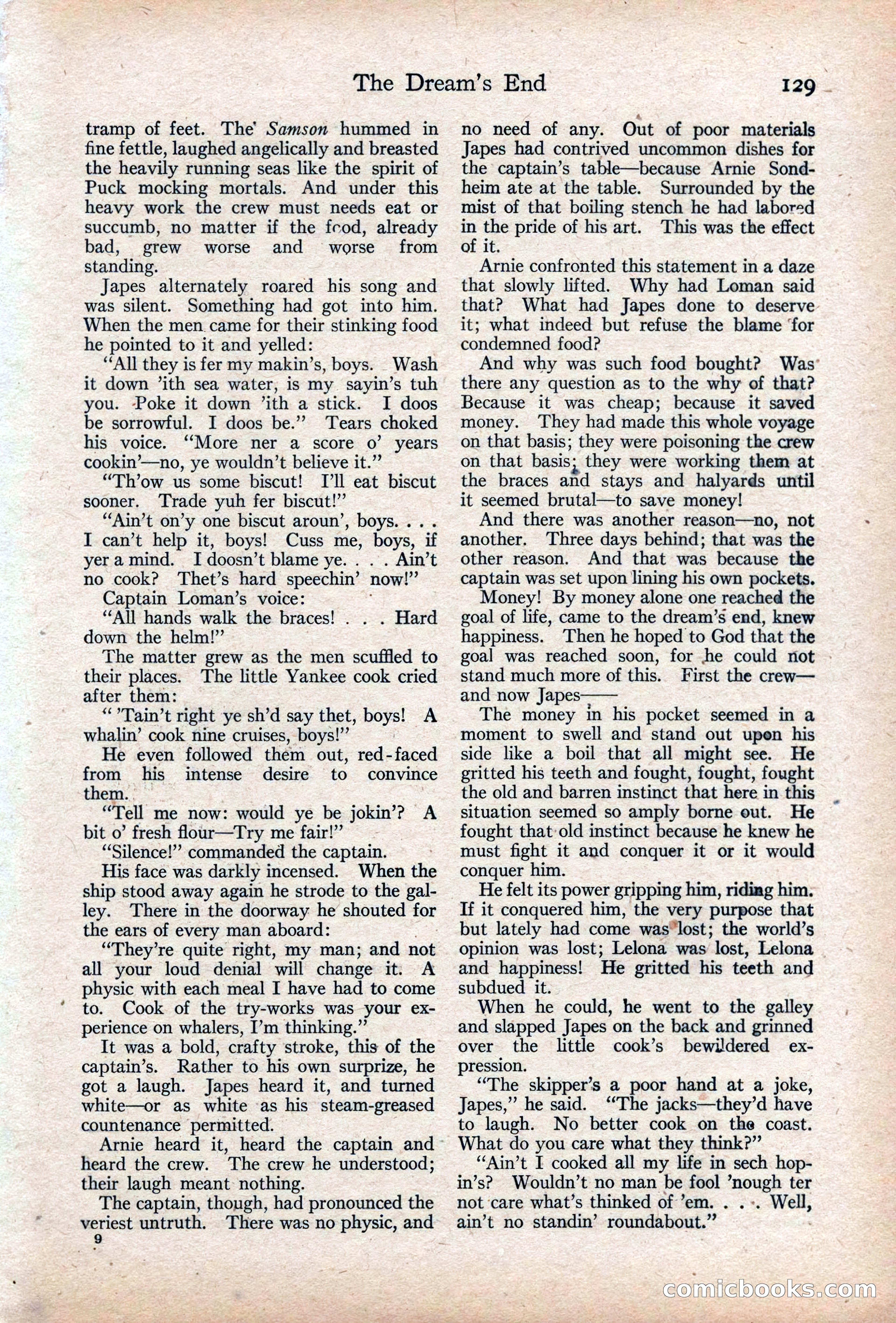
A restored page from Pulp Fiction, 1921. Page through the whole issue in the reader above.
📄 Transcribed text from this page (OCR, searchable)
Machine-transcribed from the original scan — historical spelling and the odd misread are preserved.
The Dream’s End tramp of feet. The’ Samson hummed in fine fettle, laughed angelically and breasted the heavily running seas like the spirit of Puck mocking mortals. And under this heavy work the crew must needs eat or succumb, no matter if the feod, already bad, grew worse and worse’ from standing. Japes alternately roared his song and was silent. Something had got into him. When the men came for their stinking food he pointed to it and yelled: ‘All they is fer my makin’s, boys. Wash it down ’ith sea water, is my sayin’s tuh you. Poke it down ’ith a stick. I doos be sorrowful. I doos be.” Tears choked his voice. ‘“‘More ner a score 0’ years cookin’—no, ye wouldn’t believe it.” “Th’ow us some biscut! I'll eat biscut sooner. Trade yuh fer biscut!”’ ““Ain’t on’y one biscut aroun’, boys... . I can’t help it, boys! Cuss me, boys, if yeramind. Idoosn’t blame ye... . Ain’t no cook? Thet’s hard speechin’ now!” Captain Loman’s voice: ‘All hands walk the braces! . . down the helm!” The matter grew as the men scuffled to their places. The little Yankee cook cried after them: “Tain’t right ye sh’d say thet, boys! A whalin’ cook nine cruises, boys!” He even followed them out, red-faced from his intense desire to convince them. | “Tell me now: would ye be jokin’? A bit o’ fresh flour—Try me fair!” “Silence!”’? commanded the captain. His face was darkly incensed. When the . Hard ship stood away again he strode to the gal- _ ley. There in the doorway he shouted for the ears of every man aboard: . “They’re quite right, my man; and not all your loud denial will change s eage physic with each meal I have had to come to. Cook of the try-works was your ex- perience on whalers, I’m thinking.” It was a bold, crafty stroke, this of the captain’s. Rather to his own surprize, he got a laugh. Japes heard it, and turned white—or as white as his steam-greased countenance permitted. Arnie heard it, heard the captain and~ heard the crew. The crew he understood; their laugh meant: nothing. The captain, though, had pronounced the veriest untruth. There was no physic, and 9 . : no need of any. Out of poor materials Japes had contrived uncommon dishes for the captain’s table—because Arnie Sond- heim ate at the table. Surrounded by the mist of that boiling stench he had labored in the pride of his art. This was the effect of it. Arnie confronted this statement in a daze that slowly lifted. Why had Loman said that? What had Japes done to deserve it; what indeed but refuse the blame ‘for condemned food? And why was such food bought? there any question as to the why of that? Because it was cheap; because it saved money. ‘They had made this whole voyage on that basis; they were poisoning the crew on that basis; they were working them at the braces and stays and halyards until it seemed brutal—to save money! And there was another reason—no, not another. Three days behind; that was the other reason. And that was because the captain was set upon lining his own pockets. Money! By money alone one reached the goal of life, came to the dream’s end, knew happiness. Then he hoped to God that the Was’ 129 . goal was reached soon, for be could not . stand much more of this. First the crew— and now Japes The money in his pocket seemed in a moment to swell and stand out upen his side like a boil that all might see. He gritted his teeth and fought, fought, fought the old and barren instinct that here in this situation seemed so amply borne out. He fought that-old instinct because he knew he must fight it and conquer it or it would conquer him. He felt its power gripping him, riding him. If it conquered him, the very purpose that but lately had come was*lost; the world’s opinion was lost; Lelona was lost, Lelona and happiness! He gritted his teeth and subdued it. When he could, he went to the galley and slapped Japes on the back and grinned over the little cook’s bewildered ex- pression. “The skipper’s a poor hand at a joke, Japes,” he said. “The jacks—they’d have to laugh. No better cook on the coast. What do you care what they think?” “Ain’t I cooked all my life in sech hop- in’s? Wouldn’t no man be fool = ter not ‘care what’s thinked of ’em. . .-. Well, ain’t no standin’ roundabout.” EOPMICG OOOLK CO