
Pulp Fiction, 1921 · page 14 of 204
Adventure Magazine Cover — page 14: what you’re looking at
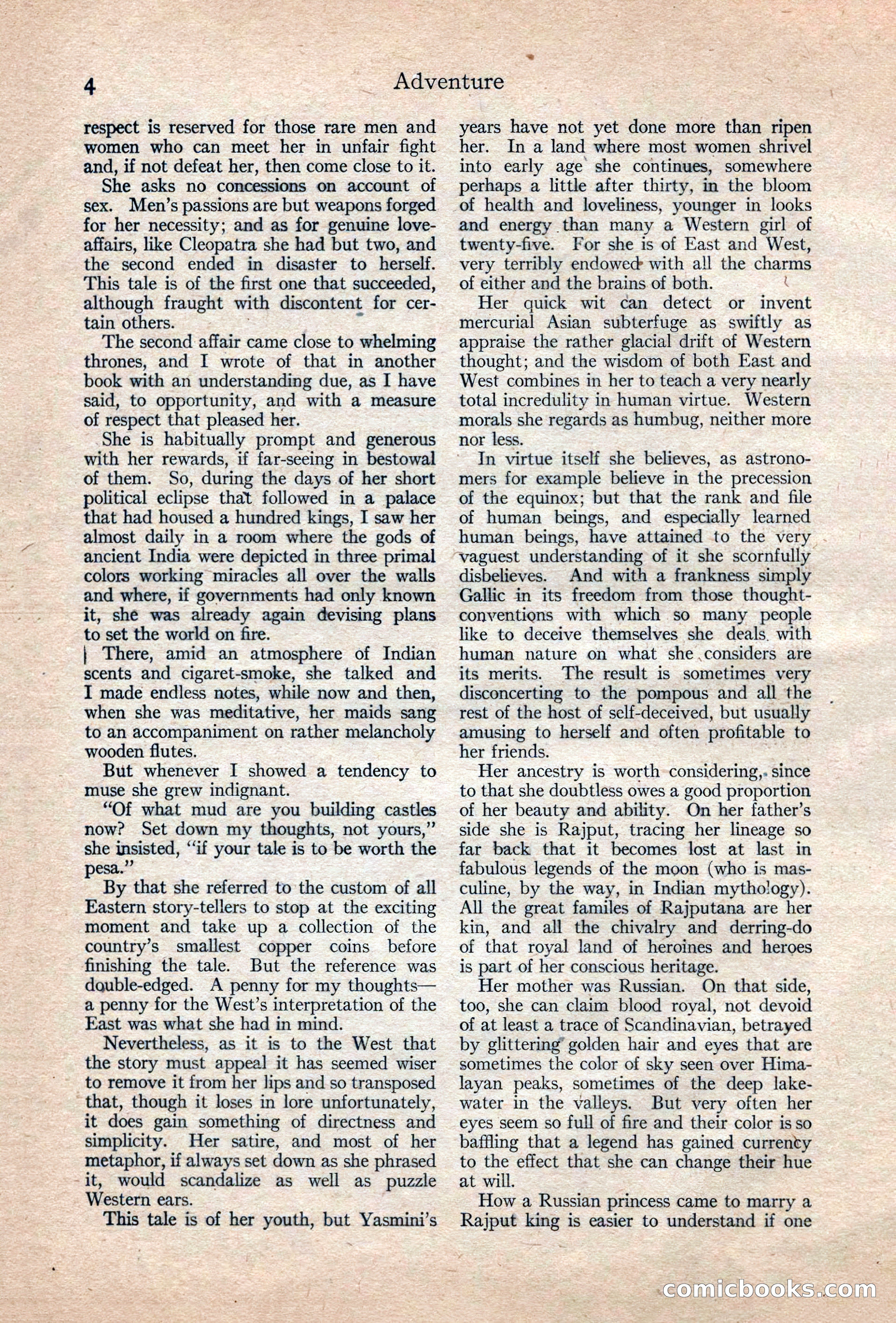
A restored page from Pulp Fiction, 1921. Page through the whole issue in the reader above.
📄 Transcribed text from this page (OCR, searchable)
Machine-transcribed from the original scan — historical spelling and the odd misread are preserved.
4 _ Adventure respect is reserved for those rare men and women who can meet her in unfair fight and, if not defeat her, then come close to it. She asks no concessions on account of sex. Men’s passions are but weapons forged for her necessity; and as for genuine love- affairs, like Cleopatra she had but two, and the second ended in disaster to herself. This tale is of the first one that succeeded, although fraught with discontent for cer- tain others. : s The second affair came close to whelming thrones, and I wrote of that in another book with an understanding due, as I have said, to opportunity, and with a measure of respect that pleased her. She is habitually prompt and generous with her rewards, if far-seeing in bestowal of them. So, during the days of her short political eclipse that followed in a palace that had housed a hundred kings, I saw her almost daily in a room where the gods of ancient India were depicted in three primal colors working miracles all over the walls and where, if governments had only known it, she was already again devising plans to set the world on fire. | There, amid an atmosphere of Indian scents and cigaret-smoke, she talked and I made endless notes, while now and then, when she was meditative, her maids sang to an accompaniment on rather melancholy wooden flutes. But whenever I showed a tendency to muse she grew indignant. “Of what mud are you building castles now? Set down my thoughts, not yours,” she insisted, “if your tale is to be worth the esa.” By that she referred to the custom of all Eastern story-tellers to stop at the exciting moment and take up a collection of the country’s smallest copper coins before finishing the tale. But the reference was double-edged. A penny for my thoughts— a penny for the West’s interpretation of the East was what she had in mind. Nevertheless, as it is to the West that the story must appeal it has seemed wiser to remove it from her lips and so transposed that, though it loses in lore unfortunately, it does gain something of directness and simplicity. Her satire, and most of her metaphor, if always set down as she phrased -it, would scandalize as well as puzzle Western ears. This tale is of her youth, but Yasmini’s years have not yet done more than ripen her. In a land where most women shrivel into early age she continues, somewhere perhaps a little after thirty, in the bloom of health and loveliness, younger in looks and energy than many a Western girl of twenty-five. For she is of East and West, very terribly endowec with all the charms of either and the brains of both. t Her quick wit can detect or invent mercurial Asian subterfuge as swiftly as appraise the rather glacial drift of Western thought; and the wisdom of both East and West combines in her to teach a very nearly total incredulity in human virtue. Western morals she regards as humbug, neither more nor less. In virtue itself she believes, as astrono- mers for example believe in the precession of the equinox; but that the rank and file of human beings, and especially learned human beings, have attained to the very . vaguest understanding of it she scornfully disbelieves. And with a frankness simply Gallic in its freedom from those thought- conventions with which so many people like to deceive themselves she deals. with human nature on what she .considers are its merits. The result is sometimes very disconcerting to the pompous and all the rest of the host of self-deceived, but usually amusing to herself and often profitable to her friends. Her ancestry is worth considering,. since to that she doubtless owes a good proportion of her beauty and ability. On her father’s side she is Rajput, tracing her lineage so far back that it becomes lost at last in fabulous legends of the moon (who is mas- culine, by the way, in Indian mythology). All the great familes of Rajputana are her kin, and all the chivalry and derring-do of that royal land of heroines and heroes is part of her conscious heritage. Her mother was Russian. On that side, too, she can claim blood royal, not devoid of at least a trace of Scandinavian, betrayed by glittering’ golden hair and eyes that are sometimes the color of sky seen over Hima- Jayan peaks, sometimes of the deep lake- water in the valleys. But very often her eyes seem so full of fire and their color is so baffling that a legend has gained currenty to the effect that she can change their hue at will. How a Russian princess came to marry a Rajput king is easier to understand if one "cOMIGDOO cS {E(o)