
Pulp Fiction, 1921 · page 147 of 204
Adventure Magazine Cover — page 147: what you’re looking at
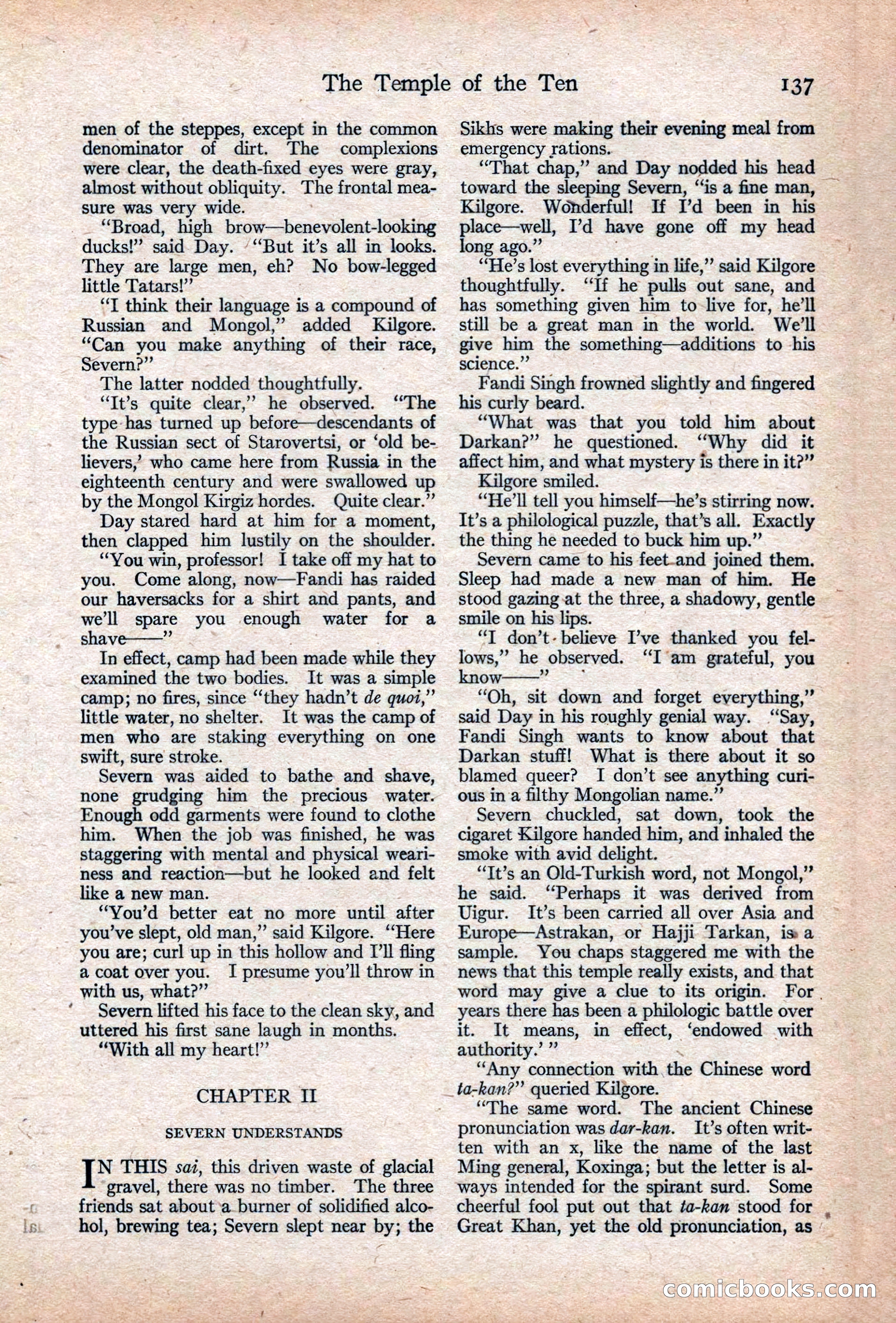
A restored page from Pulp Fiction, 1921. Page through the whole issue in the reader above.
📄 Transcribed text from this page (OCR, searchable)
Machine-transcribed from the original scan — historical spelling and the odd misread are preserved.
The Temple of the Ten men of the steppes, except in the common denominator of dirt. The complexions were clear, the death-fixed eyes were gray, almost without obliquity. The frontal mea- sure was very wide. : “Broad, high brow—benevolent-looking ducks!” said Day. ‘‘‘But it’s all in looks. They are large men, eh? No bow-legged little Tatars!” “T think their language is a compound of Russian and Mongol,” added Kilgore. “Can you make anything of their race, Severn?” | The latter nodded thoughtfully. “Tt’s quite clear,’ he observed. “The type: has turned up before—descendants of the Russian sect of Starovertsi, or ‘old be- lievers,’ who came here from Russia in the eighteenth century and were swallowed up by the Mongol Kirgiz hordes. Quite clear.” Day stared hard at him for a moment, then clapped him lustily on the shoulder. “You win, professor! I take off my hat to you. Come along, now—Fandi has raided our haversacks for a shirt and pants, and we'll spare you enough water for a shave——” In effect, camp had been made while they examined the two bodies. It was a simple camp; no fires, since ‘“‘they hadn’t de quoi,”’ little water, no shelter. It was the camp of men who are staking everything on one swift, sure stroke. Severn was aided to bathe and shave, none grudging him the precious water. Enough odd garments were found to clothe him. When the job was finished, he was staggering with mental and physical weari- ness and reaction—but he looked and felt like a new man. “You'd better eat no more until after you’ve slept, old man,” said Kilgore. “Here you are; curl up in this hollow and Tl fling a coat over you. I presume you'll throw in with us, what?” Severn lifted his face to the clean sky, and uttered his first sane laugh in months. “With all my heart!” CHAPTER II SEVERN UNDERSTANDS [4 THIS sai, this driven waste of glacial gravel, there was no timber. The three friends sat about ‘a burner of solidified alco- hol, brewing tea; Severn slept near by; the 137 Sikhs were making their evening meal from emergency rations. “That chap,” and Day nodded his head toward the sleeping Severn, “is a fine man, Kilgore. Wonderful! If I’d been in his place—well, I'd have gone off my head long ago.’ ‘He’s lost everything in life,” said Kilgore thoughtfully. “If he pulls out sane, and has something given him to live for, he'll still be a great man in the world. We'll give him the something—additions to -his science.’ Fandi Singh frowned slightly and fingered his curly beard. “What was that you told him about Darkan?” he questioned. “Why did it affect him, and what mystery is there i in it?” Kilgore ‘smiled. “He'll tell you himself—he’s stirring now. It’s a philological puzzle, that’s all. Exactly the thing he needed to buck him up.” Severn came to his feet-and joined them. Sleep had made a new man of him. He stood gazing at the three, a shadowy, gentle smile on his lips. “T don’t- believe I’ve thanked you fel- lows,” he observed. “Tam grateful, you know “Oh, sit down and forget everything,” said Day in his roughly genial way. “Say, Fandi Singh wants to know about that Darkan stuff! What is there about it so blamed queer? I don’t see anything curi- ous ina filthy Mongolian name.” Severn chuckled, sat down, took the cigaret Kilgore handed him, and inhaled the smoke with avid delight. “Tt’s an Old-Turkish word, not Mongol,” he said. “Perhaps it was derived from Uigur. It’s been carried all over Asia and Europe—Astrakan, or Hajji Tarkan, is a sample. You chaps staggered me with the news that this temple really exists, and that word may give a clue to its origin. For. years there has been a philologic battle over it. It means, in effect, ‘endowed with authority.’ ” “Any connection with the Chinese word : ta-kan?” queried Kilgore. “The same word. The ancient Chinese pronunciation was dar-kan. It’s often writ- ten with an x, like the name of the last Ming general, Koxinga; but the letter is al- ways intended for the spirant surd. Some cheerful fool put out that ta-kan stood for Great Khan, yet the old pronunciation, as - Eomichooks (E(0) a