
Pulp Fiction, 1921 · page 189 of 204
Adventure Magazine Cover — page 189: what you’re looking at
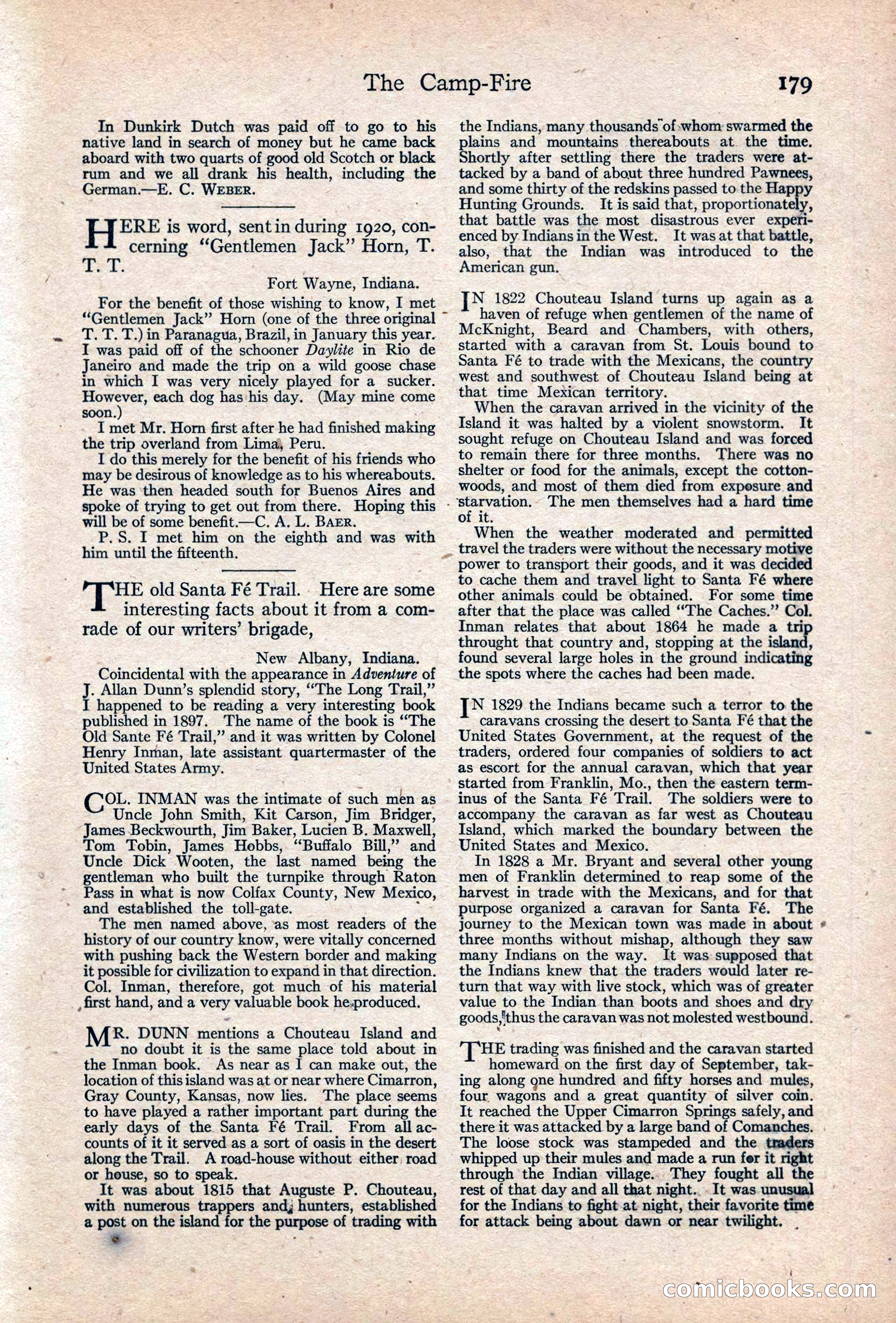
A restored page from Pulp Fiction, 1921. Page through the whole issue in the reader above.
📄 Transcribed text from this page (OCR, searchable)
Machine-transcribed from the original scan — historical spelling and the odd misread are preserved.
’ and established the toll-gate. The Camp-Fire In Dunkirk Dutch was paid off to go to his native land in search of money but he came back aboard with two quarts of good old Scotch or black rum and we all drank his health, including the German.—E. C. WEBER. ERE is word, sentin during 1920, con- cerning ‘Gentlemen Jack’ Horn, T. Le: Fort Wayne, Indiana. For the benefit of those wishing to know, I met “Gentlemen Jack” Horn (one of the three original ~ T. T. T.) in Paranagua, Brazil, in January this year. I was paid off of the schooner Daylite in Rio de Janeiro and made the trip on a wild goose chase in which I was very nicely played for a sucker. ee each dog has his day. (May mine come soon. : I met Mr. Horn first after he had finished making the trip overland from Lima, Peru. I do this merely for the benefit of his friends who may be desirous of knowledge as to his whereabouts. He was then headed south for Buenos Aires and spoke of trying to get out from there. Hoping this will be of some benefit.—C. A. L. BAER. P.S. I met him on the eighth and was with him until the fifteenth. HE old Santa Fé Trail... Here are some interesting facts about it from a com- rade of our writers’ brigade, New Albany, Indiana. Coincidental with the appearance in Adventure of J. Allan Dunn’s splendid story, ‘“The Long Trail,” I happened to be reading a very interesting book published in 1897. The name of the book is “The Old Sante Fé Trail,” and it was written by Colonel Henry Inman, late assistant quartermaster of the United States Army. Cot. INMAN was the intimate of such men as Uncle John Smith, Kit Carson, Jim Bridger, James Beckwourth, Jim Baker, Lucien B. Maxwell, Tom Tobin, James Hobbs, “Buffalo Bill,” and Uncle Dick Wooten, the last named being the gentleman who built the turnpike through Raton Pass in what is now Colfax County, New Mexico, The men named above, as most readers of the history of our country know, were vitally concerned with pushing back the Western border and making it possible for civilization to expand in that direction. Col. Inman, therefore, got much of his material _ first hand, and a very valuable book he.:produced. R. DUNN mentions a Chouteau Island and no doubt it is the same place told about in the Inman book. As near as I can make out, the location of this island was at or near where Cimarron, Gray County, Kansas, now lies. The place seems to have played a rather important part during the early days of the Santa Fé Trail. From all ac- counts of it it served as a sort of oasis in the desert along the Trail. A road-house without either road or house, so to speak. It was about 1815 that Auguste P. Chouteau, with numerous trappers andj hunters, established a post on the island for the purpose of trading with e ° 179 the Indians, many thousands of:whom: swarmed the plains and mountains thereabouts at the time. Shortly after settling there the traders were at- tacked by a band of about three hundred Pawnees, and some thirty of the redskins passed to the Happy Hunting Grounds. It is said that, proportionately, that battle was the most disastrous ever expefi- enced by Indians in the West. It was at that battle, also, that the Indian was introduced to the American gun. [NX 1822 Chouteau Island turns up again as a haven of refuge when gentlemen of the name of McKnight, Beard and Chambers, with others, started with a caravan from St. Louis bound to Santa Fé to trade with the Mexicans, the country west and southwest of Chouteau Island being at that time Mexican territory. When the caravan arrived in the vicinity of the Island it was halted by a violent snowstorm. It sought refuge on Chouteau Island and was forced to remain there for three months. There was no shelter or food for the animals, except the cotton- woods, and most of them died from expesure and . starvation.- The men themselves had a hard time of it. When the weather moderated and permitted _. travel the traders were without the necessary motive power to transport their goods, and it was decided to cache them and travel light to Santa Fé where other animals could be obtained. For some time after that the place was called “The Caches.’’ Col. Inman relates that about 1864 he made a tri throught that country and, stopping at the island, found several large holes in the ground indicating the spots where the caches had been made. IN 1829 the Indians became such a terror to the caravans crossing the desert to Santa Fé that the United States Government, at the request of the traders, ordered four companies of soldiers to act as escort for the annual caravan, which that year started from Franklin, Mo., then the eastern term- inus of the Santa Fé Trail. The soldiers were to accompany the caravan as far west as Chouteau Island, which marked the boundary between the United States and Mexico. In 1828 a Mr. Bryant and several other young men of Franklin determined to reap some of the harvest in trade with the Mexicans, and for that purpose organized a caravan for Santa Fé. The journey to the Mexican town was made in about three months without mishap, although they saw many Indians on the way. It was supposed that the Indians knew that the traders would later re- turn that way with live stock, which was of greater value to the Indian than boots and shoes and dry goods,'thus the caravan was not molested westbound. HE trading was finished and the caravan started homeward on the first day of September, tak- ing along gne hundred and fifty horses and mules, four wagons and a great quantity of silver coin. It reached the Upper Cimarron Springs safely, and 2 there it was attacked by a large band of Comanches. . The loose stock was stampeded and the traders whipped up their mules and made a run fer it right through the Indian village.. They fought all the rest of that day and all that night... It was unusual for the Indians to fight at night, their favorite time for attack being about dawn or near twilight. _ COMIC XOOK<S in (EO)