
Pulp Fiction, 1921 · page 192 of 204
Adventure Magazine Cover — page 192: what you’re looking at
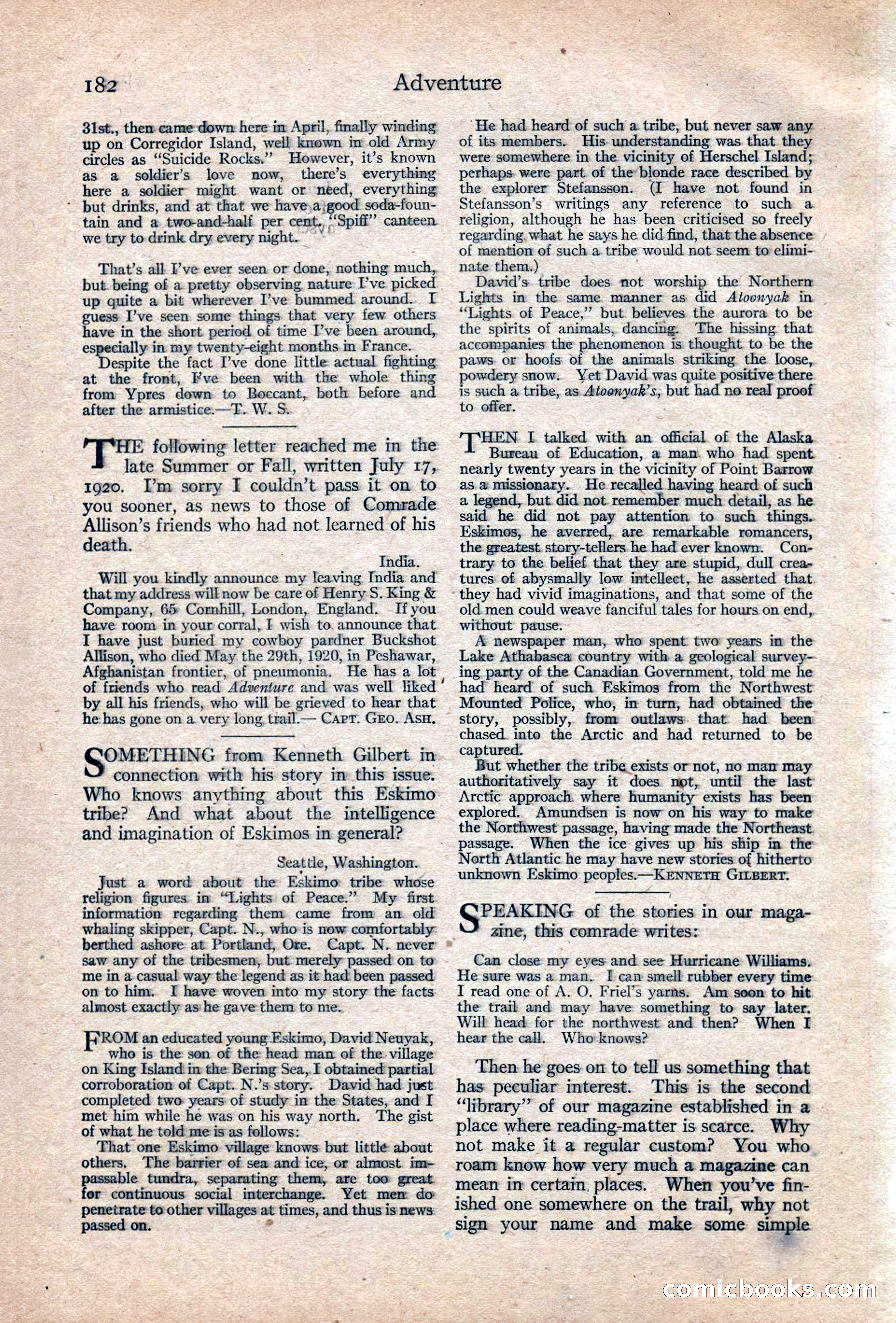
A restored page from Pulp Fiction, 1921. Page through the whole issue in the reader above.
📄 Transcribed text from this page (OCR, searchable)
Machine-transcribed from the original scan — historical spelling and the odd misread are preserved.
182° 31st., them came-dowr here im April, finally winding up on Corregidor Island, well known im old Army circles as ‘Suicide Rocks,” However, it’s known as a soldier’s love now, there’s everything here a soldier might want or need, everything * but drinks, and at that we havea} soda-foun- tain and a two-and-half per cent,, ~Spiff” canteen we try to drink dry every night. © That’s all I’ve ever seen or done, nothing much, but. being of a. pretty observing, nature I’ve picked _ up quite a bit wherever I’ve bummed. around... I guess I’ve seen some things. that very few others have in the short. period of time I’ve been around, especially in my twenty-eight months. in France. espite the fact I’ve done little actual fighting at the front, Fve been with the whole thing from Ypres down. to Boecant, both before and after the armistice.—T. W. S. 6 4/3 following letter reached me in the late Summer or Fall, written July 17, 1920. I’m sorry I couldn’t pass it on to you sooner, as news to those of Comrade Allison’s friends who had not learned of his death. India. Will you kindly announce my leaving India and that my address will now be care of Henry S. King & Company, 65 Cornhill, London, England. If you have room in your corral, I wish to. announce that I have just buried my cowboy pardner Buckshot Allison, who died May the 29th, 1920, in Peshawar, Afghanistan frontier, of pneumonia. He has a lot | of friends who read Adventure and was well liked by all his friends, who will be grieved to hear that he has gone on a very long, trail — Capt. Gro. As, OMETHING from Kenneth Gilbert. in connection with his story in this issue. Who knows anything about this Eskimo tribe? And what about the intelligence and imagination of Eskimos in general? Seattle, Washington. Just a word about the Eskimo tribe whose religion figures. im “Lights of Peace.” My first information r ag them came from an old whaling skipper, Capt. N., who is now comfortably berthed ashore at Portland, Ore. Capt. N. never * saw any of the tribesmen, but merely passed on to me in a casual way the legend as it had been on to him. I have woven into my story the facts almost exactly as he gave them to me. FROM: an educated young Eskimo, David Neuyak, who is the son of the head man of the. village on King Island in the Bering Sea, I obtained partial corroboration of Capt. N.’s story. David had just completed two: years of study in the States, and I met him while he was on his way north. The gist of what he told me is as follows: That one Eskimo village knows: but little about others. The barrier of sea and ice, or almost. im- le tundra, separating them, are too great. _ for continuous social Yet mem do penetrate to other villages at times, and thus is mews: passed on. ? Adventure ‘He had heard of such a tribe, reg am of its members. His-u as. that. they were somewhere in the vicinity of Tianichel Island; perhaps. were part of the blonde race described by the explorer Stefansson. (I have not found in Stefansson’s writings any reference to such a religion, although he has been criticised so freely regarding. what he says he did find, that the absence of mention of such a. tribe would not seem to elimi- nate them.) David’s tribe does not worship the Northern Lights in the same manner as Atoonyak in “Lights of Peace,” but believes the aurora to be the spirits of animals, dancing. The hissing that accompanies the phenomenon is thought to to be the paws. or hoofs of the animals striking the loose, powdery snow. Yet David was quite positive there is BES a tribe, as Atoonyak’s, but had no real proof to offer. THEN L talked with an official of the Alaska Bureau of Education, a man. who had spent. nearly twenty years in the vicinity of Point Barrow as a missionary. He ee ease go ag mag = gictngear amet 2 detail, as he said he did not pay attention to such things.. Eskimos, he averred, are remarkable romancers, the greatest. story-teHers he had ever known. Con- trary to the belief that they are stupid, dull crea- tures: of abysmally low intellect, he asserted that. ‘they had vivid imaginations, and that some of the old.men could weave fanciful tales for hours on end, without pause. A newspaper man, who spent two’ years im the Lake Athabasca country with a geological survey- ing party of the Canadian Government, told me he had heard of such Eskimos from the Northwest Mounted Police, who, in turn, had obtained the story, possibly, from outlaws. that had been chased into the Arctic and had returned to be captured. But whether the tribe exists or not, no man may authoritatively say it does not, until the last’ Arctic approach. where humanity exists has been explored. Amundsen is now on his way to make the Northwest passage, having made the Northeast. passage. When the ice gives up his ship in the North Atlantic he may have new stories of hitherto unknown Eskimo peoples.—KENNETH GILBERT. eit of the stories in our maga- zine, this comrade writes: Can close: my eyes and see Hurricane Williams. He sure was a man. I cam smell rubber every time I read one of A. O. Friel’s yarns. Am soon to hit the trail and may have something to say later. Will head for the northwest and then? When I hear the call. Who knows? Then he goes on to tell us something that has peculiar interest. This is the second “library” of our magazine established in a place where reading-matter is scarce. Why not make it a regular custom? You who roam know how very much a magazine can mean in certain, places. When you’ve fin- ished one somewhere on the trail, why not sign your name and make some simple EGomichooks (E@)