
Pulp Fiction, 1921 · page 47 of 204
Adventure Magazine Cover — page 47: what you’re looking at
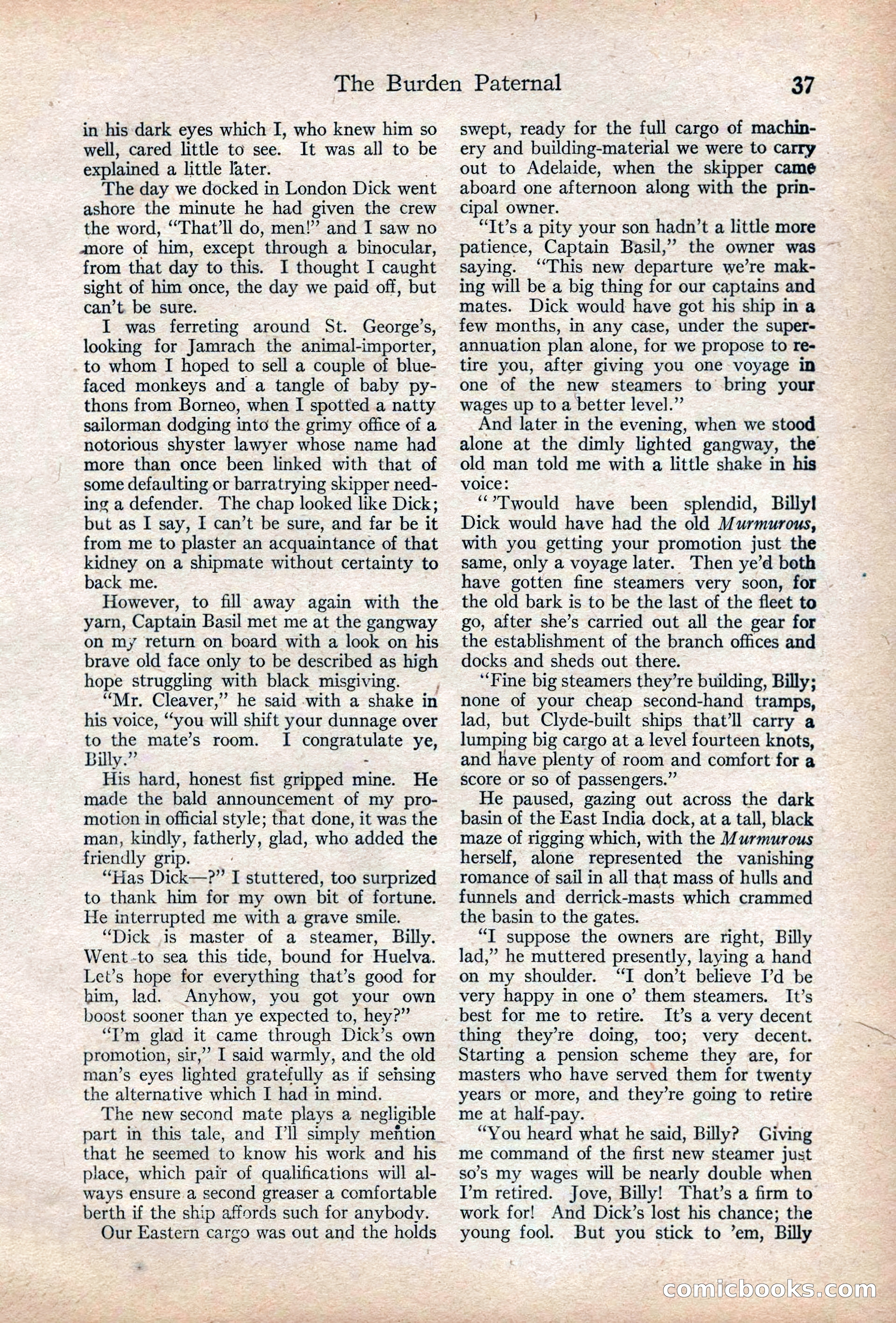
A restored page from Pulp Fiction, 1921. Page through the whole issue in the reader above.
📄 Transcribed text from this page (OCR, searchable)
Machine-transcribed from the original scan — historical spelling and the odd misread are preserved.
The Burden Paternal in his dark eyes which I, who knew him so well, cared little to see. It was all to be explained a little later. The day we docked in London Dick went ashore the minute he had given the crew the word, ‘““That’ll do, men!” and I saw no anore of him, except ‘through a binocular, from that day to this. I thought I caught sight of him once, the day we paid off, but can’t. be sure. I was ferreting around St. George’s, looking for Jamrach the animal-importer, to whom I hoped to sell a couple of blue- faced monkeys and a tangle of baby py- thons from Borneo, when I spotted a natty sailorman dodging into the grimy office of a notorious shyster lawyer whose name had more than once been linked with that of some defaulting or barratrying skipper need- ing a defender. The chap looked like Dick; but as I say, I can’t be sure, and far be it from me to plaster an acquaintance of that kidney on a shipmate without certainty to back me. However, to fill away again with the yarn, Captain Basil met me at the gangway on my return on board with a look on his brave old face only to be described as high hope struggling with black misgiving. “Mr. Cleaver,”’ his voice, “you will shift your dunnage over to the mate’s room. I pe eas ye, Billy.” His hard, honest fist gripped mine. He made the bald announcement of my pro- motion in official style; that done, it was the man, kindly, fatherly, glad, who ‘added the friendly grip. “Has Dick—?”’ I stuttered, too surprized to thank him for my own bit of fortune. He interrupted me with a grave smile. “Dick is master of a steamer, Billy. Went-to sea this tide, bound for Huelva. Let’s hope for everything that’s good for him, lad. Anyhow, you got your own boost sooner than ye expected to, hey?” “Vm glad it came through Dick’s own promotion, sir,” I said warmly, and the old man’s eyes lighted gratefully as if sehsing the alternative which I had in mind. The new second mate plays a negligible part in this tale, and I’ll simply mention_ that he seemed to know his work and his place, which pair of qualifications will al- ways ensure a second greaser a comfortable berth if the ship affords such for anybody. Our Eastern cargo was out and the holds he said with a shake in 37 swept, ready for the full cargo of machin- ery and building-material we were to carry | out to Adelaide, when the skipper came aboard one afternoon along with the prin- cipal owner. “It’s a pity your son hadn’t a little more patience, Captain Basil,” the owner was ~ saying. ‘This new departure we’re mak- ing will be a big thing for our captains and mates. Dick would have got his ship ina few months, in any case, under the super- annuation plan alone, for we propose to re- tire you, after giving you one voyage in one of the new steamers to bring your wages up to a better level.”’ And later in the evening, when we stood alone at the dimly lighted gangway, the old man told me with a little shake in his voice: ‘“°Twould have been splendid, Billy! Dick would have had the old Murmurous, with you getting your promotion just the same, only a voyage later. Then ye’d both have gotten fine steamers very soon, for the old bark is to be the last of the fleet to go, after she’s carried out all the gear for the establishment of the branch offices and docks and sheds out there. ‘‘Fine big steamers they’re building, Billy; none of your cheap second-hand tramps, lad, but Clyde-built ships that'll carry a lumping big cargo at a level fourteen knots, and have plenty of room and comfort for a score or so of passengers.” He paused, gazing out across the dark basin of the East India dock, at a tall, black maze of rigging which, with the Murmurous herself, alone represented the vanishing romance of sail in all that mass of hulls and funnels and derrick-masts which crammed the basin to the gates. “I suppose the owners are right, Billy lad,” he muttered presently, laying a hand on my shoulder. “I don’t believe I’d be very happy in one o’ them steamers. It’s best for me to retire. It’s a very decent thing they’re doing, too; very decent. Starting a pension scheme they are, for masters who have served them for twenty years or more, and they’re going to retire me at half-pay. “You heard what he said, Billy? Giving me command of the first new steamer just so’s my wages will be nearly double when I’m retired. Jove, Billy! That’s a firm to work for! And Dick’s lost his chance; the young fool. But you stick to ’em, Billy CONNIE DOOlKS (E@)