
Pulp Fiction, 1921 · page 65 of 204
Adventure Magazine Cover — page 65: what you’re looking at
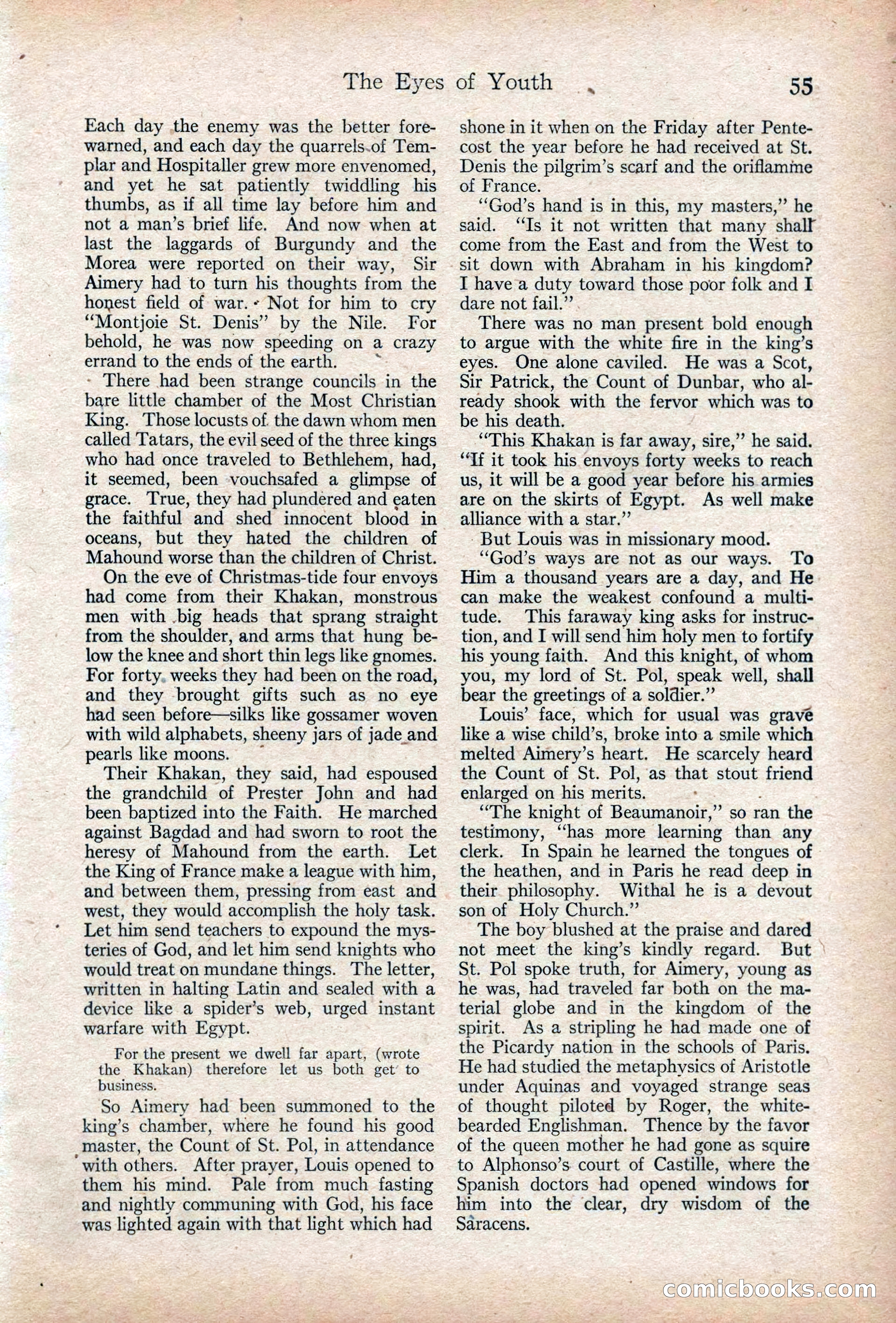
A restored page from Pulp Fiction, 1921. Page through the whole issue in the reader above.
📄 Transcribed text from this page (OCR, searchable)
Machine-transcribed from the original scan — historical spelling and the odd misread are preserved.
The Eyes of Youth Each day the enemy was the better fore- warned, and each day the quarrels.of Tem- plar and Hospitaller grew more envenomed, and yet he sat patiently twiddling his thumbs, as if all time lay before him and not a man’s brief life. And now when at last the laggards of Burgundy and the Morea were reported on their way, Sir Aimery had to turn his thoughts from the honest field of war.- Not for him to cry ““Montjoie St. Denis” by the Nile. For behold, he was now speeding on a crazy errand to the ends of the earth. - There had been strange councils in the ae little chamber of the Most Christian King. Those locusts of. the dawn whom men called Tatars, the evil seed of the three kings who had once traveled to Bethlehem, had, it seemed, been vouchsafed a glimpse of grace. True, they had plundered and eaten the faithful and shed innocent blood in oceans, but they hated the children of Mahound worse than the children of Christ. On the eve of Christmas-tide four envoys had come from their Khakan, monstrous men with .big heads that sprang straight from the shoulder, and arms that hung be- low the knee and short thin legs like gnomes. For forty. weeks they had been on the road, and they brought gifts such as no eye had seen before—silks like gossamer woven with wild alphabets, sheeny jars of jade_and pearls like moons. Their Khakan, they said, had espoused the grandchild of Prester John and had been baptized into the Faith. He marched against Bagdad and had sworn to root the heresy of Mahound from the earth. Let the King of France make a league with him, and between them, pressing from east and west, they would accomplish the holy task. Let him send teachers to expound the mys- teries of God, and let him send knights who would treat on mundane things. The letter, written in halting Latin and sealed with a device like a spider’s web, urged instant warfare with Egypt. For the present we dwell far apart, (wrote the Khakan) therefore let us both get’ to business. So Aimery had been summoned to the king’s chamber, where he found his good master, the Count of St. Pol, in attendance ‘with others. After prayer, Louis opened to them his mind. Pale from much fasting and nightly communing with God, his face was lighted again with that light which had eas +55 shone in it when on the Friday after Pente- cost the year before he had received at St. Denis the pilgrim’s scarf and the oriflamme of France. ‘““God’s hand is in this, my masters,” he said. “Is it not written that many shalf come from the East and from the West to -sit down with Abraham in his kingdom? I have a duty toward those poor folk and I dare not fail.”’ There was no man present bold enough to argue with the white fire in the king’s eyes. One alone caviled. He was a Scot, Sir Patrick, the Count of Dunbar, who al- ready shook with the fervor which was to be his death. “This Khakan is far away, sire,” he said. “Tf it took his envoys forty weeks to reach us, it will be a good year before his armies are on the skirts of Egypt. As well make alliance with a star.” -But Louis was in missionary mood. ‘““God’s ways are not as our ways. To Him a thousand years are a day, and He can make the weakest confound a multi- tude. This faraway king asks for instruc- tion, and I will send him holy men to fortify his young faith. And this knight, of whom you, my lord of St. Pol, speak well, shall bear the greetings of a soldier.” Louis’ face, which for usual was grave like a wise child’s, broke into a smile which melted Aimery’s heart. He scarcely heard the Count of St. Pol, as that stout friend enlarged on his merits. “The knight of Beaumanoir,” so ran the testimony, ‘has more learning than any clerk. In Spain he learned the tongues of the heathen, and in Paris he read deep in their philosophy. Withal he is a devout son of Holy Church.” The boy blushed at the praise and dared not meet the king’s kindly regard. But St. Pol spoke truth, for Aimery, young as he was, had traveled far both on the ma- terial globe and in the kingdom of the spirit. As a stripling he had made one of the Picardy nation in the schools of Paris. He had studied the metaphysics of Aristotle under Aquinas and voyaged strange seas of thought piloted by Roger, the white- bearded Englishman. Thence by the favor of the queen mother he had gone as squire to Alphonso’s court of Castille, where the Spanish doctors had opened windows for him into the clear, dry wisdom of the Saracens. comichbook (E@)