
Pulp Fiction, 1921 · page 67 of 204
Adventure Magazine Cover — page 67: what you’re looking at
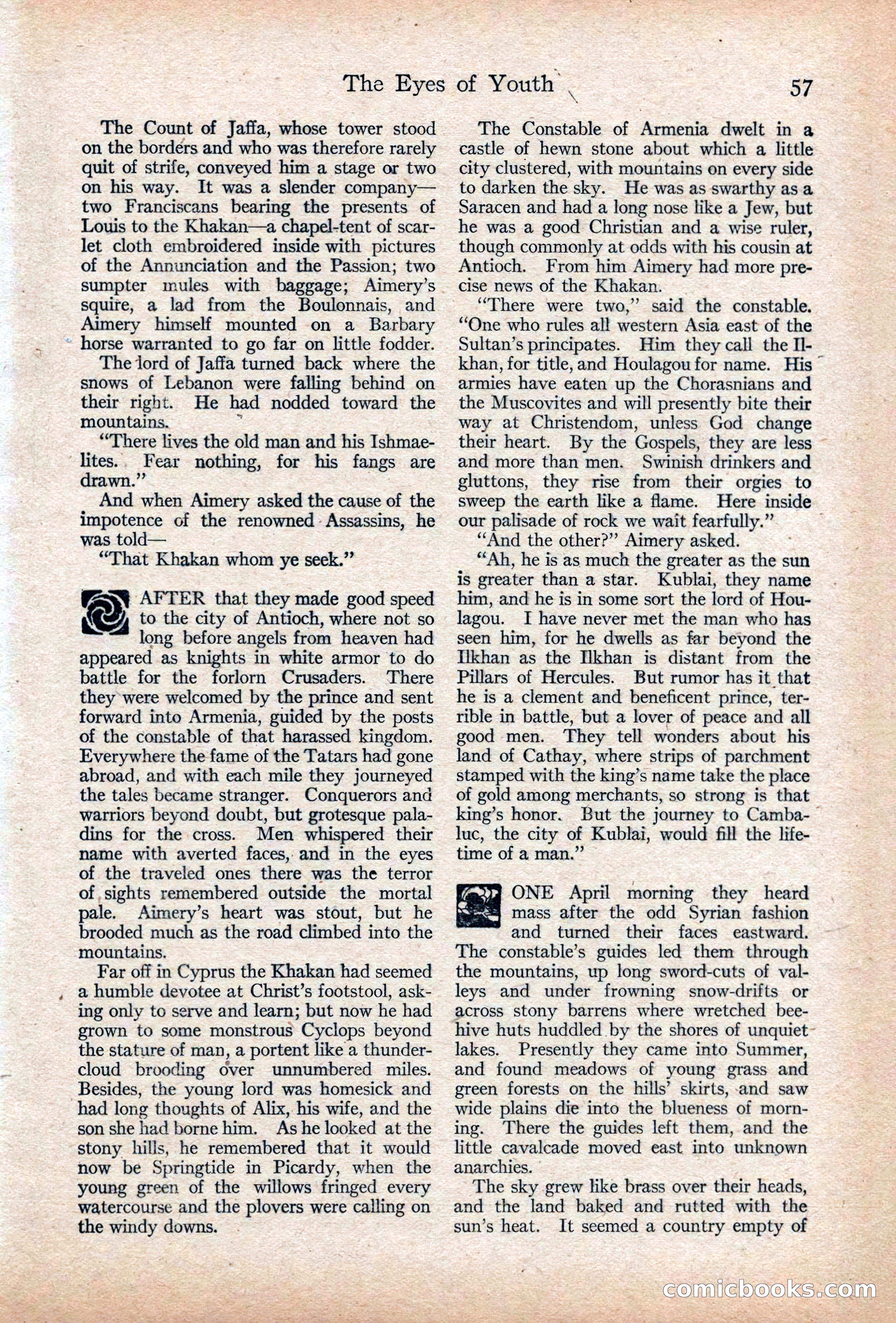
A restored page from Pulp Fiction, 1921. Page through the whole issue in the reader above.
📄 Transcribed text from this page (OCR, searchable)
Machine-transcribed from the original scan — historical spelling and the odd misread are preserved.
The Eyes The Count of Jaffa, whose tower stood on the borders and who was therefore rarely quit of strife, conveyed him a stage or two on his way. It was a slender company— two Franciscans bearing the presents of Louis to the Khakan—a chapel-tent of scar- let cloth embroidered inside with pictures of the Annunciation and the Passion; two sumpter mules with baggage; Aimery’s squire, a lad from the Boulonnais, and Aimery himself mounted on a Barbary * horse warranted to go far on little fodder. The lord of Jaffa turned back where the snows of Lebanon were falling behind on their right. He had nodded toward the mountains. z “There lives the old man and his Ishmae- lites.. Fear nothing, for his fangs are drawn. > And when Aimery asked the cause of the impotence of the renowned Assassins, he was told— “That Khakan whom ye seek.” Gant AFTER that they made good speed KO) to the city of Antioch, where not so long before angels from heaven had appeared as knights in white armor to do battle for the forlorn Crusaders. There they were welcomed by the prince and sent forward into Armenia, guided by the posts of the constable of that harassed kingdom. Everywhere the fame of the Tatars had gone abroad, and with each mile they journeyed the tales became stranger. Conquerors and warriors beyond doubt, but grotesque pala- dins for the cross. Men whispered their name with averted faces, and in the eyes of the traveled ones there was the terror of sights remembered outside the mortal pale. Aimery’s heart was stout, but he brooded much as the road climbed into the mountains. Far off in Cyprus the Khakan had seemed a humble devotee at Christ’s footstool, ask- ing only to serve and learn; but now he had grown to some monstrous Cyclops beyond the stature of man, a portent like a thunder- cloud brooding over unnumbered miles. Besides, the young lord was homesick and had long thoughts of Alix, his wife, and the son she had borne him. As he looked at the stony hills, he remembered that it would now be Springtide in Picardy, when the young green of the willows fringed every watercourse and the plovers were calling on the windy downs. o7 The Constable of Armenia dwelt in a castle of hewn stone about which a little city clustered, with mountains on every side to darken the sky. He was as swarthy asa Saracen and had a long nose like a Jew, but he was a good Christian and a wise ruler, though commonly at odds with his cousin at Antioch. From him Aimery had more pre- cise news of the Khakan. ‘There were two,” said the constable. “One who rules all western Asia east of the Sultan’s principates. Him they call the II- of Youth . khan, for title, and Houlagou for name. His armies have eaten up the Chorasnians and the Muscovites and will presently bite their way at Christendom, unless God change their heart. and more than men. Swinish drinkers and gluttons, they rise from their orgies to sweep the earth like a flame. our palisade of rock we wait fearfully.” “And the other?” Aimery asked. ““Ah, he is as much the greater as the sun is greater than a star. Kublai, they name him, and he is in some sort the lord of Hou- lagou. I have never met the man who has seen him, for he dwells as far beyond the Iikhan as the Ilkhan is distant from the Pillars of Hercules. But rumor has it that he is a clement and beneficent prince, ter- rible in battle, but a lover of peace and all good men. They tell wonders about his land of Cathay, where strips of parchment stamped with the king’s name take the place of gold among merchants, so strong is that king’s honor. luc, the city of Kublai, would fill the life- time of a man.” uy ONE April morning they heard S wa mass after the odd Syrian fashion and turned their faces eastward. The constable’s guides led them through the mountains, up long sword-cuts of val- leys and under frowning snow-drifts or across stony barrens where wretched bee- hive huts huddled by the shores of unquiet- lakes. Presently they came into Summer, and found meadows of young grass and green forests on the hills’ skirts, -and saw wide plains die into the blueness of morn- ing. ‘There the guides left them, and the little cavalcade moved east into unknown anarchies. | The sky grew lke brass over their heads, and the land baked and rutted with the sun’s heat. It seemed a country empty of com <S By the Gospels, they are less ~ Here inside But the journey to Camba-— JOO EO