
Pulp Fiction, 1921 · page 120 of 204
Adventure Magazine Cover — page 120: what you’re looking at
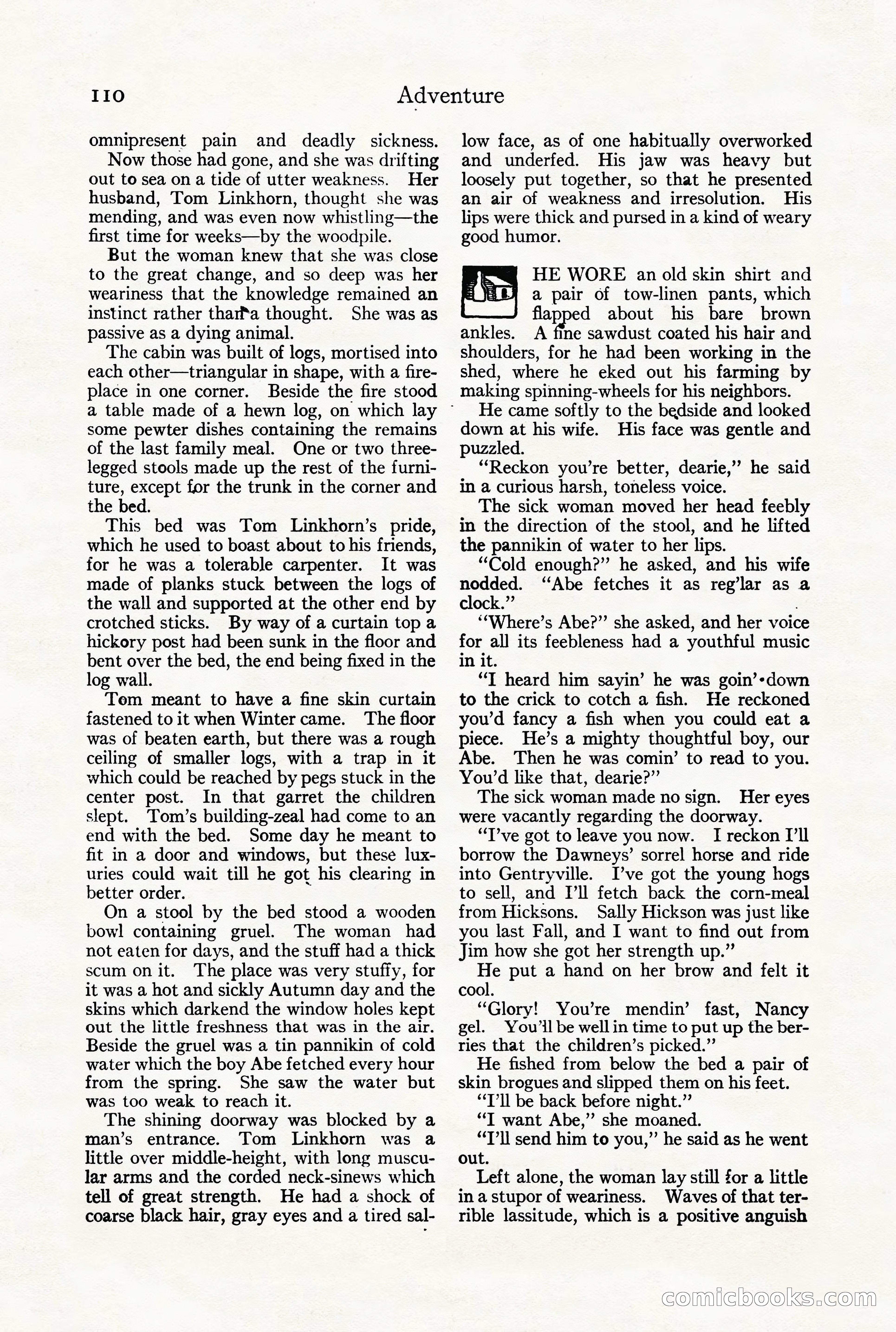
A restored page from Pulp Fiction, 1921. Page through the whole issue in the reader above.
📄 Transcribed text from this page (OCR, searchable)
Machine-transcribed from the original scan — historical spelling and the odd misread are preserved.
IIo omnipresent pain and deadly sickness. Now those had gone, and she was drifting out to sea on a tide of utter weakness. Her husband, Tom Linkhorn, thought she was mending, and was even now whistling—the first time for weeks—by the woodpile. But the woman knew that she was close to the great change, and so deep was her weariness that the knowledge remained an instinct rather tharfa thought. She was as passive as a dying animal. The cabin was built of logs, mortised into each other—triangular in shape, with a fire- place in one corner. Beside the fire stood a table made of a hewn log, on which lay ~ some pewter dishes containing the remains of the last family meal. One or two three- legged stools made up the rest of the furni- ture, except for the trunk in the corner and the bed. This bed was Tom Linkhorn’s pride, which he used to boast about to his friends, for he was a tolerable carpenter. It was made of planks stuck between the logs of the wall and supported at the other end by crotched sticks. By way of a curtain topa hickory post had been sunk in the floor and bent over the bed, the end being fixed in the log wall. Tom meant to have a fine skin curtain fastened to it when Winter came. The floor was of beaten earth, but there was a rough ceiling of smaller logs, with a trap in it which could be reached by pegs stuck in the center post. In that garret the children slept. Tom’s building-zeal had come to an end with the bed. Some day he meant to fit in a door and windows, but these lux- uries could wait till he got his clearing in better order. On a stool by the bed stood a wooden bowl containing gruel. The woman had not eaten for days, and the stuff had a thick scum on it. The place was very stuffy, for it was a hot and sickly Autumn day and the skins which darkend the window holes kept out the little freshness that was in the air. Beside the gruel was a tin pannikin of cold water which the boy Abe fetched every hour from the spring. She saw the water but was too weak to reach it. The shining doorway was blocked by a man’s entrance. Tom Linkhorn was a little over middle-height, with long muscu- lar arms and the corded neck-sinews which tell of great strength. He had a shock of coarse black hair, gray eyes and a tired sal- Adventure low face, as of one habitually overworked and underfed. His jaw was heavy but loosely put together, so that he presented an air of weakness and irresolution. His lips were thick and pursed in a kind of weary good humor. HE WORE an old skin shirt and a pair of tow-linen pants, which flapped about his bare brown ankles. A fine sawdust coated his hair and shoulders, for he had been working in the shed, where he eked out his farming by making spinning-wheels for his neighbors. He came softly to the bedside and looked down at his wife. His face was gentle and puzzled. ‘“‘Reckon yow’re better, dearie,”’ he said in a curious harsh, toneless voice. The sick woman moved her head feebly in the direction of the stool, and he lifted the pannikin of water to her lips. ‘“‘Cold enough?” he asked, and his wife nodded. “Abe fetches it as reg’lar as a clock.”’ ‘‘Where’s Abe?” she asked, and her voice for all its feebleness had a youthful music in it. “TI heard him sayin’ he was goin’*down to the crick to cotch a fish. He reckoned you’d fancy a fish when you could eat a piece. He’s a mighty thoughtful boy, our Abe. Then he was comin’ to read to you. You’d like that, dearie?”’ The sick woman made no sign. Her eyes were vacantly regarding the doorway. “T’ve got to leave you now. I reckon I’ll borrow the Dawneys’ sorrel horse and ride into Gentryville. I’ve got the young hogs to sell, and I'll fetch back the corn-meal from Hicksons. Sally Hickson was just like you last Fall, and I want to find out from Jim how she got her strength up.” He put a hand on her brow and felt it cool. “Glory! You’re mendin’ fast, Nancy gel. You'll be well in time to put up the ber- ries that the children’s picked.” He fished from below the bed a pair of skin brogues and slipped them on his feet. “‘T’ll be back before night.” “TI want Abe,” she moaned. “T’ll send him to you,” he said as he went out. Left alone, the woman lay still for a little in a stupor of weariness. Waves of that ter- rible lassitude, which is a positive anguish Aw COmiclbook CO