
Pulp Fiction, 1921 · page 121 of 204
Adventure Magazine Cover — page 121: what you’re looking at
A restored page from Pulp Fiction, 1921. Page through the whole issue in the reader above.
📄 Transcribed text from this page (OCR, searchable)
Machine-transcribed from the original scan — historical spelling and the odd misread are preserved.
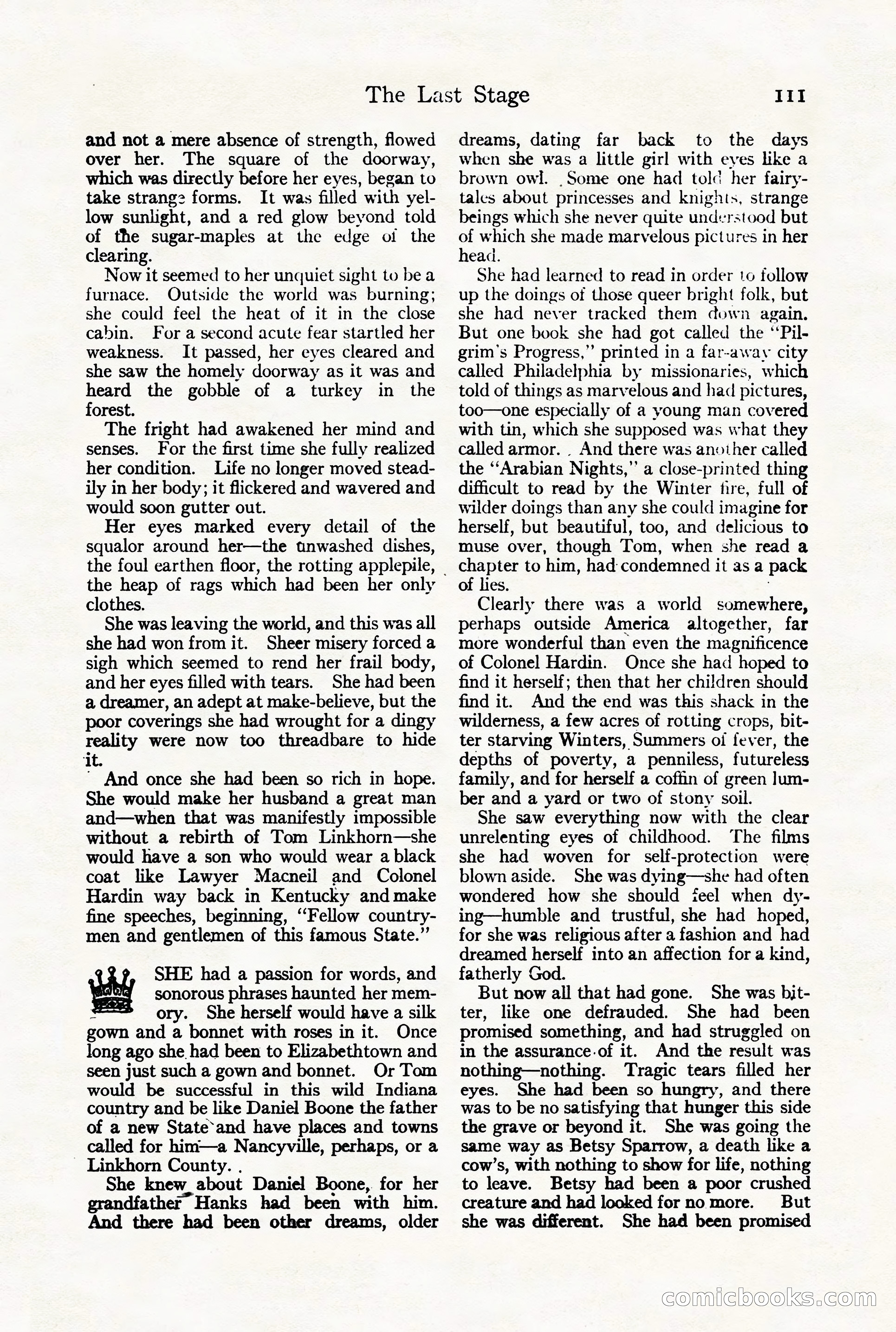
The Last Stage and not a mere absence of strength, flowed over her. The square of the doorway, which was directly before her eyes, began to take strang2 forms. It was filled with yel- low sunlight, and a red glow beyond told of the sugar-maples at the edge of the clearing. Now it seemed to her unquiet sight to be a furnace. Outside the world was burning; she could feel the heat of it in the close cabin. Fora second acute fear startled her weakness. It passed, her eyes cleared and she saw the homely doorway as it was and heard the gobble of a turkey in the forest. The fright had awakened her mind and senses. For the first time she fully realized her condition. Life no longer moved stead- ily in her body; it flickered and wavered and would soon gutter out. Her eyes marked every detail of the squalor around her—the tnwashed dishes, the foul earthen floor, the rotting applepile, the heap of rags which had been her only clothes. She was leaving the world, and this was all she had won from it. Sheer misery forced a sigh which seemed to rend her frail body, and her eyes filled with tears. She had been a dreamer, an adept at make-believe, but the poor coverings she had wrought for a dingy reality were now too threadbare to hide It. ' And once she had been so rich in hope. She would make her husband a great man and—when that was manifestly impossible without a rebirth of Tom Linkhorn—she would have a son who would wear a black coat like Lawyer Macneil and Colonel Hardin way back in Kentucky and make fine speeches, beginning, “Fellow country- men and gentlemen of this famous State.”’ SHE had a passion for words, and sonorous phrases haunted her mem- * ory. She herself would have a silk gown and a bonnet with roses in it. Once long ago she had been to Elizabethtown and seen just such a gown and bonnet. Or Tom would be successful in this wild Indiana country and be like Daniel Boone the father of a new Stateand have places and towns called for him—a Nancyville, perhaps, or a Linkhorn County. . She knew, about Daniel Boone, for her grandfather Hanks had been with him. And there had been other dreams, older Ii! dreams, dating far back to the days when she was a little girl with eves like a brown owl. _Some one had tole her fairy- tales about princesses and knights, strange beings which she never quite understood but of which she made marvelous pictures in her head. She had learned to read in order to follow up the doings of those queer bright folk, but she had never tracked them down again. But one book she had got called the ‘‘Pil- grim’s Progress,” printed in a far-away city called Philadelphia by missionaries, which told of things as marvelous and had pictures, too—one especially of a young man covered with tin, which she supposed was what they called armor. . And there was anther called the ‘Arabian Nights,”’ a close-printed thing difficult to read by the Winter fire, full of wilder doings than any she could imagine for herself, but beautiful, too, and delicious to muse over, though Tom, when she read a _ chapter to him, had: condemned it asa pack of lies. Clearly there was a world somewhere, perhaps outside America altogether, far more wonderful than even the magnificence of Colonel Hardin. Once she had hoped to find it herself; then that her children should find it. And the end was this shack in the wilderness, a few acres of rotting crops, bit- ter starving Winters, Summers oi fever, the depths of poverty, a penniless, futureless family, and for herself a coffin of green ]um- ber and a yard or two of stony soil. She saw everything now with the clear unrelenting eyes of childhood. The films she had woven for self-protection were blown aside. She was dying—she had often wondered how she should seel when dy- ing—humble and trustful, she had hoped, for she was religious after a fashion and had dreamed herself into an affection for a kind, fatherly God. But now all that had gone. She was bit- ter, like one defrauded. She had been promised something, and had struggled on in the assurance.of it. And the result was nothing—nothing. Tragic tears filled her eyes. She had been so hungry, and there was to be no satisfying that hunger this side the grave or beyond it. She was going the same way as Betsy Sparrow, a death like a cow’s, with nothing to show for life, nothing to leave. Betsy had been a poor crushed creature and had looked forno more. But she was different. She had been promised Comicbook ©