
Pulp Fiction, 1921 · page 123 of 204
Adventure Magazine Cover — page 123: what you’re looking at
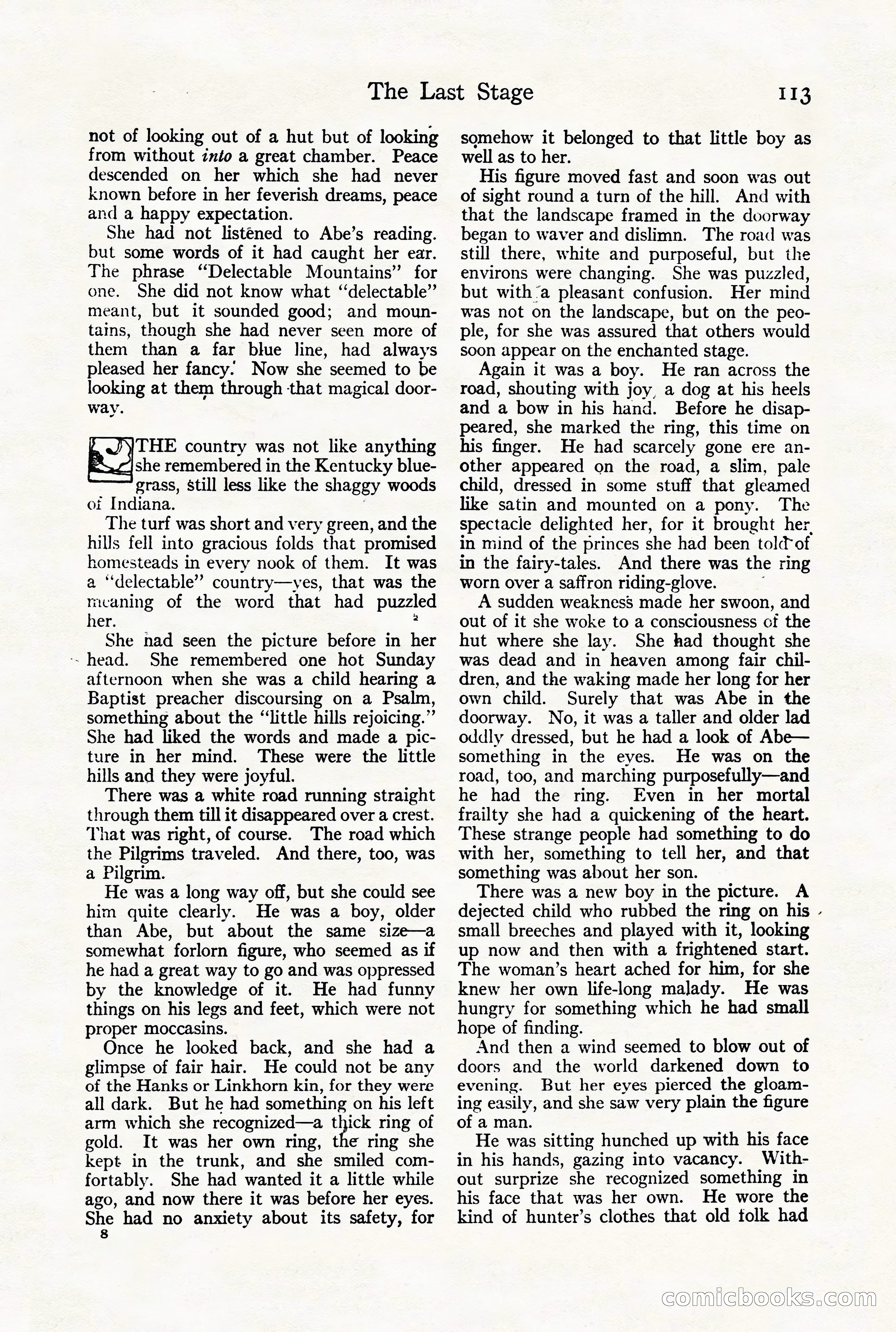
A restored page from Pulp Fiction, 1921. Page through the whole issue in the reader above.
📄 Transcribed text from this page (OCR, searchable)
Machine-transcribed from the original scan — historical spelling and the odd misread are preserved.
The Last Stage not of looking out of a hut but of looking from without into a great chamber. Peace descended on her which she had never known before in her feverish dreams, peace and a happy expectation. She had not listened to Abe’s reading. but some words of it had caught her ear. The phrase “Delectable Mountains’ for one. She did not know what “‘delectable”’ meant, but it sounded good; and moun- tars, though she had never seen more of them than a far blue line, had always pleased her fancy. Now she seemed to be looking at them through that magical door- way. v BX she remembered in the Kentucky blue- grass, Still less like the shaggy woods oi Indiana. The turf was short and very green, and the hills fell into gracious folds that promised homesteads in every nook of them. It was a “delectable” country—yes, that was the micaning of the word that had puzzled her. : She nad seen the picture before in her -- head. She remembered one hot Sunday afternoon when she was a child hearing a Baptist preacher discoursing on a Psalm, something about the “‘little hills rejoicing.”’ She had liked the words and made a pic- ture in her mind. These were the little hills and they were joyful. There was a white road running straight through them till it disappeared over a crest. ‘hat was right, of course. The road which the Pilgrims traveled. And there, too, was a Pilgrim. He was a long way off, but she could see him quite clearly. He was a boy, older than Abe, but about the same size—a somewhat forlorn figure, who seemed as if he had a great way to go and was oppressed by the knowledge of it. He had funny things on his legs and feet, which were not proper moccasins. Once he looked back, and she had a glimpse of fair hair. He could not be any of the Hanks or Linkhorn kin, for they were all dark. But he had something on his left arm which she recognized—a thick ring of gold. It was her own ring, the ring she kept in the trunk, and she smiled com- fortably. She had wanted it a little while ago, and now there it was before her eyes. She had no anxiety about its safety, for 8 THE country was not like anything 113 somehow it belonged to that little boy as well as to her. His figure moved fast and soon was out of sight round a turn of the hill. And with that the landscape framed in the doorway began to waver and dislimn. The road was still there, white and purposeful, but the environs were changing. She was puzzled, but with’a pleasant confusion. Her mind was not on the landscape, but on the peo- ple, for she was assured that others would soon appear on the enchanted stage. Again it was a boy. He ran across the road, shouting with joy, a dog at his heels and a bow in his hand. Before he disap- peared, she marked the ring, this time on his finger. He had scarcely gone ere an- other appeared on the road, a slim, pale child, dressed in some stuff that gleamed like satin and mounted on a pony. The spectacle delighted her, for it brought her. in mind of the princes she had been told of in the fairy-tales. And there was the ring worn over a saffron riding-glove. A sudden weakness made her swoon, and out of it she woke to a consciousness of the hut where she lay. She had thought she was dead and in heaven among fair chil- dren, and the waking made her long for her own child. Surely that was Abe in the doorway. No, it was a taller and older lad oddly dressed, but he had a look of Abe— something in the eyes. He was on the road, too, and marching purposefully—and he had the ring. Even in her mortal frailty she had a quickening of the heart. These strange people had something to do with her, something to tell her, and that something was about her son. There was a new boy in the picture. A dejected child who rubbed the ring on his - small breeches and played with it, looking up now and then with a frightened start. The woman’s heart ached for him, for she knew her own life-long malady. He was hungry for something which he had small hope of finding. And then a wind seemed to blow out of doors and the world darkened down to evening. But her eyes pierced the gloam- ing easily, and she saw very plain the figure of a man. He was sitting hunched up with his face in his hands, gazing into vacancy. With- out surprize she recognized something in his face that was her own. He wore the kind of hunter’s clothes that old folk had cComicbhook ©