
Pulp Fiction, 1921 · page 122 of 204
Adventure Magazine Cover — page 122: what you’re looking at
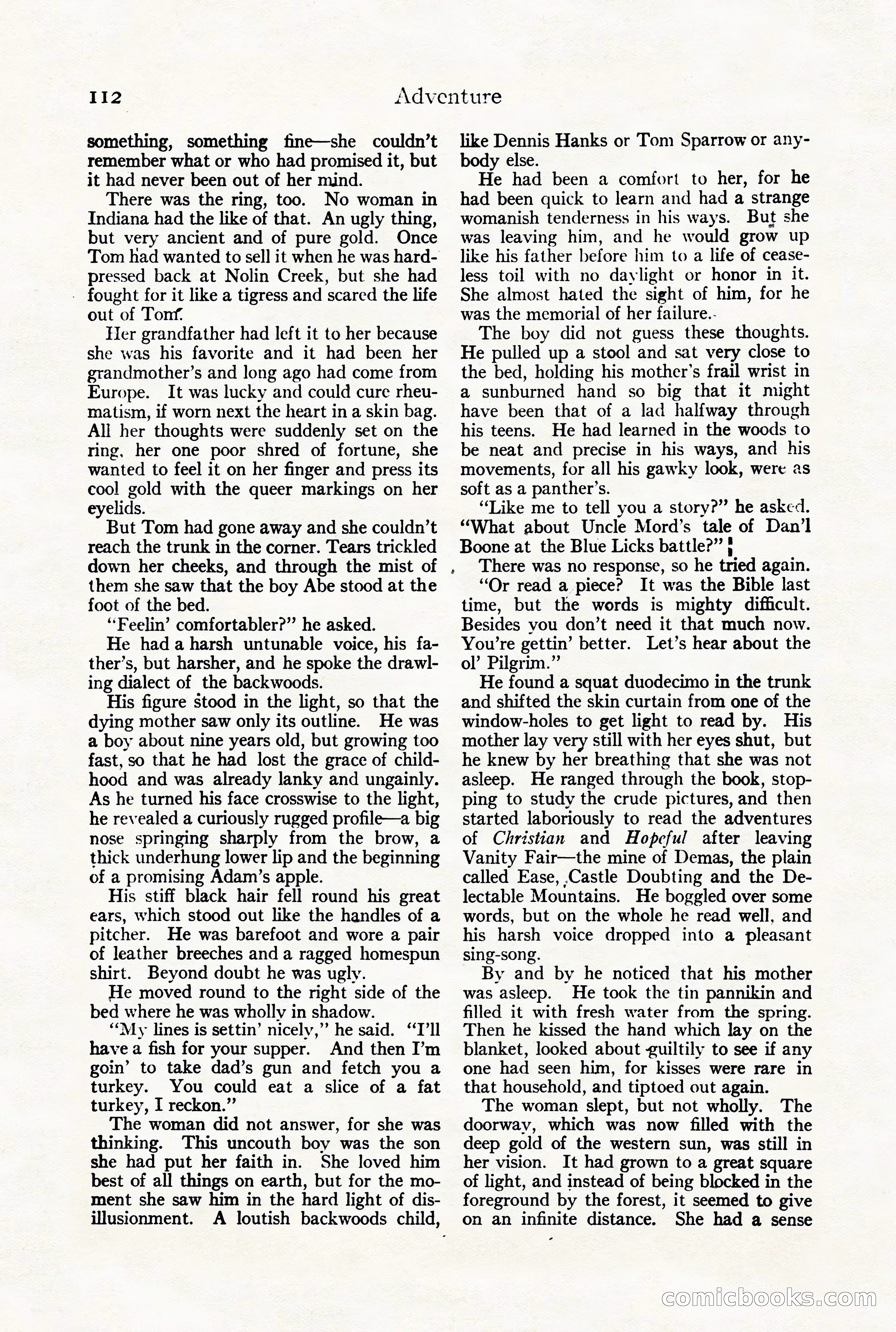
A restored page from Pulp Fiction, 1921. Page through the whole issue in the reader above.
📄 Transcribed text from this page (OCR, searchable)
Machine-transcribed from the original scan — historical spelling and the odd misread are preserved.
IIi2 something, something fine—she couldn’t remember what or who had promised it, but it had never been out of her mind. There was the ring, too. No woman in Indiana had the like of that. An ugly thing, but very ancient and of pure gold. Once Tom had wanted to sell it when he was hard- pressed back at Nolin Creek, but she had . fought for it like a tigress and scared the life out of Tonf Her grandfather had left it to her because she was his favorite and it had been her grandmother’s and long ago had come from Europe. It was lucky and could cure rheu- matism, if worn next the heart in a skin bag. All her thoughts were suddenly set on the ring, her one poor shred of fortune, she wanted to feel it on her finger and press its cool gold with the queer markings on her eyelids. But Tom had gone away and she couldn’t reach the trunk in the corner. Tears trickled down her cheeks, and through the mist of them she saw that the boy Abe stood at the foot of the bed. ‘Feelin’ comfortabler?”’ he asked. He hada harsh untunable voice, his fa- ther’s, but harsher, and he spoke the drawl- ing dialect of the backwoods. His figure stood in the light, so that the dying mother saw only its outline. He was a boy about nine years old, but growing too fast, so that he had lost the grace of child- hood and was already lanky and ungainly. As he turned his face crosswise to the light, he revealed a curiously rugged profile—a big nose springing sharply from the brow, a thick underhung lower lip and the beginning of a promising Adam’s apple. His stiff black hair fell round his great ears, which stood out like the handles of a pitcher. He was barefoot and wore a pair of leather breeches and a ragged homespun shirt. Beyond doubt he was ugly. He moved round to the right side of the bed where he was whollv in shadow. “‘My lines is settin’ nicely,” he said. ‘‘T’ll have a fish for your supper. And then I’m goin’ to take dad’s gun and fetch you a turkey. You could eat a slice of a fat turkey, I reckon.” The woman did not answer, for she was thinking. This uncouth boy was the son she had put her faith in. She loved him best of all things on earth, but for the mo- ment she saw him in the hard light of dis- illusionment. A loutish backwoods child, Adventure like Dennis Hanks or Tom Sparrow or any- body else. He had been a comfort to her, for he had been quick to learn and had a strange womanish tenderness in his ways. But she was leaving him, and he would grow up like his father before him to a life of cease- less toil with no daylight or honor in it. She almost hated the sight of him, for he was the memorial of her failure.- The boy did not guess these thoughts. He pulled up a stool and sat very close to the bed, holding his mother’s frail wrist in a sunburned hand so big that it might have been that of a lad halfway through his teens. He had learned in the woods to be neat and precise in his ways, and his movements, for all his gawky look, were as soft as a panther’s. “Like me to tell you a story?” he asked. “What about Uncle Mord’s tale of Dan’l Boone at the Blue Licks battle?” } There was no response, so he tried again. “Or read a piece? It was the Bible last time, but the words is mighty difficult. Besides vou don’t need it that much now. You're gettin’ better. Let’s hear about the ol’ Pilgrim.”’ He found a squat duodecimo in the trunk and shifted the skin curtain from one of the window-holes to get light to read by. His mother lay very still with her eyes shut, but he knew by her breathing that she was not asleep. He ranged through the book, stop- ping to study the crude pictures, and then started laboriously to read the adventures of Christian and Hopeful after leaving Vanity Fair—the mine of Demas, the plain called Ease, Castle Doubting and the De- lectable Mountains. He boggled over some words, but on the whole he read well, and his harsh voice dropped into a pleasant sing-song. By and by he noticed that his mother was asleep. He took the tin pannikin and filled it with fresh water from the spring. Then he kissed the hand which lay on the blanket, looked about guiltily to see if any one had seen him, for kisses were rare in that household, and tiptoed out again. The woman slept, but not wholly. The doorway, which was now filled with the deep gold of the western sun, was still in her vision. It had grown to a great square of light, and instead of being blocked in the foreground by the forest, it seemed to give on an infinite distance. She had a sense COMmicloo S CO