
Pulp Fiction, 1921 · page 192 of 204
Adventure Magazine Cover — page 192: what you’re looking at
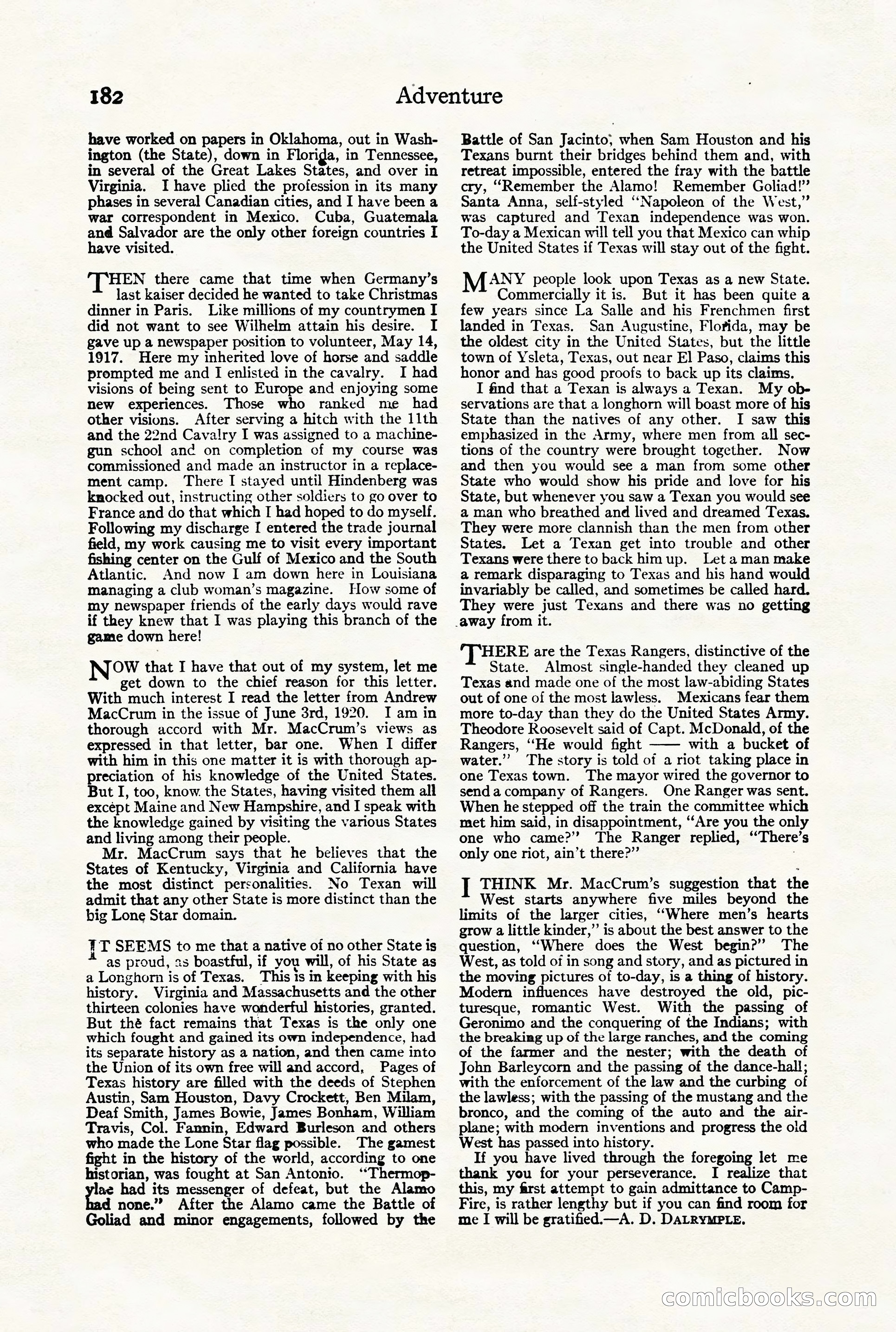
A restored page from Pulp Fiction, 1921. Page through the whole issue in the reader above.
📄 Transcribed text from this page (OCR, searchable)
Machine-transcribed from the original scan — historical spelling and the odd misread are preserved.
182 have worked on papers in Oklahoma, out in Wash- ington (the State), down in Floriga, in Tennessee, in several of the Great Lakes States, and over in Virginia. I have plied the profession in its many phases in several Canadian cities, and I have been a war correspondent in Mexico. Cuba, Guatemala and Salvador are the only other foreign countries I have visited. ‘THEN there came that time when Germany’s last kaiser decided he wanted to take Christmas dinner in Paris. Like millions of my countrymen I did not want to see Wilhelm attain his desire. I gave up a newspaper position to volunteer, May 14, 1917. Here my inherited love of horse and saddle prompted me and I enlisted in the cavalry. I had visions of being sent to Europe and enjoying some new experiences. Those who ranked me had other visions. After serving a hitch with the 11th and the 22nd Cavalry I was assigned to a machine- gun school and on completion of my course was commissioned and made an instructor in a replace- ment camp. There I stayed until Hindenberg was knocked out, instructing other soldiers to go over to France and do that which I had hoped to do myself. Following my discharge I entered the trade journal field, my work causing me to visit every important fishing center on the Gulf of Mexico and the South Atlantic. And now I am down here in Louisiana managing a club woman’s magazine. How some of my newspaper friends of the early days would rave if they knew that I was playing this branch of the game down here! OW that I have that out of my system, let me get down to the chief reason for this letter. With much interest I read the letter from Andrew MacCrum in the issue of June 3rd, 1920. I am in thorough accord with Mr. MacCrum’s views as expressed in that letter, bar one. When I differ with him in this one matter it is with thorough ap- preciation of his knowledge of the United States. But I, too, know. the States, having visited them all excépt Maine and New Hampshire, and I speak with the knowledge gained by visiting the various States and living among their people. Mr. MacCrum says that he believes that the States of Kentucky, Virginia and California have the most distinct personalities. No Texan will admit that any other State is more distinct than the big Lone Star domain. ¥T SEEMS to me that a native of no other State is 4 as proud, 2s boastful, if you will, of his State as a Longhorn is of Texas. This 1s in keeping with his history. Virginia and Massachusetts and the other thirteen colonies have wonderful histories, granted. But thé fact remains that Texas is the only one which fought and gained its own independence, had its separate history as a nation, and then came into the Union of its own free will and accord, Pages of Texas history are filled with the deeds of Stephen Austin, Sam Houston, Davy Crockett, Ben Milam, Deaf Smith, James Bowie, James Bonham, William Travis, Col. Fannin, Edward Burleson and others who made the Lone Star flag possible. The gamest fight in the history of the world, according to one historian, was fought at San Antonio. ‘‘Thermop- lace had its messenger of defeat, but the Alamo d none.” After the Alamo came the Battle of Goliad and minor engagements, followed by the Adventure Battle of San Jacinto; when Sam Houston and his Texans burnt their bridges behind them and, with retreat impossible, entered the fray with the battle cry, ‘‘Remember the Alamo! Remember Goliad!’ Santa Anna, self-styled ‘Napoleon of the West,” was captured and Texan independence was won. To-day a Mexican will tell you that Mexico can whip the United States if Texas will stay out of the fight. MANY people look upon Texas as a new State. Commercially it is. But it has been quite a few years since La Salle and his Frenchmen first landed in Texas. San Augustine, Florida, may be the oldest city in the United States, but the little town of Ysleta, Texas, out near El Paso, claims this honor and has good proofs to back up its claims. I find that a Texan is always a Texan. My ob- servations are that a longhorn will boast more of his State than the natives of any other. I saw this emphasized in the Army, where men from all sec- tions of the country were brought together. Now and then you would see a man from some other State who would show his pride and love for his State, but whenever you saw a Texan you would see a man who breathed and lived and dreamed Texas. They were more clannish than the men from other States. Let a Texan get into trouble and other Texans were there to back himup. Let aman make a remark disparaging to Texas and his hand would invariably be called, and sometimes be called hard. They were just Texans and there was no getting away from it. ‘THERE are the Texas Rangers, distinctive of the State. Almost single-handed they cleaned up Texas and made one of the most law-abiding States out of one of the most lawless. Mexicans fear them more to-day than they do the United States Army. Theodore Roosevelt said of Capt. McDonald, of the Rangers, ‘‘He would fight with a bucket of water.” The story is told of a riot taking place in one Texas town. The mayor wired the governor to send a company of Rangers. One Ranger was sent. When he stepped off the train the committee which met him said, in disappointment, ‘‘Are you the only one who came?’”’ The Ranger replied, ‘“There’s only one riot, ain’t there?”’ I THINK Mr. MacCrum’s suggestion that the West starts anywhere five miles beyond the limits of the larger cities, ““Where men’s hearts grow a little kinder,” is about the best answer to the question, ‘“‘Where does the West beginr’”’ The West, as told of in song and story, and as pictured in the moving pictures of to-day, is a thing of history. Modern influences have destroyed the old, pic- turesque, romantic West. With the passing of Geronimo and the conquering of the Indians; with the breaking up of the large ranches, and the coming of the farmer and the nester; with the death of John Barleycorn and the passing of the dance-hall; with the enforcement of the law and the curbing of the lawless; with the passing of the mustang and the bronco, and the coming of the auto and the air- plane; with modern inventions and progress the old West has passed into history. If you have lived through the foregoing let me thank you for your perseverance. I realize that this, my farst attempt to gain admittance to Camp- Fire, is rather lengthy but if you can find room for me I will be gratified.—A. D. DALRYMPLE. CO MICLOOKS S|