
Pulp Fiction, 1921 · page 193 of 204
Adventure Magazine Cover — page 193: what you’re looking at
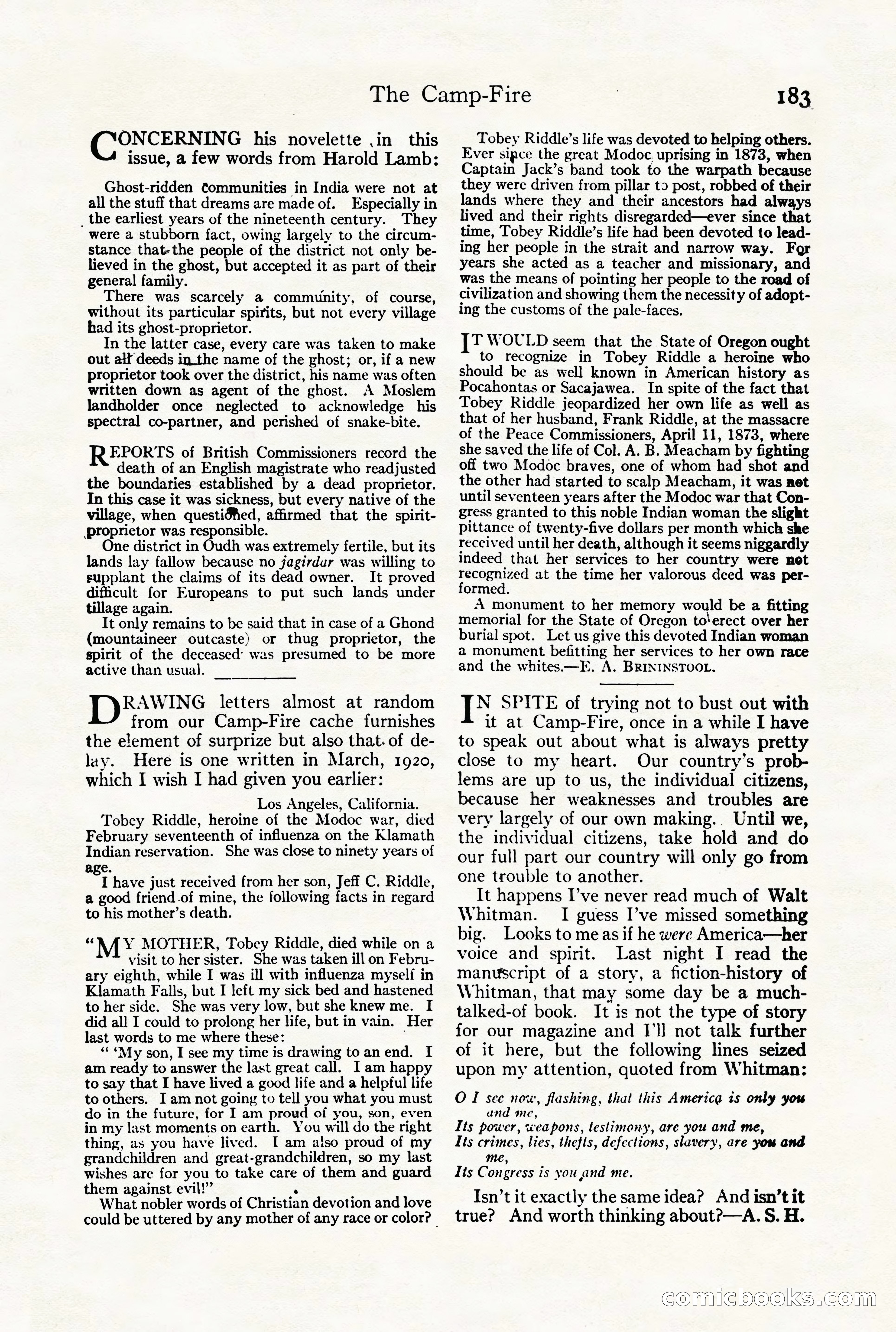
A restored page from Pulp Fiction, 1921. Page through the whole issue in the reader above.
📄 Transcribed text from this page (OCR, searchable)
Machine-transcribed from the original scan — historical spelling and the odd misread are preserved.
The Camp-Fire ONCERNING his novelette .in this issue, a few words from Harold Lamb: Ghost-ridden Communities in India were not at all the stuff that dreams are made of. Especially in _ the earliest years of the nineteenth century. They were a stubborn fact, owing largely to the circum- stance that-the people of the district not only be- lieved in the ghost, but accepted it as part of their general family. There was scarcely a community, of course, without its particular spirits, but not every village had its ghost-proprietor. In the latter case, every care was taken to make out alf deeds in the name of the ghost; or, if a new proprietor took over the district, his name was often written down as agent of the ghost. A Moslem landholder once neglected to acknowledge his spectral co-partner, and perished of snake-bite. EPORTS of British Commissioners record the death of an English magistrate who readjusted the boundaries established by a dead proprietor. In this case it was sickness, but every native of the village, when questifRted, affirmed that the spirit- Proprietor was responsible. One district in Oudh was extremely fertile, but its lands lay fallow because no jagirdur was willing to supplant the claims of its dead owner. It proved difficult for Europeans to put such lands under tillage again. It only remains to be said that in case of a Ghond (mountaineer outcaste) or thug proprietor, the spirit of the deceased’ was presumed to be more active than usual. __ RAWING letters almost at random from our Camp-Fire cache furnishes the element of surprize but also that. of de- lay. Here is one written in March, 1920, which I wish I had given you earlier: Los Angeles, California. Tobey Riddle, heroine of the Modoc war, died February seventeenth of influenza on the Klamath Indian reservation. She was close to ninety years of age. + have just received from her son, Jeff C. Riddle, a good friend-of mine, the following facts in regard to his mother’s death. “NAY MOTHER, Tobey Riddle, died while on a Visit to her sister. She was taken ill on Febru- ary eighth, while I was ill with influenza myself in Klamath Falls, but I left my sick bed and hastened to her side. She was very low, but she knew me. I did all I could to prolong her life, but in vain. Her last words to me where these: “‘ “My son, I see my time is drawing to anend. I am ready to answer the last great call. I am happy to say that I have lived a good life and a helpful life to others. Iam not going to tell you what you must do in the future, for I am proud of you, son, even in my last moments on earth. You will do the right thing, as you have lived. I am also proud of my grandchildren and great-grandchildren, so my last wishes are for you to take care of them and guard them against evil!” ‘ What nobler words of Christian devotion and love could be uttered by any mother of any race or color? | 183 Tobey Riddle’s life was devoted to helping others. Ever siace the great Modoc. uprising in 1873, when Captain Jack’s band took to the warpath because they were driven from pillar to post, robbed of their lands where they and their ancestors had always lived and their rights disregarded—ever since that time, Tobey Riddle’s life had been devoted to lead- ing her people in the strait and narrow way. Fer years she acted as a teacher and missionary, and was the means of pointing her people to the road of civilization and showing them the necessity of adopt- ing the customs of the pale-faces. [Tt WOULD seem that the State of Oregon ought to recognize in Tobey Riddle a heroine who should be as well known in American history as Pocahontas or Sacajawea. In spite of the fact that Tobey Riddle jeopardized her own life as well as that of her husband, Frank Riddle, at the massacre of the Peace Commissioners, April 11, 1873, where she saved the life of Col. A. B. Meacham by fighting off two Modoc braves, one of whom had shot and the other had started to scalp Meacham, it was net until seventeen years after the Modoc war that Con- gress granted to this noble Indian woman the slight pittance of twenty-five dollars per month which she received until her death, although it seems niggardly indeed that her services to her country were not recognized at the time her valorous deed was per- formed. A monument to her memory would be a fitting memorial for the State of Oregon to'erect over her burial spot. Let us give this devoted Indian woman a monument befitting her services to her own race and the whites.—E. A. BRININSTOOL. N SPITE of trying not to bust out with it at Camp-Fire, once in a while I have to speak out about what is always pretty close to my heart. Our country’s prob- lems are up to us, the individual citizens, because her weaknesses and troubles are very largely of our own making.. Until we, the individual citizens, take hold and do our full part our country will only go from one trouble to another. It happens I’ve never read much of Walt Whitman. I guess I’ve missed something big. Looks to meas if he were America—her voice and spirit. Last night I read the manvscript of a story, a fiction-history of Whitman, that may some day be a much- talked-of book. It is not the type of story for our magazine and I'll not talk further of it here, but the following lines seized upon my attention, quoted from Whitman: OT see now, flashing, that this America ts only you and me, Its power, weapons, testimony, are you and me, Its crimes, lies, thefts, defections, slavery, are you and me, Tis Congress is you and me. Isn’t it exactly the same idea? And isn’t it true? And worth thinking about?—A. S. H. cCOmiclboolks