
Pulp Fiction, 1921 · page 186 of 200
Adventure Magazine Cover, August 18, 1921 — page 186: what you’re looking at
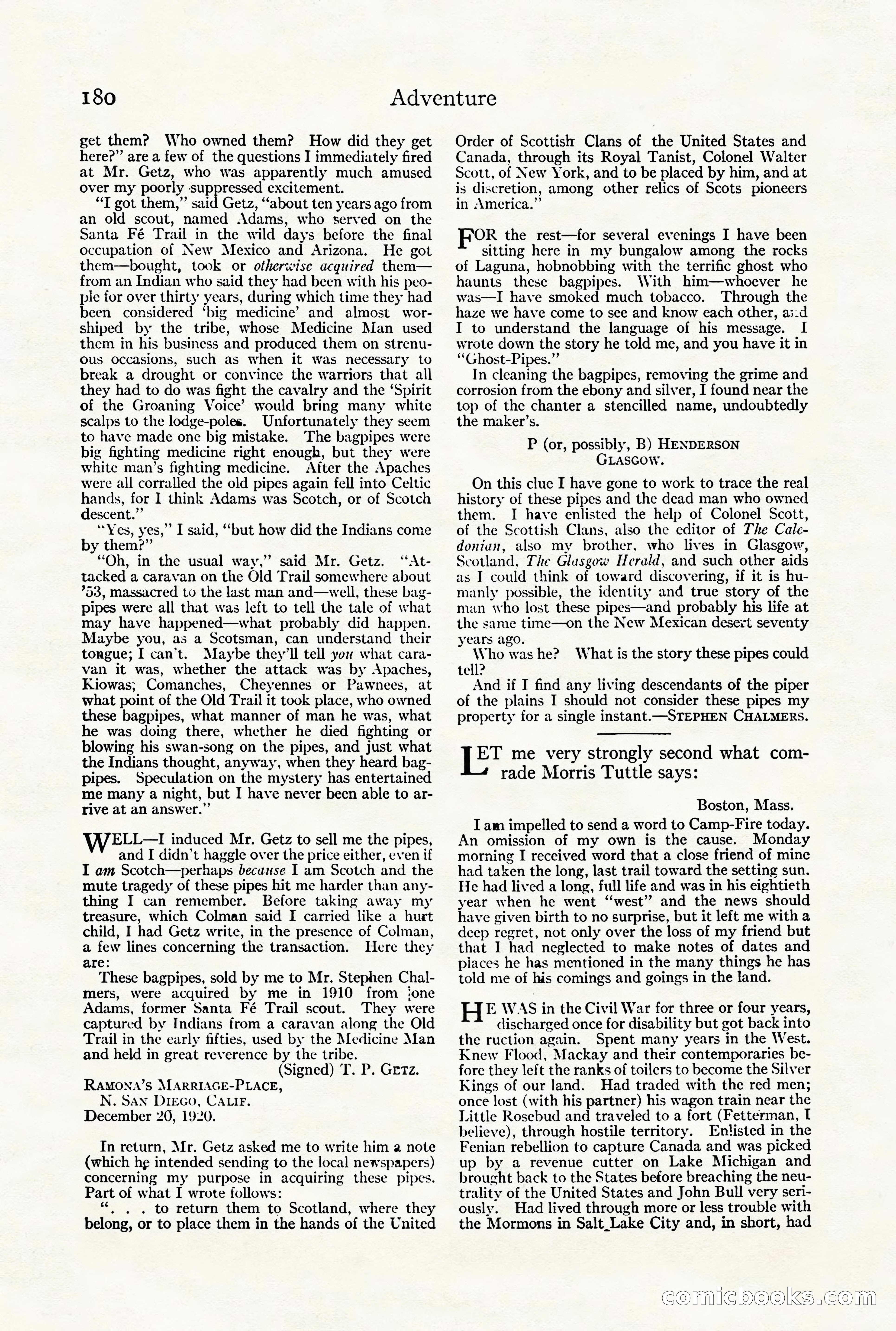
A restored page from Pulp Fiction, 1921. Page through the whole issue in the reader above.
📄 Transcribed text from this page (OCR, searchable)
Machine-transcribed from the original scan — historical spelling and the odd misread are preserved.
180 get them? Who owned them? How did they get here?” are a few of the questions I immediately fired at Mr. Getz, who was apparently much amused over my poorly suppressed excitement. “T got them,” said Getz, “about ten years ago from an old scout, named Adams, who served on the Santa Fé Trail in the wild days before the final occupation of New Mexico and Arizona. He got them—bought, took or otherwise acquired them— from an Indian who said they had been with his peo- ple for over thirty years, during which time they had been considered ‘big medicine’ and almost wor- shiped by the tribe, whose Medicine Man used them in his business and produced them on strenu- Ous occasions, such as when it was necessary to break a drought or convince the warriors that all they had to do was fight the cavalry and the ‘Spirit of the Groaning Voice’ would bring many white scalps to the lodge-poles. Unfortunately they seem to have made one big mistake. The bagpipes were big fighting medicine right enough, but they were white man’s fighting medicine. After the Apaches were all corralled the old pipes again fell into Celtic hands, for I think Adams was Scotch, or of Scotch descent.” “Yes, yes,” I said, ‘but how did the Indians come by them?” “Oh, in the usual way,” said Mr. Getz. ‘‘At- tacked a caravan on the Old Trail somewhere about 753, massacred to the last man and—well, these bag- pipes were all that was left to tell the tale of what may have happened—what probably did happen. Maybe you, as a Scotsman, can understand their tongue; I can’t. Maybe they’ll tell you what cara- van it was, whether the attack was by .\paches, Kiowas; Comanches, Cheyennes or Pawnees, at what point of the Old Trail it took place, who owned these bagpipes, what manner of man he was, what he was doing there, whether he died fighting or blowing his swan-song on the pipes, and just what the Indians thought, anyway, when they heard bag- pipes. Speculation on the mystery has entertained me many a night, but I have never been able to ar- rive at an answer.” WELL—I induced Mr. Getz to sell me the pipes, and I didn’t haggle over the price either, even if I am Scotch—perhaps because I am Scotch and the mute tragedy of these pipes hit me harder than any- thing I can remember. Before taking away my treasure, which Colman said I carried like a hurt child, I had Getz write, in the presence of Colman, a few lines concerning the transaction. Here they are: These bagpipes, sold by me to Mr. Stephen Chal- mers, were acquired by me in 1910 from ione Adams, former Santa Fé Trail scout. They were captured by Indians from a caravan along the Old Trail in the early fifties, used by the Medicine Man and held in great reverence by the tribe. (Signed) T. P. Griz. RAMONA’S MARRIAGE-PLACE, N. SAN DiceGo, CALIF. December 20, 1920. In return, Mr. Getz asked me to write him a note (which hg intended sending to the local newspapers) concerning my purpose in acquiring these pipes. Part of what I wrote follows: “., . to return them to Scotland, where they belong, or to place them in the hands of the United Adventure Order of Scottish Clans of the United States and Canada, through its Royal Tanist, Colonel Walter Scott, of New York, and to be placed by him, and at is discretion, among other relics of Scots pioneers in America.” FoR the rest—for several evenings I have been sitting here in my bungalow among the rocks of Laguna, hobnobbing with the terrific ghost who haunts these bagpipes. With him—whoever he was—I have smoked much tobacco. Through the haze we have come to see and know each other, a;.d I to understand the language of his message. I wrote down the story he told me, and you have it in “‘Ghost-Pipes.”’ In cleaning the bagpipes, removing the grime and corrosion from the ebony and silver, I found near the top of the chanter a stencilled name, undoubtedly the maker’s. P (or, possibly, B) HENDERSON GLASGOW. On this clue I have gone to work to trace the real history of these pipes and the dead man who owned them. I have enlisted the help of Colonel Scott, of the Scottish Clans, also the editor of The Cale- donian, also my brother, who lives in Glasgow, Scotland, The Glusgow Herald, and such other aids as I could think of toward discovering, if it is hu- manly possible, the identity and true story of the min who lost these pipes—and probably his life at the same time—on the New Mexican desert seventy years ago. Who was he? What is the story these pipes could tell? And if I find any living descendants of the piper of the plains I should not consider these pipes my property for a single instant.—STEPHEN CHALMERS. ET me very strongly second what com- rade Morris Tuttle says: Boston, Mass. I am impelled to send a word to Camp-Fire today. An omission of my own is the cause. Monday morning I received word that a close friend of mine had taken the long, last trail toward the setting sun. He had lived a long, full life and was in his eightieth year when he went “west” and the news should have given birth to no surprise, but it left me with a deep regret, not only over the loss of my friend but that I had neglected to make notes of dates and places he has mentioned in the many things he has told me of his comings and goings in the land. H E WAS in the Civil War for three or four years, discharged once for disability but got back into the ruction again. Spent many years in the West. Knew Flood, Mackay and their contemporaries be- fore they left the ranks of toilers to become the Silver Kings of our land. Had traded with the red men; once lost (with his partner) his wagon train near the Little Rosebud and traveled to a fort (Fetterman, I believe), through hostile territory. Enlisted in the Fenian rebellion to capture Canada and was picked up by a revenue cutter on Lake Michigan and brought back to the States before breaching the neu- trality of the United States and John Bull very seri- ously. Had lived through more or less trouble with the Mormons in Salt_Lake City and, in short, had C© MICLOOKS CO S|