
Pulp Fiction, 1921 · page 187 of 200
Adventure Magazine Cover, August 18, 1921 — page 187: what you’re looking at
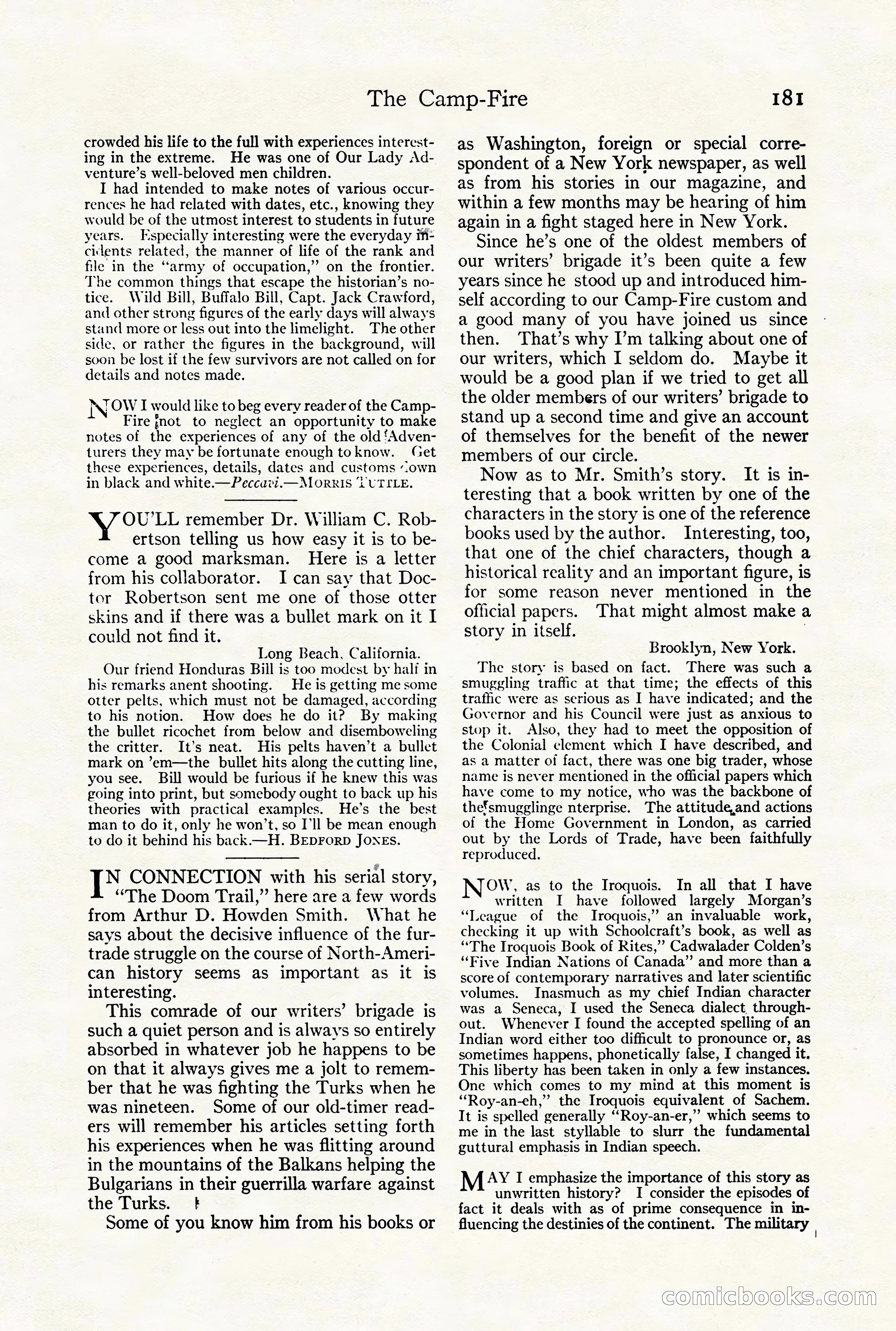
A restored page from Pulp Fiction, 1921. Page through the whole issue in the reader above.
📄 Transcribed text from this page (OCR, searchable)
Machine-transcribed from the original scan — historical spelling and the odd misread are preserved.
The Camp-Fire crowded his life to the full with experiences interest- ing in the extreme. He was one of Our Lady Ad- venture’s well-beloved men children. I had intended to make notes of various occur- rences he had related with dates, etc., knowing they would be of the utmost interest to students in future years. Especially interesting were the everyday i- cidents related, the manner ‘of life of the rank and file in the “army of occupation,” on the frontier. The common things that escape the historian’s no- tice. Wild Bill, Buffalo Bill, Capt. Jack Crawford, and other strong figures of the early days will always stand more or less out into the limelight. The other side, or rather the figures in the background, will soon be lost if the few survivors are not called on for details and notes made. N OW I would like to beg every reader of the Camp- . B res e Fire ynot to neglect an opportunity to make notes of the experiences of any of the old ‘Adven- turers they may be fortunate enough toknow. Get these experiences, details, dates and customs “own in black and white.—Peccavi.—MorRIS ‘L UTILE. OU’LL remember Dr. William C. Rob- ertson telling us how easy it is to be- come a good marksman. Here is a letter from his collaborator. I can say that Doc- tor Robertson sent me one of those otter skins and if there was a bullet mark on it I could not find it. Long Beach, California. Our friend Honduras Bill is too modest by half in his remarks anent shooting. He is getting me some otter pelts, which must not be damaged, according to his notion. How does he do it? By making the bullet ricochet from below and disemboweling the critter. It’s neat. His pelts haven’t a bullet mark on ’em—the bullet hits along the cutting line, you see. Bill would be furious if he knew this was going into print, but somebody ought to back up his theories with practical examples. He’s the best man to do it, only he won’t, so I'll be mean enough to do it behind his back.—H. BEDFORD JONES. [4 CONNECTION with his serial story, “The Doom Trail,” here are a few words from Arthur D. Howden Smith. What he says about the decisive influence of the fur- trade struggle on the course of North-Ameri- can history seems as important as it is interesting. This comrade of our writers’ brigade is such a quiet person and is always so entirely absorbed in whatever job he happens to be on that it always gives me a jolt to remem- ber that he was fighting the Turks when he was nineteen. Some of our old-timer read- ers will remember his articles setting forth his experiences when he was flitting around in the mountains of the Balkans helping the Bulgarians in their guerrilla warfare against the Turks. | Some of you know him from his books or 181 as Washington, foreign or special corre- spondent of a New York newspaper, as well as from his stories in our magazine, and within a few months may be hearing of him again in a fight staged here in New York. Since he’s one of the oldest members of our writers’ brigade it’s been quite a few years since he stood up and introduced him- self according to our Camp-Fire custom and a good many of you have joined us since then. That’s why I’m talking about one of our writers, which I seldom do. Maybe it would be a good plan if we tried to get all the older members of our writers’ brigade to stand up a second time and give an account of themselves for the benefit of the newer members of our circle. Now as to Mr. Smith’s story. It is in- teresting that a book written by one of the characters in the story is one of the reference books used by the author. Interesting, too, that one of the chief characters, though a historical reality and an important figure, is for some reason never mentioned in the official papers. That might almost make a story in itself. 3 Brooklyn, New York. The story is based on fact. There was such a smuggling traffic at that time; the effects of this traffic were as serious as I have indicated; and the Governor and his Council were just as anxious to stop it. Also, they had to meet the opposition of the Colonial element which I have described, and as a matter of fact, there was one big trader, whose name is never mentioned in the official papers which have come to my notice, who was the backbone of thefsmugglinge nterprise. The attitude,and actions of the Home Government in London, as carried out by the Lords of Trade, have been faithfully reproduced. NON, as to the Iroquois. In all that I have written I have followed largely Morgan’s “League of the Iroquois,’ an invaluable work, checking it up with Schoolcraft’s book, as well as “The Iroquois Book of Rites,” Cadwalader Colden’s “Five Indian Nations of Canada” and more than a score of contemporary narratives and later scientific volumes. Inasmuch as my chief Indian character was a Seneca, I used the Seneca dialect, through- out. Whenever I found the accepted spelling of an Indian word either too difficult to pronounce or, as sometimes happens, phonetically false, I changed it. This liberty has been taken in only a few instances. One which comes to my mind at this moment is ‘‘Roy-an-eh,” the Iroquois equivalent of Sachem. It is spelled generally ‘‘Roy-an-er,’’ which seems to me in the last styllable to slurr the fundamental guttural emphasis in Indian speech. MA4Y I emphasize the importance of this story as unwritten history? I consider the episodes of fact it deals with as of prime consequence in in- fluencing the destinies of the continent. The military | Ebooks S|