
Pulp Fiction, 1921 · page 188 of 200
Adventure Magazine Cover, August 18, 1921 — page 188: what you’re looking at
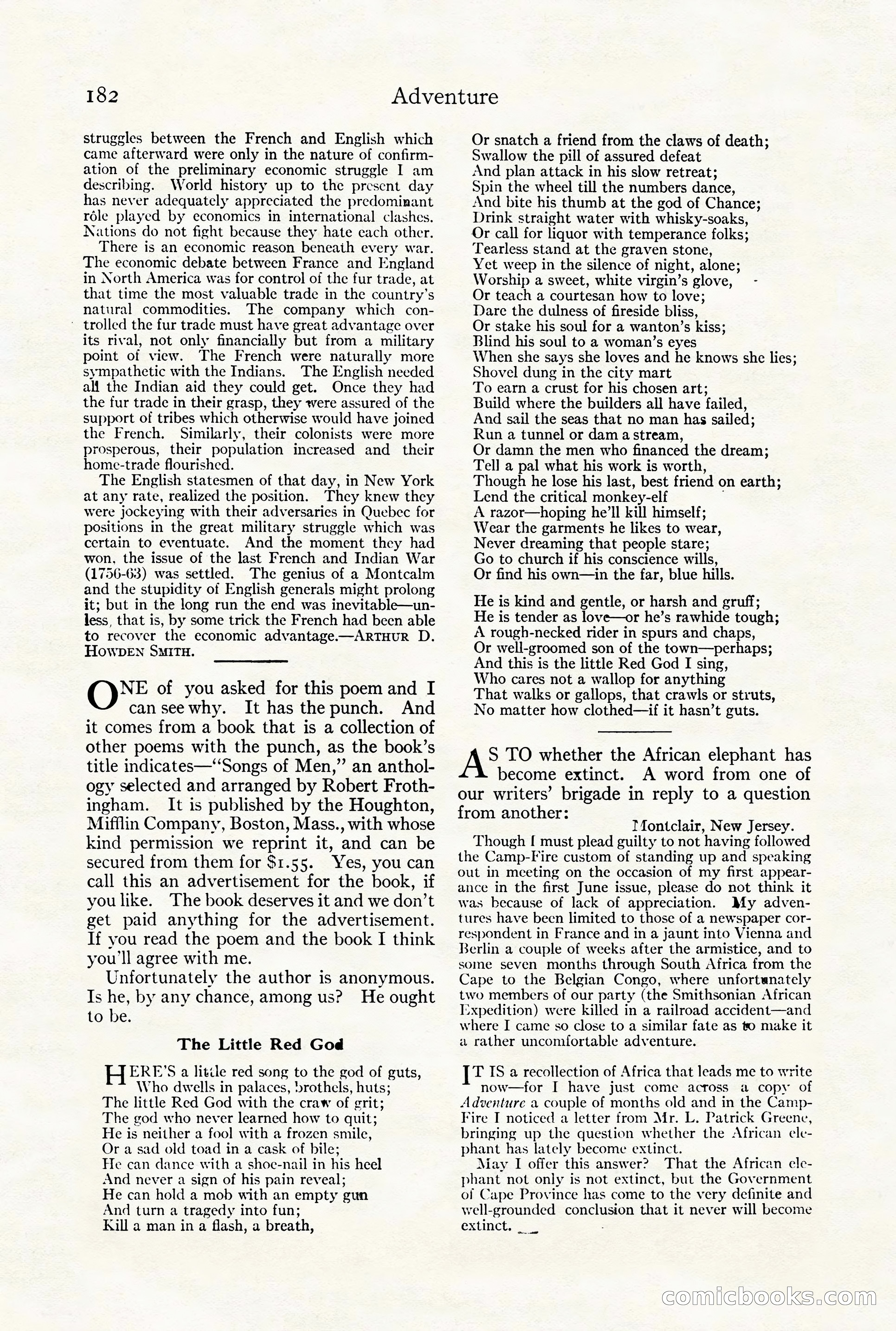
A restored page from Pulp Fiction, 1921. Page through the whole issue in the reader above.
📄 Transcribed text from this page (OCR, searchable)
Machine-transcribed from the original scan — historical spelling and the odd misread are preserved.
182 struggles between the French and English which came afterward were only in the nature of confirm- ation of the preliminary economic struggle I am describing. World history up to the present day has never adequately appreciated the predominant réle played by economics in international clashes. Nations do not fight because they hate each other. There is an economic reason beneath every war. The economic debate between France and England in North America was for control of the fur trade, at that time the most valuable trade in the country’s natural commodities. The company which con- ' trolled the fur trade must have great advantage over its rival, not only financially but from a military point of view. The French were naturally more sympathetic with the Indians. The English needed ali the Indian aid they could get. Once they had the fur trade in their grasp, they were assured of the support of tribes which otherwise would have joined the French. Similarly, their colonists were more prosperous, their population increased and _ their home-trade flourished. The English statesmen of that day, in New York at any rate, realized the position. They knew they were jockeying with their adversaries in Quebec for positions in the great military struggle which was certain to eventuate. And the moment they had won, the issue of the last French and Indian War (1756-63) was settled. The genius of a Montcalm and the stupidity of English generals might prolong it; but in the long run the end was inevitable—un- less, that is, by some trick the French had been able to recover the economic advantage.—ARTHUR D. HOWDEN SMITH. ONE of you asked for this poem and I canseewhy. It has the punch. And it comes from a book that is a collection of other poems with the punch, as the book’s title indicates—‘‘Songs of Men,” an anthol- ogy selected and arranged by Robert Froth- ingham. It is published by the Houghton, Mifflin Company, Boston, Mass., with whose kind permission we reprint it, and can be secured from them for $1.55. Yes, you can call this an advertisement for the book, if you like. The book deserves it and we don’t get paid anything for the advertisement. If you read the poem and the book I think you'll agree with me. Unfortunately the author is anonymous. Is he, by any chance, among us? He ought to be. The Little Red God ERE’S a litile red song to the god of guts, Who dwells in palaces, brothels, huts; The little Red God with the craw of grit; The god who never learned how to quit; He is neither a fool with a frozen smile, Or a sad old toad in a cask of bile; He can dance with a shoc-nail in his heel And never a sign of his pain reveal; He can hold a mob with an empty gun And turn a tragedy into fun; Kill a man in a flash, a breath, Adventure Or snatch a friend from the claws of death; Swallow the pill of assured defeat And plan attack in his slow retreat; Spin the wheel till the numbers dance, And bite his thumb at the god of Chance; Drink straight water with whisky-soaks, Or call for liquor with temperance folks; Tearless stand at the graven stone, Yet weep in the silence of night, alone; Worship a sweet, white virgin’s glove, Or teach a courtesan how to love; Dare the dulness of fireside bliss, Or stake his soul for a wanton’s kiss; Blind his soul to a woman’s eyes When she says she loves and he knows she lies; Shovel dung in the city mart To earn a crust for his chosen art; Build where the builders all have failed, And sail the seas that no man has sailed; Run a tunnel or dam astream, Or damn the men who financed the dream; Tell a pal what his work is worth, Though he lose his last, best friend on earth; Lend the critical monkey-elf : A razor—hoping he’ll kill himself; Wear the garments he likes to wear, Never dreaming that people stare; Go to church if his conscience wills, Or find his own—in the far, blue hills. He is kind and gentle, or harsh and gruff; He is tender as love—or he’s rawhide tough; A rough-necked rider in spurs and chaps, Or well-groomed son of the town—perhaps; And this is the little Red God I sing, Who cares not a wallop for anything That walks or gallops, that crawls or struts, No matter how clothed—if it hasn’t guts. A° TO whether the African elephant has become extinct. A word from one of our writers’ brigade in reply to a question from another: Tfontclair, New Jersey. Though [ must plead guilty to not having followed the Camp-Fire custom of standing up and speaking out in meeting on the occasion of my first appear- ance in the first June issue, please do not think it was because of lack of appreciation. My adven- tures have been limited to those of a newspaper cor- respondent in France and in a jaunt into Vienna and Berlin a couple of weeks after the armistice, and to some seven months through South Africa from the Cape to the Belgian Congo, where unfortanately two members of our party (the Smithsonian African I:xpedition) were killed in a railroad accident—and where I came so close to a similar fate as to make it «a rather uncomfortable adventure. [t IS a recollection of Africa that leads me to write now—for I have just come across a copy of Adventure a couple of months old and in the Camp- Tire I noticed a letter from Mr. L. Patrick Greene, bringing up the question whether the African elc- phant has lately become extinct. May I offer this answer? That the African ele- phant not only is not extinct, but the Government of Cape Province has come to the very definite and well-grounded conclusion that it never will become extinct. =: C© S} CloOOLkKS C© S|