
Pulp Fiction, 1921 · page 32 of 200
Adventure Magazine Cover, August 18, 1921 — page 32: what you’re looking at
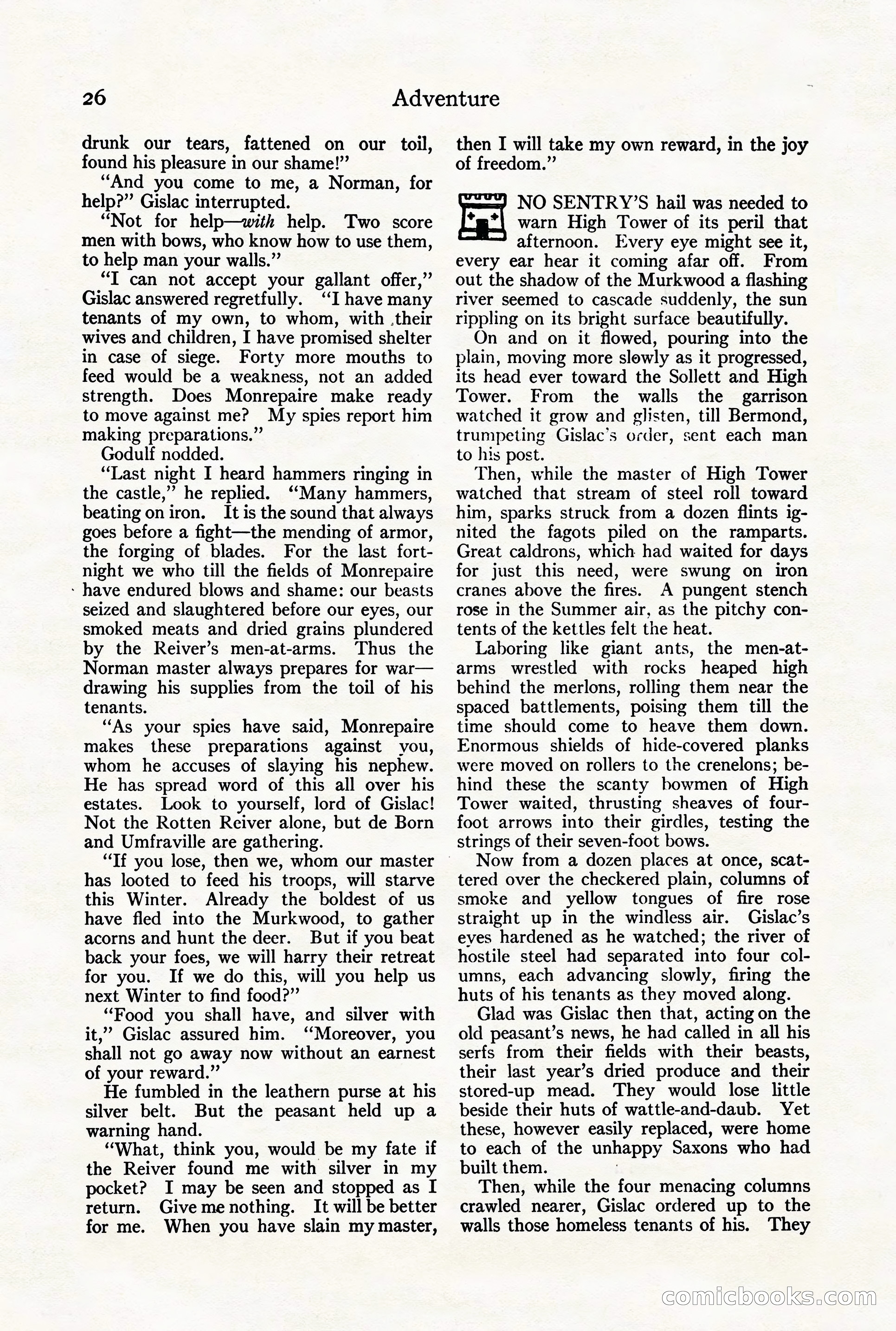
A restored page from Pulp Fiction, 1921. Page through the whole issue in the reader above.
📄 Transcribed text from this page (OCR, searchable)
Machine-transcribed from the original scan — historical spelling and the odd misread are preserved.
26 drunk our tears, fattened on our toil, found his pleasure in our shame!”’ ‘And you come to me, a Norman, for help?” Gislac interrupted. “Not for help—with help. Two score men with bows, who know how to use them, to help man your walls.” “IT can not accept your gallant offer,” Gislac answered regretfully. ‘I have many tenants of my own, to whom, with .their wives and children, I have promised shelter in case of siege. Forty more mouths to feed would be a weakness, not an added strength. Does Monrepaire make ready to move against me? My spies report him making preparations.” Godulf nodded. “Last night I heard hammers ringing in the castle,’ he replied. ‘Many hammers, beating on iron. It is the sound that always goes before a fight—the mending of armor, the forging of blades. For the last fort- night we who till the fields of Monrepaire - have endured blows and shame: our beasts seized and slaughtered before our eyes, our smoked meats and dried grains plundered by the Reiver’s men-at-arms. Thus the Norman master always prepares for war— drawing his supplies from the toil of his tenants. “As your spies have said, Monrepaire makes these preparations against vou, whom he accuses of slaying his nephew. He has spread word of this all over his estates. Look to yourself, lord of Gislac! Not the Rotten Reiver alone, but de Born and Umfraville are gathering. “If you lose, then we, whom our master — has looted to feed his troops, will starve this Winter. Already the boldest of us have fled into the Murkwood, to gather acorns and hunt the deer. But if you beat back your foes, we will harry their retreat for you. If we do this, will you help us next Winter to find food?” “Food you shall have, and silver with it,’ Gislac assured him. “Moreover, you shall not go away now without an earnest of your reward.” He fumbled in the leathern purse at his silver belt. But the peasant held up a warning hand. “What, think you, would be my fate if the Reiver found me with silver in my pocket? I may be seen and stopped as I return. Give me nothing. It will be better for me. When you have slain my master, Adventure then I will take my own reward, in the joy of freedom.” pe’ NO SENTRY’S hail was needed to | warn High Tower of its peril that ——— afternoon. Every eye might see it, every ear hear it coming afar off. From out the shadow of the Murkwood a flashing river seemed to cascade suddenly, the sun rippling on its bright surface beautifully. On and on it flowed, pouring into the plain, moving more slowly as it progressed, its head ever toward the Sollett and High Tower. From the walls the garrison watched it grow and glisten, till Bermond, trumpeting Gislac’s order, sent each man to his post. Then, while the master of High Tower watched that stream of steel roll toward him, sparks struck from a dozen flints ig- nited the fagots piled on the ramparts. Great caldrons, which had waited for days for just this need, were swung on iron cranes above the fires. A pungent stench rose in the Summer air, as the pitchy con- tents of the kettles felt the heat. Laboring like giant ants, the men-at- arms wrestled with rocks heaped high behind the merlons, rolling them near the spaced battlements, poising them till the time should come to heave them down. Enormous shields of hide-covered planks were moved on rollers to the crenelons; be- hind these the scanty bowmen of High Tower waited, thrusting sheaves of four- foot arrows into their girdles, testing the strings of their seven-foot bows. Now from a dozen places at once, scat- tered over the checkered plain, columns of smoke and yellow tongues of fire rose straight up in the windless air. Gislac’s eves hardened as he watched; the river of hostile steel had separated into four col- umns, each advancing slowly, firing the huts of his tenants as they moved along. Glad was Gislac then that, acting on the old peasant’s news, he had called in all his serfs from their fields with their beasts, their last year’s dried produce and their stored-up mead. They would lose little beside their huts of wattle-and-daub. Yet these, however easily replaced, were home to each of the unhappy Saxons who had built them. : Then, while the four menacing columns crawled nearer, Gislac ordered up to the walls those homeless tenants of his. They CoMmicbhook C©