
Pulp Fiction, 1921 · page 33 of 200
Adventure Magazine Cover, August 18, 1921 — page 33: what you’re looking at
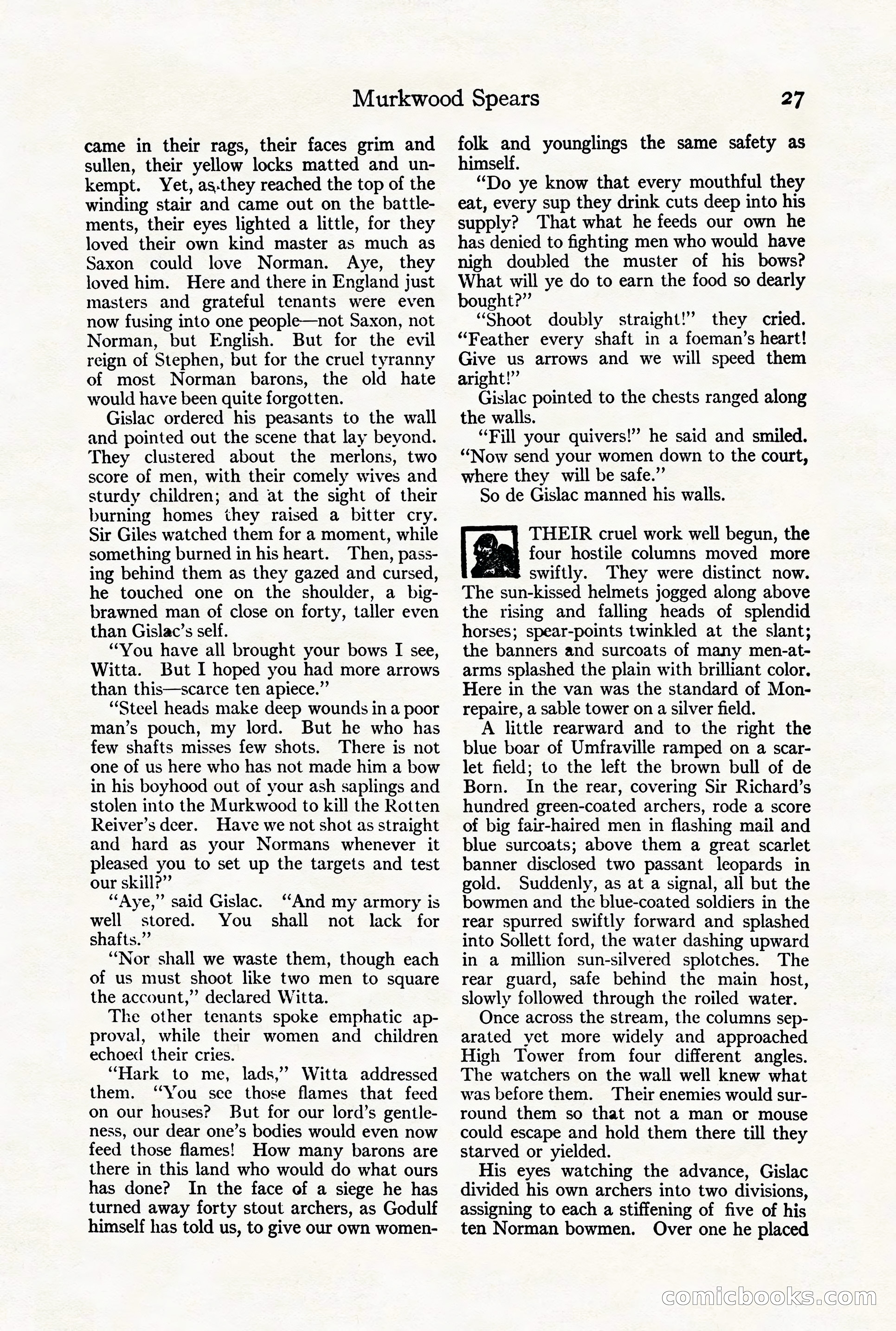
A restored page from Pulp Fiction, 1921. Page through the whole issue in the reader above.
📄 Transcribed text from this page (OCR, searchable)
Machine-transcribed from the original scan — historical spelling and the odd misread are preserved.
Murkwood Spears came in their rags, their faces grim and sullen, their yellow locks matted and un- kempt. Yet, as-they reached the top of the winding stair and came out on the battle- ments, their eyes lighted a little, for they loved their own kind master as much as Saxon could love Norman. Aye, they loved him. Here and there in England just masters and grateful tenants were even now fusing into one people—not Saxon, not Norman, but English. But for the evil reign of Stephen, but for the cruel tyranny of most Norman barons, the old hate would have been quite forgotten. Gislac ordered his peasants to the wall and pointed out the scene that lay beyond. They clustered about the merlons, two score of men, with their comely wives and sturdy children; and at the sight of their burning homes they raised a bitter cry. Sir Giles watched them for a moment, while something burned in his heart. Then, pass- ing behind them as they gazed and cursed, he touched one on the shoulder, a big- brawned man of close on forty, taller even than Gislac’s self. “You have all brought your bows I see, Witta. But I hoped you had more arrows than this—scarce ten apiece.” ‘Steel heads make deep wounds in a poor man’s pouch, my lord. But he who has few shafts misses few shots. There is not one of us here who has not made him a bow in his boyhood out of your ash saplings and stolen into the Murkwood to kill the Rotten Reiver’s deer. Have we not shot as straight and hard as your Normans whenever it pleased you to set up the targets and test our skill?” “Aye,” said Gislac. well stored. You shafts.” ‘Nor shall we waste them, though each of us must shoot like two men to square the account,” declared Witta. The other tenants spoke emphatic ap- proval, while their women and children echoed their cries. “Hark to me, lads,’’ Witta addressed them. ‘“‘You sce those flames that feed on our houses? But for our lord’s gentle- ness, our dear one’s bodies would even now feed those flames! How many barons are there in this land who would do what ours has done? In the face of a siege he has turned away forty stout archers, as Godulf himself has told us, to give our own women- “And my armory is shall not lack for 27 folk and younglings the same safety as himself. “Do ye know that every mouthful they eat, every sup they drink cuts deep into his supply? That what he feeds our own he has denied to fighting men who would have nigh doubled the muster of his bows? What will ye do to earn the food so dearly bought?” “Shoot doubly straight!” they cried. “Feather every shaft in a foeman’s heart! Give us arrows and we will speed them aright!” Gislac pointed to the chests ranged along the walls. “Fill your quivers!”’ he said and smiled. ‘Now send your women down to the court, where they will be safe.”’ So de Gislac manned his walls. THEIR cruel work well begun, the four hostile columns moved more swiftly. They were distinct now. The sun-kissed helmets jogged along above the rising and falling heads of splendid horses; spear-points twinkled at the slant; the banners and surcoats of many men-at- arms splashed the plain with brilliant color. Here in the van was the standard of Mon- repaire, a sable tower on a silver field. A little rearward and to the right the blue boar of Umfraville ramped on a scar- let field; to the left the brown bull of de Born. In the rear, covering Sir Richard’s hundred green-coated archers, rode a score of big fair-haired men in flashing mail and blue surcoats; above them a great scarlet banner disclosed two passant leopards in gold. Suddenly, as at a signal, all but the bowmen and the blue-coated soldiers in the rear spurred swiftly forward and splashed into Sollett ford, the water dashing upward in a million sun-silvered splotches. The rear guard, safe behind the main host, slowly followed through the roiled water. Once across the stream, the columns sep- arated yet more widely and approached High Tower from four different angles. The watchers on the wall well knew what was before them. Their enemies would sur- round them so that not a man or mouse could escape and hold them there till they starved or yielded. His eyes watching the advance, Gislac divided his own archers into two divisions, assigning to each a stiffening of five of his ten Norman bowmen. Over one he placed COMmicloo S ©