
Pulp Fiction, 1921 · page 102 of 200
Adventure Magazine Cover — page 102: what you’re looking at
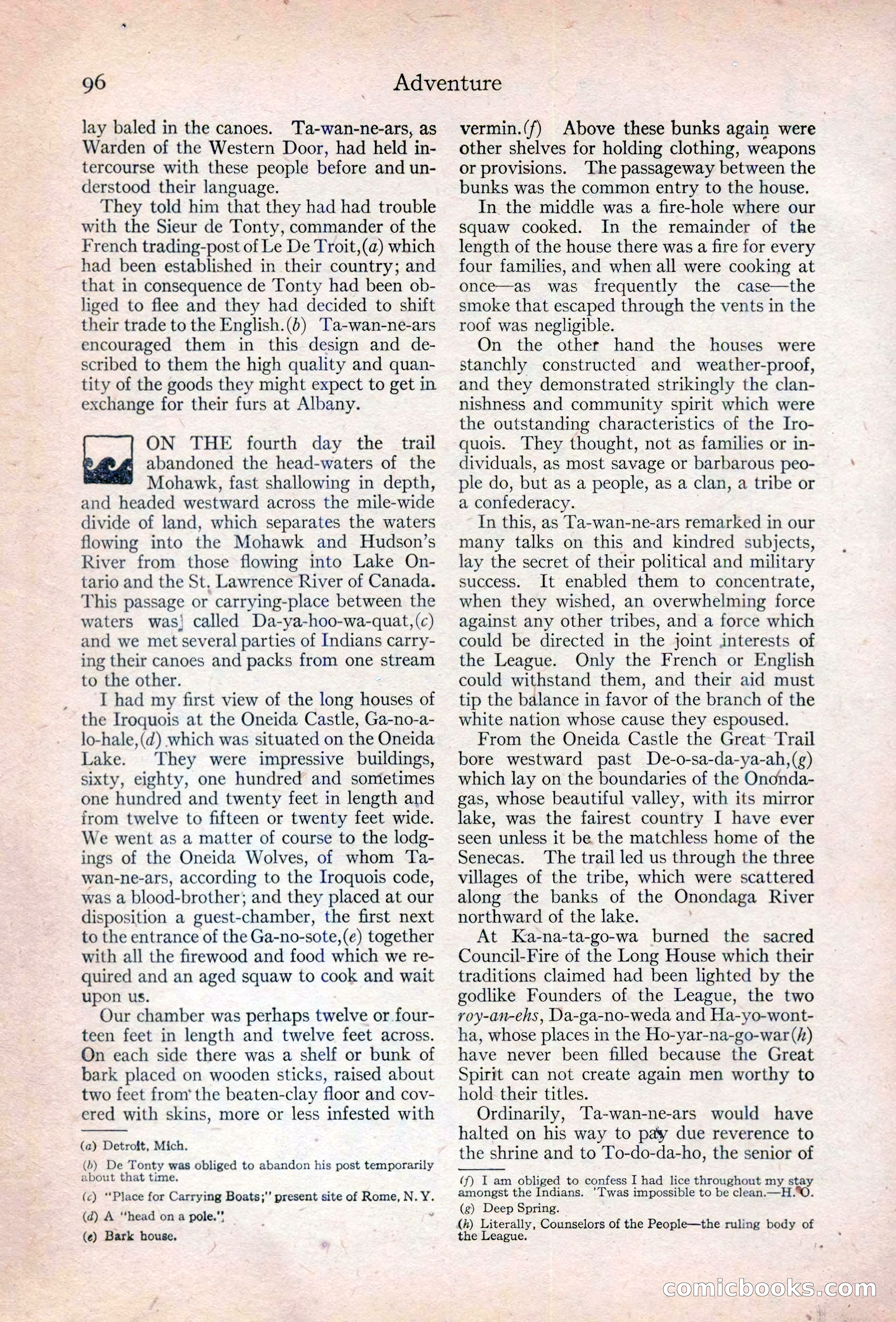
A restored page from Pulp Fiction, 1921. Page through the whole issue in the reader above.
📄 Transcribed text from this page (OCR, searchable)
Machine-transcribed from the original scan — historical spelling and the odd misread are preserved.
96 lay baled in the canoes. Ta-wan-ne-ars, as Warden of the Western Door, had held in- tercourse with these people before and un- derstood their language. They told him that they had had trouble with the Sieur de Tonty, commander of the French trading-post of Le De Troit,(@) which had been established in their country; and that in consequence de Tonty had been ob- liged to flee and they had decided to shift their trade to the English.(b) Ta-wan-ne-ars encouraged them in this design and de- scribed to them the high quality and quan- tity of the goods they might expect to get in exchange for their furs at Albany. Leg abandoned the head-waters of the Mohawk, fast shallowing in depth, and headed westward across the mile-wide divide of land, which separates the waters flowing into the Mohawk and Hudson’s River from those flowing into Lake On- tario and the St. Lawrence River of Canada. This passage or carrying-place between the waters was} called Da-ya-hoo-wa-quat,(c) and we met several parties of Indians carry- ing their canoes and packs from one stream to the other. _ [had my first view of the long bain of the Iroquois at the Oneida Castle, Ga-no-a- lo-hale,(d) which was situated on the Oneida Lake. They were impressive buildings, sixty, eighty, one hundred and sometimes one hundred and twenty feet in length and irom twelve to fifteen or twenty feet wide. We went as a matter of course to the lodg- ings of the Oneida Wolves, of whom Ta- wan-ne-ars, according to the Iroquois code, was a blood-brother; and they placed at our disposition a guest-chamber, the first next to the entrance of the Ga-no-sote,(e) together with all the firewood and food which we re- quired and an aged squaw to cook and wait upon us. Our chamber was perhaps twelve or four- teen feet in length and twelve feet across. On each side there was a shelf or bunk of bark placed on wooden sticks, raised about two feet from’ the beaten-clay floor and cov- ered with skins, more or less infested with ON THE fourth day the trail (a) Detroft, Mich. (») De Tonty was obliged to abandon his post temporarily about that time. (c) “Place for Carrying Boats;'’ present site of Rome, N.Y. (d) A “head on a pole." . (e) Bark house. Adventure vermin. (f) other shelves for holding clothing, weapons or provisions. ‘The passageway between the bunks was the common entry to the house. In the middle was a fire-hole where our squaw cooked. In the remainder of the length of the house there was a fire for every four families, and when all were cooking at once—as was frequently the case—the smoke that escaped through the vents in the roof was negligible. On the other hand the houses were stanchly constructed and weather-proof, and they demonstrated strikingly the clan- nishness and community spirit which were the outstanding characteristics of the Iro- quois. They thought, not as families or in- dividuals, as most savage or barbarous peo- ple do, but as a people, as a clan, a tribe or a confederacy. In this, as Ta-wan-ne-ars remarked in our many talks on this and kindred subjects, lay the secret of their political and military success. It enabled them to concentrate, when they wished, an overwhelming force against any other tribes, and a force which could be directed in the joint interests of the League. Only the French or English could withstand them, and their aid must tip the balance in favor of the branch of the white nation whose cause they espoused. From the Oneida Castle the Great Trail bore westward past De-o-sa-da-ya-ah,(g) which lay on the boundaries of the Ononda- gas, whose beautiful valley, with its mirror lake, was the fairest country I have ever seen unless it be the matchless home of the Senecas. The trail led us through the three villages of the tribe, which were scattered along the banks of the Onondaga River northward of the lake. At Ka-na-ta-go-wa burned the sacred Council-Fire of the Long House which their traditions claimed had been lighted by the godlike Founders of the League, the two voy-an-ehs, Da-ga-no-weda and Ha-yo-wont- ha, whose places in the Ho-yar-na-go-war(h) have never been filled because the Great Spirit can not create again men worthy to hold their titles. Ordinarily, Ta-wan-ne-ars would have halted on his way to pay due reverence to the shrine and to To-do-da-ho, the senior of ({) I am obliged to confess I had lice throughout my — amongst the Indians. 'Twas impossible to be clean.—H. (g) Deep Spring. (hk) Literally, Counselors of the People—the ruling body of the League. Gomicbooks Above these bunks again were | (F@)