
Pulp Fiction, 1921 · page 103 of 200
Adventure Magazine Cover — page 103: what you’re looking at
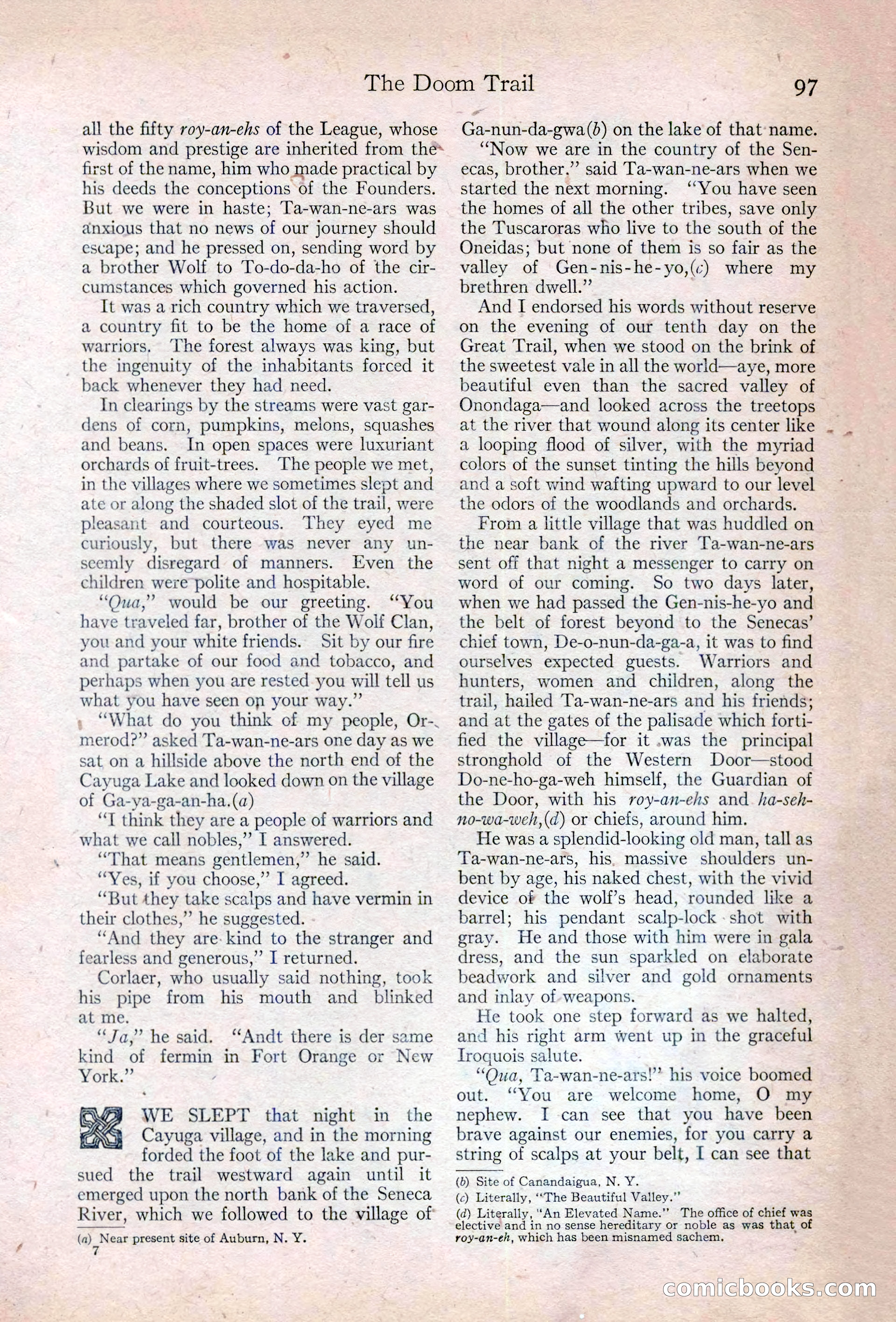
A restored page from Pulp Fiction, 1921. Page through the whole issue in the reader above.
📄 Transcribed text from this page (OCR, searchable)
Machine-transcribed from the original scan — historical spelling and the odd misread are preserved.
The Doom Trail all the fifty roy-an-ehs of the League, whose wisdom and prestige are inherited from the* first of the name, him who made practical by his deeds the conceptions of the Founders. But we were in haste; Ta-wan-ne-ars was anxious that no news of our journey should escape; and he pressed on, sending word by a brother Wolf to To-do-da-ho of the cir- cumstances which governed his action. It was a rich country which we traversed, a country fit to be the home of a race of warriors, ‘The forest always was king, but the ingenuity of the inhabitants forced it back whenever they had need. In clearings by the streams were vast gar- dens of corn, pumpkins, melons, squashes and beans. In open spaces were luxuriant orchards of fruit-trees. The people we met, in the villages where we sometimes slept and ate or along the shaded slot of the trail, were pleasant and courteous. They eyed me curiously, but there was never any un- seemly disregard of manners. Even the children were polite and hospitable. “Oua,’ would be our greeting. “You have traveled far, brother of the Wolf Clan, you and your white friends. Sit by our fire and partake of our food and tobacco, and perhaps when you are rested you will tell us what you have seen op your way.” “What do you think of my people, Or-. merod?” asked Ta-wan-ne-ars one day as we sat on a hillside above the north end of the Cayuga Lake and looked down on the village of Ga-ya-ga-an-ha. (qa) “T think they are a people of warriors and what we call nobles,” I answered. “That means gentlemen,” he said. “Ves, if you choose,” I agreed. “But they take scalps and have vermin in their clothes,” he suggested. ‘And they are-kind to the stranger and fearless and generous,” I returned. Corlaer, who usually said nothing, took his pipe from his mouth and _ blinked at me. “Ja,’ he said. ‘‘Andt there is der same kind of fermin in Fort Orange or New York.” WE SLEPT that night in the Cayuga village, and in the morning forded the foot of the lake and pur- sued the trail westward again until it emerged upon the north bank of the Seneca River, which we followed to the village of (a) Near present site of Auburn, N. Y. 7 97 Ga-nun-da-gwa(d) on the lake of that name. ‘“‘Now we are in the country of the Sen- ecas, brother.’’ said Ta-wan-ne-ars when we started the next morning. ‘You have seen the homes of all the other tribes, save only the Tuscaroras who live to the south of the Oneidas; but none of them is so fair as the valley of Gen-nis-he-yo,(c) where my brethren dwell.” | And I endorsed his words without reserve on the evening of our tenth day on the Great Trail, when we stood on the brink of the sweetest vale in all the world—aye, more beautiful even than the sacred valley of Onondaga—and looked across the treetops at the river that wound along its center like a looping flood of silver, with the myriad colors of the sunset tinting the hills beyond and a soft wind wafting upward to our level the odors of the woodlands and orchards. From a little village that was huddled on the near bank of the river Ta-wan-ne-ars sent off that night a messenger to carry on word of our coming. So two days later, when we had passed the Gen-nis-he-yo and the belt of forest beyond to the Senecas’ chief town, De-o-nun-da-ga-a, it was to find ourselves expected guests. Warriors and hunters, women and children, along the trail, hailed Ta-wan-ne-ars and his friends; and at the gates of the palisade which forti- fied the village—for it .was the principal stronghold of the Western Door—stood Do-ne-ho-ga-weh himself, the Guardian of the Door, with his roy-an-ehs and. ha-seh- no-wa-weh,(d) or chiefs, around him. He was a splendid-looking old man, tall as Ta-wan-ne-ars, his. massive shoulders un- bent by age, his naked chest, with the vivid device of the wolf’s head, rounded like a barrel; his pendant scalp-lock -shot with gray. He and those with him were in gala dress, and the sun sparkled on elaborate beadwork and silver and gold ornaments and inlay of weapons. He took one step forward as we halted, and his right arm went up in the graceful Troquois salute. “Oua, Ta-wan-ne-ars!”* his voice boomed out. “You are welcome home, O my nephew. I can see that you have been brave against our enemies, for you carry a string of scalps at your belt, I can see that (6b) Site of Canandaigua, N. Y. (c) Literally, ‘““The Beautiful Valley.” (d) Literally, ‘An Elevated Name."’ The office of chief was elective and in no sense hereditary or noble as was that of roy-an-eh, which has been misnamed sachem, <S CORMICLOO© (E@)