
Pulp Fiction, 1921 · page 188 of 200
Adventure Magazine Cover — page 188: what you’re looking at
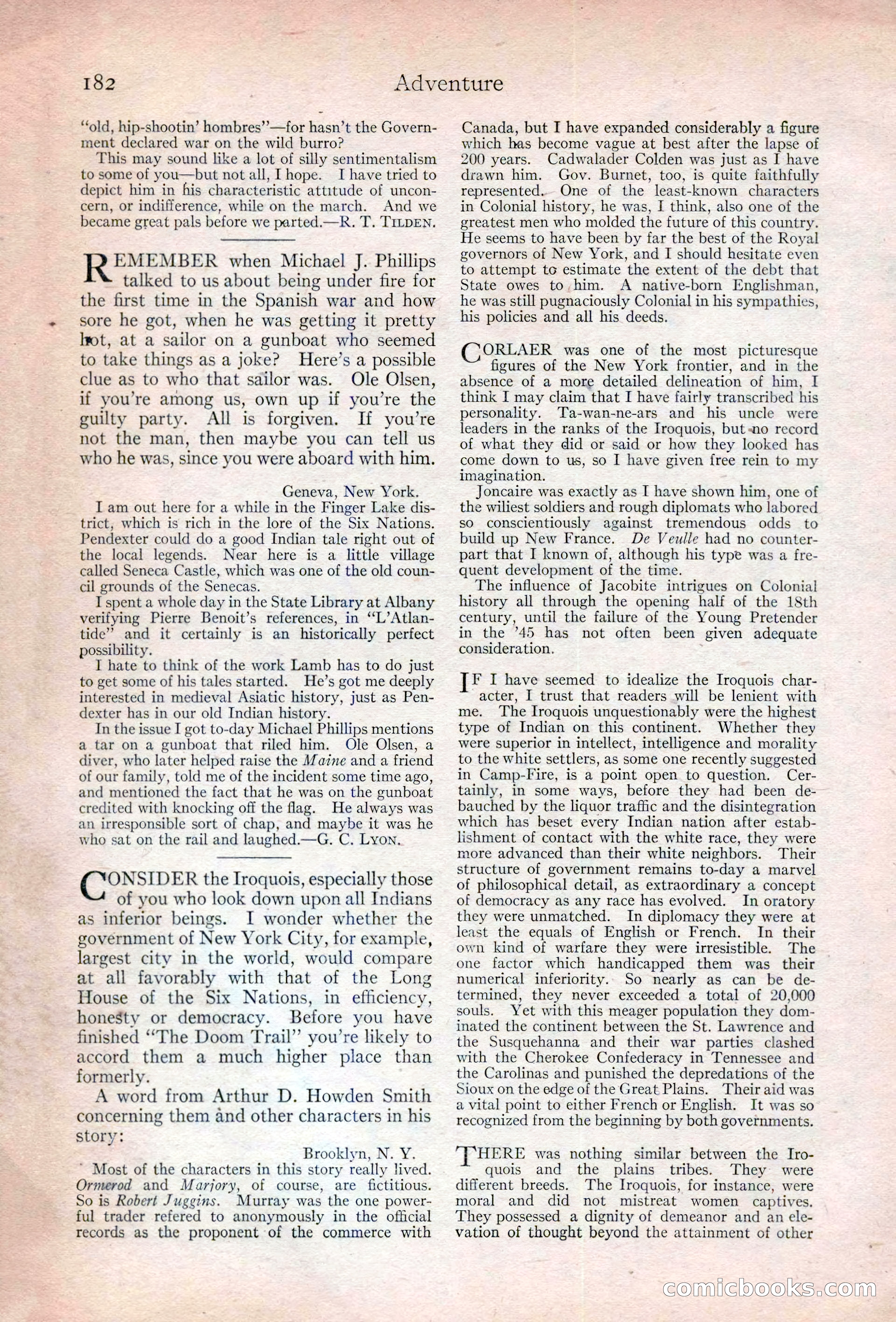
A restored page from Pulp Fiction, 1921. Page through the whole issue in the reader above.
📄 Transcribed text from this page (OCR, searchable)
Machine-transcribed from the original scan — historical spelling and the odd misread are preserved.
182 “old, hip-shootin’ hombres””—for hasn’t the Govern- ment declared war on the wild burro? This may sound like a lot of silly sentimentalism to some of you—but not all, [hope. I have tried to depict him in his characteristic attitude of uncon- cern, or indifference, while on the march. And we became great pals before we parted.—R. T. TILDEN. 7 EMBER when Michael J. Phillips talked to us about being under fire for the first time in the Spanish war and how sore he got, when he was getting it pretty lot, at a sailor on a gunboat who seemed to take things as a joke? Here’s a possible clue as to who that sailor was. Ole Olsen, if you’re among us, own up if you’re the guilty party. All is forgiven. If you’re not the man, then maybe you can tell us who he was, since you were aboard with him. Geneva, New York. I am out here for a while in the Finger Lake dis- trict, which is rich in the lore of the Six Nations. Pendexter could do a good Indian tale right out of the local legends. Near here is a little village called Seneca Castle, which was one of the old coun- cil grounds of the Senecas. I spent a whole day in the State Library at Albany verifying Pierre Benoit’s references, in “L’Atlan- tide” and it certainly is an historically perfect possibility. I hate to think of the work Lamb has to do just to get some of his tales started. He’s got me deeply interested in medieval Asiatic history, just as Pen- dexter has in our old Indian history. In the issue I got to-day Michael Phillips mentions a tar on a gunboat that riled him. Ole Olsen, a diver, who later helped raise the Mazne and a friend of our family, told me of the incident some time ago, and mentioned the fact that he was on the gunboat credited with knocking off the flag. He always was an irresponsible sort of chap, and maybe it was he who sat on the rail and laughed.—G. C, Lyon, ONSIDER the Iroquois, especially those of you who look down upon all Indians as inferior beings. I wonder whether the government of New York City, for example, largest city in the world, would compare at all favorably with that of the Long House of the Six Nations, in efficiency, honesty or democracy. Before you have finished “‘The Doom Trail” you’re likely to accord them a much higher place than formerly. A word from Arthur D. Howden Smith concerning them and other characters in his story: Brooklyn, N. Y. ’ Most of the characters in this story really lived. Ormerod and Marjory, of course, are fictitious. So is Robert Juggins. Murray was the one power- ful trader refered to anonymously in the official records as the proponent of the commerce with Adventure Canada, but I have expanded considerably a figure which has become vague at best after the lapse of 200 years. Cadwalader Colden was just as I have drawn him. Gov. Burnet, too, is quite faithfully represented... One of the least-known characters in Colonial history, he was, I think, also one of the greatest men who molded the future of this country. He seems to have been by far the best of the Royal governors of New York, and I should hesitate even to attempt to estimate the extent of the debt that State owes to him. A native-born Englishman, he was still pugnaciously Colonial in his sympathies, his policies and all his deeds. ORLAER was one of the most picturesque figures of the New York frontier, and in the absence of a more detailed delineation of him, I think I may claim that I have fairly transcribed his personality. Ta-wan-ne-ars and his uncle were leaders in the ranks of the Iroquois, but-no record of what they did or said or how they looked has come down to us, so I have given free rein to my imagination. Joncaire was exactly as I have shown him, one of the wiliest soldiers and rough diplomats who labored so conscientiously against tremendous odds _ to build up New France. De Veulle had no counter- part that I known of, although his type was a fre- quent development of the time. The influence of Jacobite intrigues on Colonial history all through the opening half of the 18th century, until the failure of the Young Pretender in the *45 has not often been given adequate consideration, F I have seemed to idealize the Iroquois char- acter, I trust that readers will be lenient with me. The Iroquois unquestionably were the highest type of Indian on this continent. Whether they were superior in intellect, intelligence and morality to the white settlers, as some one recently suggested in Camp-Fire, is a point open to question. Cer- tainly, in some ways, before they had been de- bauched by the liquor traffic and the disintegration which has beset every Indian nation after estab- lishment of contact with the white race, they were more advanced than their white neighbors. Their structure of government remains to-day a marvel of philosophical detail, as extraordinary a concept of democracy as any race has evolved. In oratory they were unmatched. In diplomacy they were at least the equals of English or French. In their own kind of warfare they were irresistible. The one factor which handicapped them was their numerical inferiority. So nearly as can be de- termined, they never exceeded a total of 20,000 souls. Yet with this meager population they dom- inated the continent between the St. Lawrence and the Susquehanna and their war parties clashed with the Cherokee Confederacy in Tennessee and the Carolinas and punished the depredations of the Sioux on the edge of the Great Plains. Their aid was a vital point to either French or English. It was so recognized from the beginning by both governments. HERE was nothing similar between the Iro- quois and the plains tribes. They were different breeds. The Iroquois, for instance, were moral and did not mistreat women captives. They possessed a dignity of demeanor and an ele- vation of thought beyond the attainment of other COMmicloooks (C@)