
Pulp Fiction, 1921 · page 189 of 200
Adventure Magazine Cover — page 189: what you’re looking at
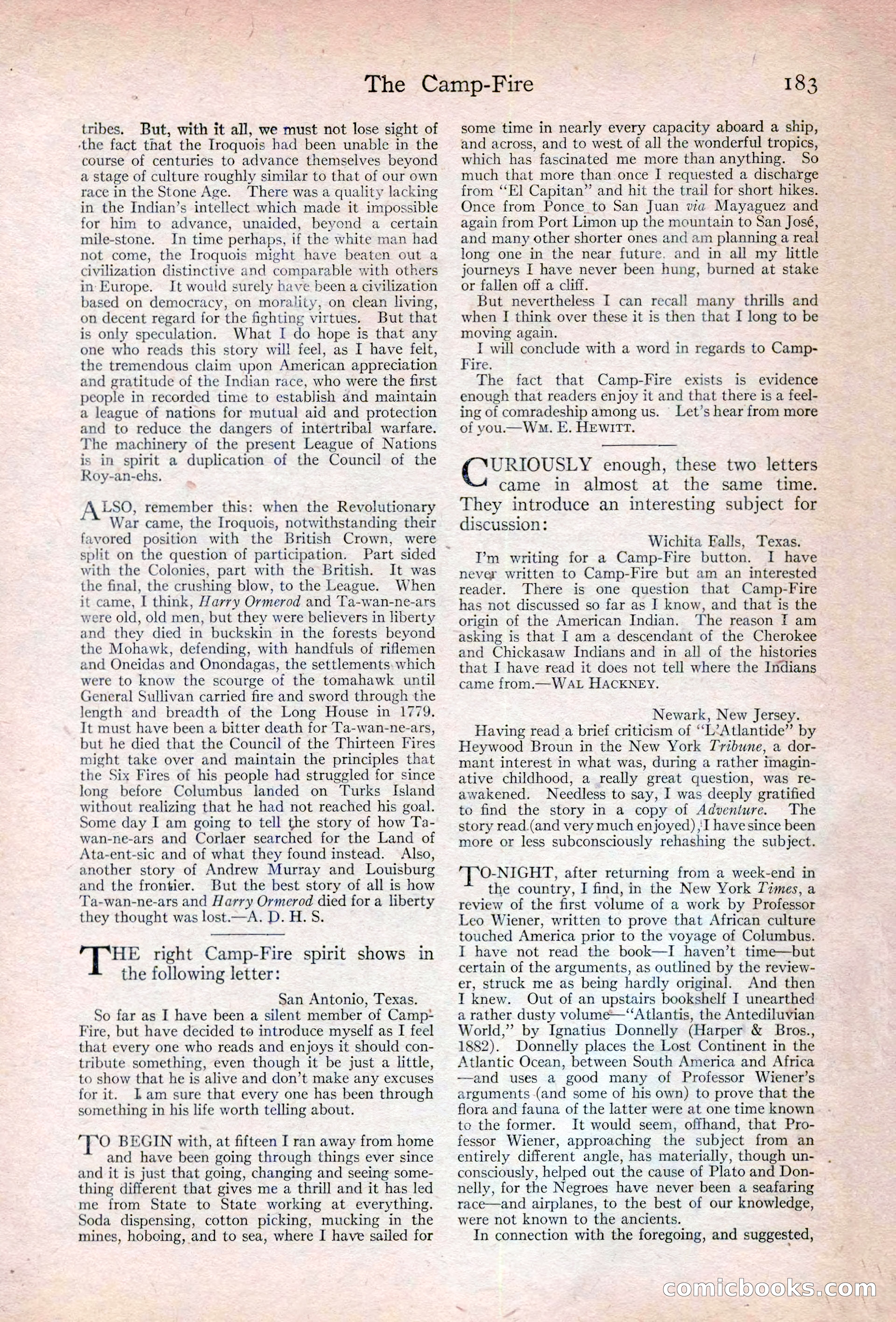
A restored page from Pulp Fiction, 1921. Page through the whole issue in the reader above.
📄 Transcribed text from this page (OCR, searchable)
Machine-transcribed from the original scan — historical spelling and the odd misread are preserved.
The Camp-Fire tribes. But, with it all, we must not lose sight of ‘the fact that the Iroquois had been unable in the course of centuries to advance themselves beyond a stage of culture roughly similar to that of our own race in the Stone Age. ‘There was a quality lacking in the Indian’s intellect which made it impossible for him to advance, unaided, beyond a certain mile-stone. In time perhaps, if the white man had not come, the Iroquois might have beaten out a civilization distinctive and comparable with others in Europe. It would surely have been a civilization based on democracy, on morality, on clean living, on decent regard for the fighting virtues. But that is only speculation. What I do hope is that any one who reads this story will feel, as I have felt, the tremendous claim upon American appreciation and gratitude of the Indian race, who were the first people in recorded time to establish and maintain a league of nations for mutual aid and protection and to reduce the dangers of intertribal warfare. The machinery of the present League of Nations is in spirit a duplication of the Council of the Roy-an-ehs. LSO, remember this: when the Revolutionary War came, the Iroquois, notwithstanding their favored position with the British Crown, were split on the question of participation. with the Colonies, part with the British. It was the final, the crushing blow, to the League. When it came, I think, Harry Ormerod and Ta-wan-ne-ars were old, old men, but they were believers in liberty and they died in buckskin in the forests beyond the Mohawk, defending, with handfuls of riflemen and Oneidas and Onondagas, the settlements. which were to know the scourge of the tomahawk until General Sullivan carried fire and sword through the length and breadth of the Long House in 1779. It must have been a bitter death for Ta-wan-ne-ars, but he died that the Council of the Thirteen [Tires might take over and maintain the principles that the Six Fires of his people had struggled for since long before Columbus landed on Turks Island without realizing that he had not reached his goal. Some day I am going to tell the story of how Ta- wan-ne-ars and Corlaer searched for the Land of Ata-ent-sic and of what they found instead. Also, another story of Andrew Murray and Louisburg and the frontier. But the best story of all is how Ta-wan-ne-ars and Harry Ormerod died for a liberty they thought was lost.—A. D. H. S. rT Se right Camp-Fire spirit shows in the following letter: San Antonio, Texas. So far as I have been a silent member of Camp* Fire, but have decided to introduce myself as I feel that every one who reads and enjoys it should con- tribute something, even though it be just a little, to show that he is alive and don’t make any excuses for it. Lam sure that every one has been through something in his life worth telling about. ‘TO BEGIN with, at fifteen I ran away from home and have been going through things ever since and it is just that going, changing and seeing some- thing different that gives me a thrill and it has led me from State to State working at everything. Soda dispensing, cotton picking, mucking in the mines, hoboing, and to sea, where I have sailed for Part sided — 183 some time in nearly every capacity aboard a ship, and across, and to west of all the wonderful tropics, which has fascinated me more than anything. So much that more than once I requested a discharge from “El Capitan” and hit the trail for short hikes. Once from Ponce to San Juan via Mayaguez and again from Port Limon up the mountain to San José, and many other shorter ones and am planning a real long one in the near future. and in all my little journeys I have never been hung, burned at stake or fallen off a cliff. But nevertheless I can recall] many thrills and when I think over these it is then that I long to be moving again. I will conclude with a word in regards to Camp- Fire. The fact that Camp-Fire exists is evidence enough that readers enjoy it and that there is a feel- ing of comradeship among us. Let’s hear from more of you.—W\y. E. Hewitt. URIOUSLY enough, these two letters came in almost at the same time. They introduce an interesting subject for discussion: Wichita Falls, Texas. I’m writing for a Camp-Fire button. I have never written to Camp-Fire but am an interested reader. There is one question that Camp-Fire has not discussed so far as I know, and that is the origin of the American Indian. The reason I am asking is that I am a descendant of the Cherokee and Chickasaw Indians and in all of the histories that I have read it does not tell where the Indians came from.—WAL HACKNEY. Newark, New Jersey. Having read a brief criticism of ‘“‘L’Atlantide” by Heywood Broun in the New York Tribune, a dor- mant interest in what was, during a rather imagin- ative childhood, a really great question, was re- awakened. Needless to say, I was deeply gratified to find the story in a copy of Adventure. The story read.(and very much enjoyed) ,'I havesince been more or less subconsciously rehashing the subject. "T O-NIGHT, after returning from a week-end in the country, I find, in the New York Zzmes, a review of the first volume of a work by Professor Leo Wiener, written to prove that African culture touched America prior to the voyage of Columbus. I have not read the book—I haven’t time—but certain of the arguments, as outlined by the review- er, struck me as being hardly original. And then T knew. Out of an upstairs bookshelf I unearthed a rather dusty volume—“‘‘Atlantis, the Antediluvian World,” by Ignatius Donnelly (Harper & Bros., 1882). Donnelly places the Lost Continent in the Atlantic Ocean, between South America and Africa —and uses a good many of Professor Wiener’s arguments (and some of his own) to prove that the flora and fauna of the latter were at one time known to the former. It would seem, offhand, that Pro- fessor Wiener, approaching the subject from an entirely different angle, has materially, though un- consciously, helped out the cause of Plato and Don- nelly, for the Negroes have never been a seafaring race—and airplanes, to the best of our knowledge, were not known to the ancients. In connection with the foregoing, and suggested, S COMMICLOO© con